Kokanee Creek mouth


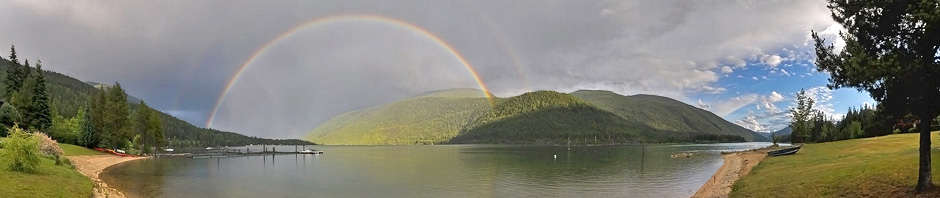
At 534.06 metres, the Lake is still a half metre below the peak flood level of 2012. However, it has been enough to flood some trails in the low parts of Kokanee Creek Park. The Lake is expected to continue to rise.

This is today’s view of the mouth of the creek and the flooded grasslands to either side of it.


Posted in weather | 3 Comments

Merganser mommy


Postings this May have been dramatic: spatting redwing blackbirdsloons fighting, mallard being raped, grizzlies foraging, many mating toads. Maybe it is time for a lovely, but non-dramatic, sighting: a family of Common Mergansers.

Two merganser chicks ride on mommy’s back while five more draft her.


Posted in birds | 3 Comments

Party toads


The Western Toad certainly knows how to throw an orgy. There were many dozen of them in the shallows mating promiscuously cheek by jowl.

The mating technique of these toads is called amplexus. Amplexus (Latin for embrace) is a type of external fertilization in which a male grasps a female with his front legs and fertilizes the eggs as they are released from her body.

Three couples couple. Each male has grasped a female from above.

Sometimes mating takes place entirely underwater.

Sometimes it takes place mainly out of water. 

And sometimes, it is a bit of each. 

Strings of eggs can be seen extending from the mating couple. 

It seems that there is often conflict. Here is an idyllic scene, but… 

when an interloper tries to take the male’s place, it is kicked away. 

There are two mating couples here.

“This has been a good orgy. Let’s do it again some time.” 


Posted in herptiles | 4 Comments

Rapidity of May


The rapidity of May is the speed of change that takes place as the region shifts from winter to summer. Events pile up on my camera. Here are a few of them.

The rising waters of the Lake overflow a walkway.

Otters dive, briefly leaving only their tails above the water.

This Wild Turkey is ready for love and looking good.

A pipit has migrated into the region.

A Western Kingbird. 

An Eastern Kingbird watches its insect-prey. 

The Eastern Kingbird flies after an insect. 

A Hover Fly visits a flower.

A browsing White-tailed Deer is in transition: starting its antlers; shedding its winter pelage.

Painted Turtles on a loafing log are the picture of tranquility. 

Harlequin Ducks have returned. 

The Spotted Sandpiper is back and feeding on grubs along the shore. 

Western Bluebirds successfully hunt insects from a great mullein.

A female Kestrel harasses a Red-tailed Hawk. 

The Spring Azure only shows the blue of the wings when it is flying.

No treatment of May would be complete without mentioning the arrival of Osprey at local nests.

 

Posted in birds, bugs, herptiles, mammals | 6 Comments

Grizzlies at dawn


At dawn and dusk for a few spring weeks, Grizzly Bears come down from the high country to visit marshy lowlands. One might think that they come for the skunk cabbage — apparently not. It seems that the attraction is the water parsnip. The roots of this plant are edible for a short time before it flowers. Grizzlies know this.

Two Grizzly Bears feast on what is likely the fresh roots of the water parsnip. 

A bear stands to sniff the air when it is curious about something. 

Buddies.


Posted in mammals | 6 Comments

Amorous swallows


The Tree Swallows were being friendly.

“Incoming.”

“Let’s name them Kaslo, Sitkum, and Taghum.”


Posted in birds | 2 Comments

Churts


I was standing in the shade of a tree listening to a sound like none I had heard before: a repeated, edgy, explosive, pop. It was coming from the far side of the tree. What could it possibly be?

When I rounded the tree, the unexpected source turned out to be a meadowlark. Although the meadowlark is noted for its melodious song, this vocalization was markedly different.

This sound is called a churt, which is a coinage likely of onomatopoeic origin. Apparently the few birds that churt do so merely as a way of saying: “Here I am.”

A Western Meadowlark churts, “I’m here.”


Posted in birds | 4 Comments

My first tutu


Posted in birds | 6 Comments

Humdinger


We get three species of hummingbirds around the Lake: Calliope, Rufous, and Black-chinned. Well, really occasionally, the Anna’s has been seen, but not by me.

Some years I have seen only one of the species, sometimes two, and now and then there will be a summer when I see all three. Amazingly, in an hour this morning, I saw all three species. The morning offered a humdinger of hummingbirds.

The Rufous Hummingbird is the scrappiest and most likely to be seen.

The Calliope Hummingbird is the smallest and next most common.

The Black-chinned Hummingbird is the least likely to be seen.

Posted in birds | 8 Comments

Mallard’s #metoo


Most mating between Mallards seems to be consensual and initiated by the female. Yet, there are more males than females. This leads to roving bands of bachelor drakes. This, in turn, leads to rape — or as naturalists delicately put it: forced copulation.

Ducks are not humans and the forced copulation presumably has evolutionary advantages for the species. Yet when seen through human eyes, the behaviour is disconcerting. 

Mommy Mallard was taking her dozen ducklings out on the water. Being a member of a sexually dimorphic species, the mallard female attends her chicks without male support.

So it was unexpected to see two males swimming towards the family. There, they began neck pumping, a sign of courtship. Mommy quacked her objection to this inappropriate behaviour.

Mommy’s first thought was to escape. However, she has a problem: if she leaves, her chicks are vulnerable. So, she returned.

Having returned to guard her chicks, Mommy was put upon. 

As far I could tell, over the next few minutes the males took turns.

“Oh come now; Do you have to do this in front of my chicks?

“What are you doing to Mommy?”


Posted in birds | 5 Comments