Happenstance birds


Recently I wrote an essay about the difficulty of observing flying birds. It explored the reason why small birds are much harder to photograph in flight than big birds. Leaving aside the technical difficulties that the essay explored, there is the additional problem: You have to be present at just the right time and place to capture any of these images. For the fliers, below, being there was a matter of happenstance.

This is the fist year that I have seen Turkey Vultures attracted to the feast of spawning kokanee. Here are two of five soaring over the creek.

I see the Great Blue Heron maybe a half-dozen times a year, but usually at a distance. On this occasion, three juveniles flew close overhead allowing a satisfying image.

Posted in birds | Comments Off on Happenstance birds

Osprey trifles


If one had to compile a list of the significant verities of local Ospreys, I suppose that two items would stand out:

• Although Ospreys breed and raise chicks locally, they migrate and spend their winters in Central and northern South America.
• Ospreys feed on live fish.

Today’s posting does not rise to the significance of these facts: it treats trifles of the everyday life of our favourite summer resident.

Ospreys suffer constant harassment by wasps — after all, they both like fish. There is a wasp in the centre of this picture.

In addition to the wasps, this picture shows a frequent Osprey preparation for flying: It is defecating. This is presumably a way to lighten the load. Defecating just prior to flying is a common practice among large birds, from eagles to hawks. It might be argued that this is also the reason that Canada Geese leave such a mess on our lawns. They must constantly poop so as to be as light as possible in case a predator prompts them to fly. This female adult will soon migrate.

The omnipresence of wasps in underscored by this shot of a juvenile. It is flying off with a partially eaten fish, but it is accompanied by a wasp. The wasp will fail to keep pace with the Osprey.

A somewhat unexpected view of an osprey is this one of it dragging its claws in the Lake. No, it is not fishing. It has already been feasting on fish and is now merely washing its claws.

Posted in birds | 4 Comments

Kokanee scavenger


Yesterday, I casually presented a list of some predators of spawning kokanee. In addition to bears, I listed: eagles, ospreys, ravens, and gulls. Bert Port then added mallards, and while I suggested they snack on the eggs, these could also be considered to be kokanee, if fertilized.

While I hadn’t presumed that my list was exhaustive, I had not guessed that I would so quickly add — if not a predator — at least a kokanee scavenger. 

This is one of five Turkey Vultures that were seen eyeing spawners from high in the trees. Vultures find meals by the odour of rotting flesh — something unmistakable along the spawning channel.

Posted in birds, fish | 1 Comment

Osprey & fish


The recent posting about fish and bears might have left the impression that it was only bears that take advantage of spawning kokanee salmon. Not so: eagles, ospreys, ravens and gulls do likewise.

Mind you, this Osprey flying past looks as if it is packing its favourite snack: a sucker. Just behind the fish is a wasp that is trying to keep pace.

Near the spawning channel, another Osprey is feasting on a kokanee. The intensity of this bird’s gaze in defence of its meal reminded me of last April’s shot of a Merlin doing likewise.

Posted in birds, fish | 2 Comments

Fish & bears


Creeks fill with spawning kokanee salmon; bears come to feast; people come to watch. Mind you, it is not easy to coordinate a visit with the bears: They follow their own clocks.

This has been a rather good year to watch spawning kokanee.

There are two families of black bears working the creek. This is the sow of one of them.

When she catches a fish, she moves it to the bank and leaves it there after maybe a nibble of two.

This is one of her two cubs that she has left high in a tree until she has gathered food for all.

It is time to call the cubs down from their perch.

A cub arrives at the ground and is greeted by mommy.


Posted in fish, mammals | 3 Comments

Brown Creeper


The Brown Creeper has to be one of the most cryptic of our local residents. I have yet to spot one on my own. On the rare occasions when I have seen it, someone else found it for me. My response tended to be: “Huh? Where? I don’t see anything.”

The bird inhabits forests with many large live trees, which it scours for insects. That it blends in with the tree bark is a given.

“There is nothing to see here folks, I am just another bit of tree bark.”

Posted in birds | Comments Off on Brown Creeper

Menu addition


My father’s Shaeffer fountain pen.

Essays, has been added to the above menu bar. 

As the linked page notes: Sometimes a series of blog postings congeals into an essay. The page links to PDFs of recent ones.

Some of these have been published elsewhere; some are just too eccentric to appeal to most editors. 


Posted in commentary | Comments Off on Menu addition

Mach bands


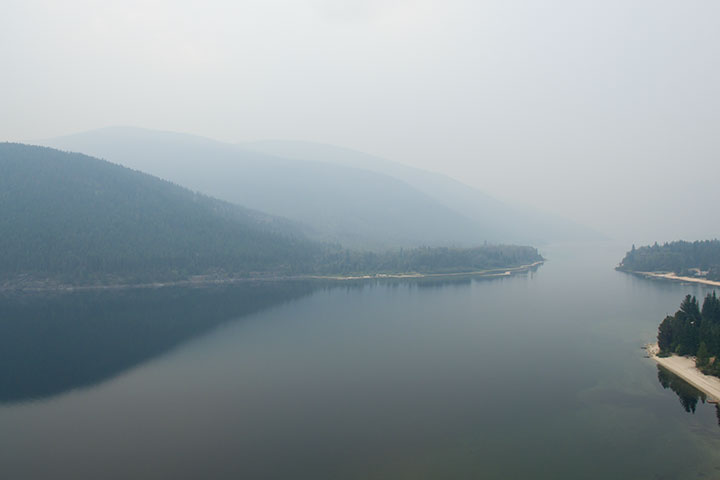
Local wildfire smoke from this grim season had all but vanished when more flowed in from the south. As uncomfortable as it is, the smoke provides the hazy air that easily enables the identification of Mach bands.

Mach bands are not a feature of the external natural world. Rather, they arise in the eye and are an optical illusion first explained by Ernst Mach (1838–1916). The bands result from a process in our retinas that enhances contrast. Consequently, they appear subtly in everything we see, whether it is a view of the external world or just a picture of that view. However, the bands are never so apparent as when looking at step-like transitions in brightness. A succession of distant ridges seen through a smoky haze provides an ideal place to examine them.

Consider the receding ridges in the centre of this scene looking across the Lake. Each ridge seems to be edged with a thin diffuse dark band which contrasts with an adjacent brighter band on the ridge beyond it. Neither band is present in the external world; they are creations of our eyes.

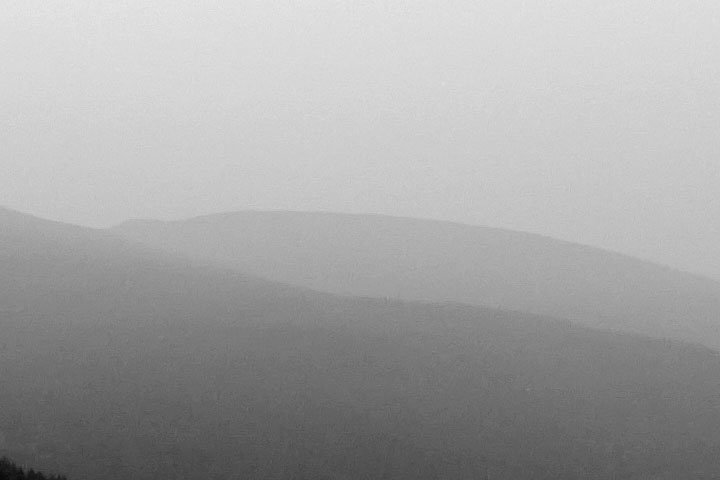
Here is a detail from the centre left of the picture where one ridge passes behind another. The picture has been rendered in black and white, but the thin Mach bands are readily apparent.

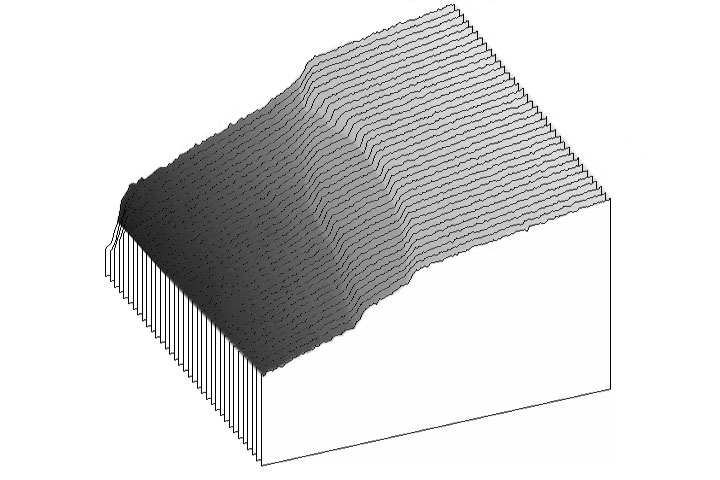
When the brightness is plotted for the picture detail, the two cliffs marking the shift from one ridge to the next are apparent. Yet this quantitative analysis does not show the bands that the eye perceives: there is no small trench on the dark side of the cliff or small ridge on the bright side. Mach bands are an illusion created by one’s own image processing. Our subjective view differs from the objective scene.

Posted in commentary, scenes | 3 Comments

Not a chipmunk


Two years ago, I noticed a touristy website that tried to pass off a Golden-mantled Ground Squirrel as being a Chipmunk (posting). Fascinated by this ineptitude, I searched stock-photo sites and discovered that it wasn’t uncommon to label pictures of a Golden-mantle Ground Squirrel as being a Chipmunk. As I noted at the time, one should not turn to stock-photo companies for biological insights. 

The mistake is easy to make if the viewer applies an algorithm for squirrels: stripes mean chipmunk. The problem is that it isn’t true. While the chipmunk has multiple white stripes that extend from its back to its head (another example), the much larger Golden-mantled Ground Squirrel has two white stripes, one on each side, and neither extends to its head. 

A Golden-mantled Ground Squirrel enjoys a snack high in a subalpine forest. The single white stripe on either side does not extend to the head.

The reason for the designaton of golden mantle isn’t always obvious, but here the golden pelage on the head and shoulders is abundantly clear.

Posted in mammals | Comments Off on Not a chipmunk

EEEP


… Now I remember only
The long ascent of the lonely valley, the live
Pine spirally scarred by lightning, the slicing pipe
Of invisible pika…. 
                            David, by Earle Birney (1942)

The slicing pipe of the pika (invisible or not) is: “EEEP”.

Birney’s reference to the call of the invisible pika resonates with hikers adjacent to talus in the subalpine of Western North America: the furtive pika is heard much more often than it is seen.

A pika issues its call of EEEP upon spotting an interloper in its world.

Another pika doesn’t seem to know it is being watched when it presents its profile to the camera.

Apparently secure in its invisibility this pika strikes a hero’s pose.

Posted in mammals | 2 Comments