Vulture’s matutinal ritual


When one watches a Turkey Vulture’s morning, it certainly seems to reveal a ritualistic behaviour.

The day begins with the vulture spreading its wings to warm then in the early morning sunlight.

Then comes the obligatory stretching of the wings.

And the pooping.

There follows more stretching, while scanning the ground below for a possible breakfast.

It is time to head off and look for tasty carrion.

OK, this is going to take a bit more effort.


Posted in birds | 2 Comments

Mountain lady’s slipper


The mountain lady’s slipper is the third species of wild orchid found in Kokanee Creek Park this year. The earlier two were the fairy slipper and the striped coralroot.

A lone mountain lady’s slipper sits in the forest.


Posted in wildflowers | Comments Off on Mountain lady’s slipper

Big-chick feeding


There is a narrow window of opportunity to be able to see dipper chicks leaning out of their nest and being fed. When slightly younger, they stay inside; when slightly older they have fledged and are gone.

When I looked through my pictures of this event, something struck me as incongruous. The pictures of all the chicks showed them as apparently larger than the adults doing the feeding. How can this be?

I immediately thought about just-fledged juvenile eagles. They look bigger than the adults attending them only because the juvenile feathers are unworn and fluffed up. Then it dawned on me that in addition to the fluffy chick feathers, the dipper adult’s feathers were matted down from it having just swum underwater in the creek to retrieve the meal. So, the disparity in size makes sense, but it does look a bit odd.

Four dipper chicks lean out of their nest to beg for food.


Posted in birds | 5 Comments

Cedar Waxwings feed


Gregarious, garrulous, and guileless, a couple of dozen Cedar Waxwings feast on the petals of a black hawthorn tree. This is the first time I have seen a flock of these birds feeding on the petals of flowers. 

The Cedar Waxwing visits to breed here in the warm season. But, it also wanders about to feed.

One of the many Cedar Waxwings sits amidst its target blossoms of the black hawthorn tree.

As a bird depletes the petals at one spot, it quickly flies to another.

It seems that the thing being eaten is actually the petals of the blossoms.

And soon a bird is off to sample another blossom.


Posted in birds | 3 Comments

Rainbow


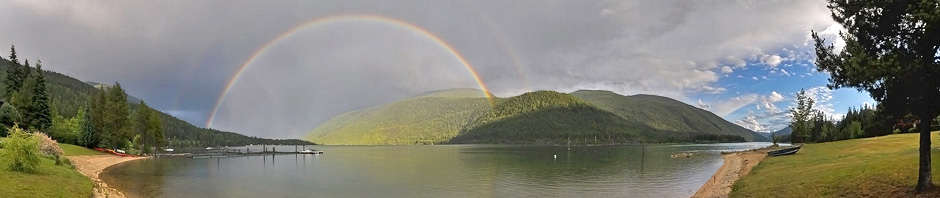
A nice characteristic of convective thunderstorms is that they tend to occur late in the day when the Sun is low in the sky. Sometimes, this results in rainbows.

A rainbow envelopes the peninsula of Kokanee Creek Provincial Park. 


Posted in weather | 3 Comments

Tiger Swallowtail


This is the time of year for visits from swallowtail butterflies — so I watch for them. We have a number of different swallowtail species, and I thought that, on subsequent days, I had spotted two different ones. However, when I examined my pictures, they all seemed to be the same species: a Canadian Tiger Swallowtail. I certainly am open to contrary suggestions as to the ID. 


Posted in bugs | 3 Comments

May goulash


This is a largish collection of images from May, none of which has had a posting of its own.

The House Finch is a colourful western bird that has now spread across the continent.

The Killdeer arrives from the south in March, but I saw my first one this year in May. 

Related to the robin, the Townsend’s Solitaire is with us year round, although it spends most of the warm season in the high country.

After the provincial parks were closed for five weeks, some of the wildlife got used to being without those intrusive humans. Generally well hidden, a Columbian ground squirrel was occupying a park trail when humans returned.

The Northern Rough-winged Swallow arrives in April to breed but is gone again in August.

The Violet-green Swallow usually has a longer season here: from March to September. 

The Eastern Kingbird is a large flycatcher that catches insects on the wing.

A female Western Tanager visits.

A male white-tailed deer is both starting on its antlers and moulting into its summer coat.

That a group of Pipits stopped by for a visit was unexpected as they generally nest at higher elevations. Yet, it seems that during migration they can be seen elsewhere.

Mommy merganser swims by with her fifteen charges. They are not necessarily all of her own offspring for merganser chicks have a habit of just joining any passing parade.

The Spotted Sandpiper, our most common summer shorebird, scarfs an arthropod.

A dipper parent feeds a grub to its chick in the nest.

 

Posted in birds, mammals | 2 Comments

Hummingbird moth


The hummingbird moth has been billed by Nature Canada as one of Canada’s coolest creatures. Although a moth, it is out during the daytime when it sips nectar by hovering over flowers like a tiny hummingbird.

Somewhat uncommon, I have seen our local species only a couple of times, most recently in 2016. It is the Rocky Mountain Clearwing (Hemaris thetis). Four different species of hummingbird moths are found in North America, but sources suggest that thetis is the only one found in British Columbia. 

It is again the time of year to watch for this strange creature, so yesterday I went looking. What I spotted, was clearly a hummingbird moth. It was out in the daytime and sipping nectar as it hovered over flowers. However, it was distinctly different than the thetis normally found in BC. What was it, and how did it get here?

I start with a picture of thetis, a Rocky Mountain Clearwing I took four years ago so as to show the differences with this year’s moth. 

This is the moth seen yesterday. It behaves the same way as thetis as it hovers over a flower sipping nectar. Further, it is about the same size, but its body and wing pattern is different. When this blog was first posted. I thought yesterday’s moth was an eastern hummingbird moth. I was wrong. It is a Yellow-banded Day Sphinx Moth (Proserpinus flavofasciata), something labeled a hawk moth. However, this hawk moth behaves much like the hummingbird moth: it hovers over flowers as it sips nectar.

Here is a side view of the moth sipping nectar.


Posted in bugs | 8 Comments

Striped coralroot


The striped coralroot is a wild orchid that is both uncommon and widespread. Favouring the deep forest floor that little sunlight reaches, it obtains its energy, not as a result of photosynthesis, but through fungi. Indeed, the plant lacks not only chlorophyll, but even leaves. 

The striped coralroot was the second wild orchid found in Kokanee Creek Park this year.


Posted in wildflowers | 3 Comments

Grazing grizzlies


The grizzly bear has a fearsome reputation as a predator. It is earned: the bear is strong and combative. But, while it is a carnivore, most of its time is spent eating plants, often just grazing. 

A grizzly sow (r.h.s.) and her two yearling cubs were grazing in a meadow. While people often suggest that grizzlies eat skunk cabbage, this family ignored them and just went for the grass.

When the bear’s head was down, it was difficult to decide which plant it was eating, but when it lifted its head, the grass dangling from its jaws provided compelling evidence.

The sow is in the foreground and her (male?) cub is behind. A grizzly’s dished face profile is clear.

Here, it looks as if mommy is growling at something and her (female?) cub is cowering. Such is the happenstance of the shot. Actually, the sow is just chewing some grass and the cub is merely lowering its head to graze some more.


Posted in mammals | 4 Comments