Kingfisher’s fish


I am used to seeing kingfishers hunt from pilings. This one is a juvenile.

It seeks minnows and fry such as these shown a week ago

Having spotted something, the bird dives.

Carrying a minnow, it picks a piling upon which to feast. Unfortunately, the present occupant objects.

The kingfisher chooses a different piling and soon downs the minnow.

Posted in birds, fish | Comments Off on Kingfisher’s fish

Not a topiary


I had no idea what I was looking at, but it reminded me of an enormous topiary sculpted in the forest.

I was on an osprey survey with the Friends of Kootenay Lake. We were passing along the east shore of the Lake when a huge structure was spotted. Kat McGlynn said it looked like a mistletoe infection. 

This was subsequently confirmed and expanded when I sent the picture to Doug Thorburn, who said:

… this is a severe case of Douglas-fir dwarf mistletoe (Arceuthobium douglasii) … I am used to seeing it in the East Kootenay, and it is only recently that I realized how prevalent it is on the east shore of Kootenay Lake as well.

Douglas-fir dwarf mistletoe is a destructive native parasite that grows on Douglas-fir trees. In earlier times, frequent wildfires killed small infected trees, but with modern wildfire suppression, the parasite has spread. Similarly, logging, with its practice of harvesting the healthier trees and leaving the poorer ones has contributed to the spread of the parasite. (See, Douglas-fir Dwarf Mistletoe.)

I now fear its arrival on my side of the Lake.

The parasitic plant, Arceuthobium douglasii, has taken over a Douglas-fir and will kill it and spread.

Posted in commentary, wildflowers | 1 Comment

Mysterious bird


A blur flew past me over the calm waters at the mouth of Kokanee Creek. At first, it could have been almost any smallish bird: sandpiper, kingfisher, kingbird, any of a half-dozen local swallows. For five minutes it banked and swooped over the water apparently hunting insects. Although it remained a blur, its behaviour suggested a swallow.

I repeatedly tried to take its picture, but it flew too close and fast. Repeatedly, by the time I clicked, the bird had moved out of the picture. On the few occasions it appeared, it was badly out of focus — except for one clear shot. Yep, it was a swallow, and a juvenile, but which one?

It was a problem: Species identification seemed to change depending upon the portion of the bird being examined. I was out of my depth even though there were few choices. Eventually, the picture was shared among five experienced birders, and while acknowledging some inconsistencies, the conclusion was that the mysterious bird was a juvenile Cliff Swallow. Indeed, I know of a nesting site for Cliff Swallows only eight kilometres from this spot.

The mysterious bird scouring the air for insects is revealed to be a juvenile Cliff Swallow.

Posted in birds, commentary | 4 Comments

Rainbow season


One year differs from the next. Last year had a dramatic forest fire; this year almost nothing burned. Last year we hardly noticed black bears; this year they abound. Last year offered copious dragonflies; this year there were few.

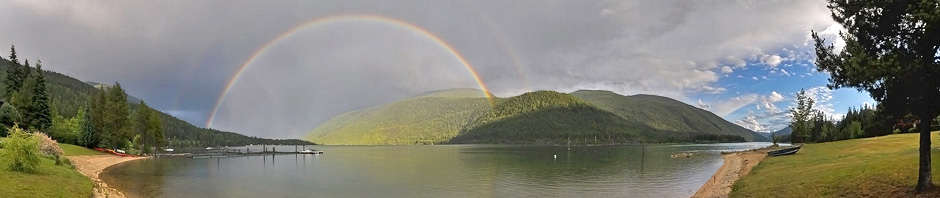
There are years when one is treated to many rainbows, usually starting in June. This year, rainbows have been sparse. The one below, from last evening, is — sigh — offered as a bit of tokenism merely to acknowledge that the laws of physics still apply.

Posted in weather | 1 Comment

Fish fete


When humans, bears and ospreys gather to watch the same thing, you know that the kokanee are spawning again. 

The objects of all the interest are spawning kokanee, the speckled, red and green, landlocked sockeye salmon that take over local creeks.

An osprey, which normally hunts over the Lake, now finds creeks of interest.

It soon flies off with lunch.

To the delight of those gathered to watch the spawning kokanee, a black bear worked its way up the channel travelling close to humans on the bank and under those on a footbridge. The bear had only one thing on its mind and offered hardly a sideways glance. Alas, when it did catch a kokanee, it was facing away, so there was no picture of that.

The bear dragged its prize up the bank and feasted.

It would seem that this bear’s mommy didn’t say it shouldn’t chew with its mouth open.

Posted in birds, fish, mammals | 3 Comments

Minnows and fry


These may be the most plentiful fish caught for sport in Kootenay Lake.

That is just a speculation as I am neither fisherman nor ichthyologist. Nevertheless, small children wading in the shallows catch copious quantities in buckets and fishermen collect them for bait. 

When a child, I called all of these tiny fish, minnows. Yet, many of these show signs of parr marks, which suggests that some of these are the fry of salmonoid species.

Posted in fish | Comments Off on Minnows and fry

Shape-shifter


Six months ago I posted merganser planing. It showed pictures of swimming Common Mergansers that had moved from displacement mode to planing mode.

Most things moving across the surface of water do so in displacement mode: they are moving so slowly across the water that weight is supported (primarily) by buoyancy (static pressure). This applies equally to kayaks and supertankers, muskrats and moose. Some boats and some birds are capable of planing: they are moving so quickly across the water that weight is (primarily) supported by the lift provided by the rush of water against a sloping bottom (dynamic pressure). Planing is not an easy trick to pull off; to achieve it takes more power than most animals can muster. Yet, some can do it.

Planing boats have: A broad flattish bottom (against which the rushing water provides lift); A hard chine (which helps directional stability and disperses spray; Paramount is an immersed transom with a sharp transition to the hull (required for the separation of the flow from the boat).

Being able to plane requires more than just power; it also requires the boat or bird to have the right shape. Boat designers have known this for a century. The crucial shape that allows a boat to plane is an immersed transom joined to the bottom of the hull at about a right-angle. This allows the water underneath to sweep out past the stern and separate easily from the boat rather than flowing up the transom as it would with the longitudinally rounded stern long favoured by rowboats and ducks. 

A Common Merganser swims in displacement mode. Her tail is up and her stern is rounded. (2013/06/06)

A boat designer, who read my posting about merganser planing, wrote me to emphasize the point that planing absolutely requires an immersed and sharp transition between hull and transom. He then suggest that birds are incapable of planing because birds have rounded butts. I understood his point about the shape of birds, and I understood his point about the necessity of the sharp transition. Yet, I had seen birds plane. How did they manage this trick?

I waited and watched. With the coming of spring, I saw Mallard chicks planing and the light went on: the birds that do this are shape shifters. While swimming in displacement mode, the bird’s butt certainly is rounded; when it is swimming in planing mode, the tail feathers are pressed down strongly to create the necessary sharp underwater transition. 

I had to wait until this week before getting a somewhat overhead view of a duck doing this. (With most side views, the duck’s wake obscures the view of the depressed tail).

A female Common Merganser is planing. Weight is supported by the lift provided by the rush of water against a sloping belly. Wings are held tight to the side to provide a hard chine. Tail feathers are forced down to give the sharp underwater transition needed for planing. 

Posted in birds | Comments Off on Shape-shifter

Two leaps


Hundreds of photographers have been working hard recently to bring images of athletic events to the world. However, one can also watch superb athletes oneself by looking outdoors. Here are two leaps seen yesterday.  

A pika launches itself to the next rock. Jumping is its preferred way to move across a talus field. 

A white-tailed fawn displays its eponymous tail as its leaps across the rut of a side road.

Posted in mammals | 1 Comment

Osprey diversion


Osprey chicks are still in the nest but are now as large as adults and easy to see.

Yesterday, I had expected to go on a nest-monitoring tour to estimate this year’s chick production. Alas, the tour was rescheduled, so, I headed out on my own — not to count chicks, merely to enjoy the birds.

Here are two shots from that jaunt.

A female Osprey comes in for a landing. She is banded. I have seen her a number of times before.

A Osprey family sits on what is a new nest this season. There are three chicks (the ones with speckled wings and orange eyes) and one female adult (second from the left with yellow eyes). Soon all will have migrated with the adults leaving first.

Of course, today is also the day of my Ogopogo talk.


Posted in birds | 4 Comments

Haretage minuets


Haretage minuets: This posting offers insincere apologies to the Canadian series, Heritage Minutes.

I know that snowshoe hares are out there, but I rarely see them. It turns out I have been looking in the wrong places.

“I really like a good salad.”

“When asked to pose, I try to look my spiffy best.”

Posted in mammals | 1 Comment