Eagle’s nest


There is an Bald Eagle’s nest I have watched for a decade. In fairness, this is actually the second nest, the first having grown so big, it brought down the tree. While the first nest was easily visible from the Lake, its replacement is obscure. One must float at just the right spot for a clear view. 

An easily visible perched eagle hints that a hidden nest might be nearby. Both adults incubate the eggs, but the female spends most of the time doing so. So, this is likely the male. 

Even after spotting the perched eagle, the nest was still not easy to find. In a few weeks we may see chicks peeking over the edges of the nest.

Posted in birds | 1 Comment

Subalpine mammals


Various mammals seem to prefer living well above the valley floor. A possible reason might be avoidance of valley-clustering humans. Yet, the population density of people is not very high around here. In many cases the altitude bias of creatures seems to be driven by preferred habitat and the competition of other animals. Who knows?

These are male Mule Deer on the mountain side. It may be that competition with the valley-favouring White-tailed Deer drove the Mule Deer into the subalpine. Be that as it may, they are not often seen near the valley floor. These males have started on this year’s antlers.

Why the Yellow-pine Chipmunk is usually only found at higher elevations is unclear. When I was a child, I remember seeing chipmunks down around the Lake. What caused the change?

The Pika is an endemic subalpine creature. I had really wanted to capture a picture of this cute lagomorph, but while I did hear them around me, I didn’t see one. This lovely shot was made by Derek Kite who was observing from a spot perhaps thirty metres from me.

Derek Kite’s picture of the Pika is used with permission.

Posted in mammals | 3 Comments

Crab spider


Crab spiders (Misumena vatia) hang out on flowers where they wait to pounce on pollinating insects. I noticed my first Crab Spider a decade ago when it was hunting on a Tiger Lily: see the last picture at reddish wildflowers. Since that time, I have seen them mainly on daisies: watching crab spiders, yellow crab spider.  Yesterday, I again saw a crab spider on a Tiger Lily. Alerted by that sighting, I examined local Daisies where I spotted some more.

A crab spider on the outside of a Tiger Lily was waiting to pounce on prey. When a perceived threat, a photographer, passed by, the spider hid inside.

Having seen a crab spider on a Tiger Lily, I then scoured local Daisies.

Posted in birds | 3 Comments

Blue-winged Teal


The abundance of some birds, such as the Osprey, is considered to be a sign of the purity of a lake’s water. Around Kootenay Lake, Ospreys abound. 

I wonder if the lack of abundance of other species could also be considered to be a sign of water purity. If so, might such a species be the Blue-winged Teal? 

The Blue-winged Teal is the second most abundant duck in North America, behind the Mallard. Yet, while the Mallard is ubiquitous around Kootenay Lake, a sighting of the Blue-winged Teal is worth noting. It seems that this teal favours shallow, often brackish, vegetated wetlands with lots of decaying organic matter. No wonder, I don’t often see it on the deep pure waters of the Lake. Its relative absence seems to be a good indicator of purity.

A Blue-winged Teal couple stopped by briefly before looking for their preferred murky waters.

Posted in birds | 1 Comment

Path by creek


June brings raging creeks as the mountain snows melt. A path beside a creek close to my home is accompanied by the din of cascading water and rolling boulders.

For a decade, I have taken pictures at one spot along this path. The pictures usually fall short: The lighting might be wrong. The foamy water overexposed. However, yesterday’s shot came close to what I have been seeking.

A path alongside a raging creek keeps attracting my attention.

Posted in scenes | 1 Comment

May goulash


This is an end-of-the-month collection of images, none of which has had a posting of its own.

A Columbian Ground Squirrel does sentry duty for the colony.

A Western Wood-Pewee shows its flight feathers.

Eastern Kingbirds are arriving and leaving.

“I’m proudly Marmot.”

An uncommon visit from a non-breeding Bonaparte’s Gull.

Northern Shovelers patrol the pond.

“Shall we dance.”

Posted in birds, mammals | 3 Comments

Avianimosity


There is no love lost between ospreys and eagles, so when one encounters a scene of mutual animosity, it isn’t always clear what was the immediate cause of the confrontation. Indeed, the first sighting was confusing for it looked as if two ospreys were harassing a disabled eagle. Maybe the eagle had broken a wing and the ospreys just chose to taunt it.

The emerging story proved far different: the eagle had stolen a fish from the ospreys, and they were desperately trying to get it back.

Ospreys and eagles have somewhat different capabilities. Ospreys are superb fishers and are able to dive into the water to a depth of about a metre, catch a fish, emerge and fly off with it. As such, they can capture fish over a greater range of depths than can an eagle, which merely sweeps its claws below the water surface as it flies by. However, the eagle is a much larger bird and will often supplement its own food supply by bullying an osprey into dropping its catch so as to steal it. Needless to say, ospreys react rather badly to such treatment. And that reaction is what I encountered. (What the fish thinks about all of this remains undocumented.)

When spotted, it looked as if two ospreys were harassing an eagle that couldn’t fly. Actually, it could easily fly, but had chosen a defensible position on a breakwater with its back to some pilings. The eagle would tuck the fish out of reach between logs, and the pilings prevented an attack from the rear.

The two ospreys made repeated threatening passes, and the eagle always responded defensively while continuing to clutch its prize with one claw.

In my favourite view of the drama, the eagle has secured the fish in a gap between logs and then rears up to defend itself as an osprey screams past with claws extended. Ultimately, the ospreys failed to breach the eagle’s defences and left the eagle alone to feast.

Posted in birds, fish | 1 Comment

Forster’s Tern


A scan of topics treated here reveals an interest in the overlooked ordinary.

Today’s posting about Forster’s Tern does not fit this pattern. Not only is this bird found at only one location around Kootenay Lake, but it is the only place in British Columbia where the bird is known to breed. Not surprisingly, it is red listed, meaning, in danger of extirpation.

Terns are somewhat like gulls, but are more slender, have longer bills, and narrower wings. They also have forked tails, but perhaps a more important distinction is their hunting style. Like an osprey, but unlike a gull, they plunge dive into the water to capture a fish — albeit a somewhat smaller fish than those favoured by an osprey. 

A Forster’s Tern was hunting over the wetlands south of the Main Lake.

Not every dive into the water resulted in a catch. Here the tern lifts off without a fish.
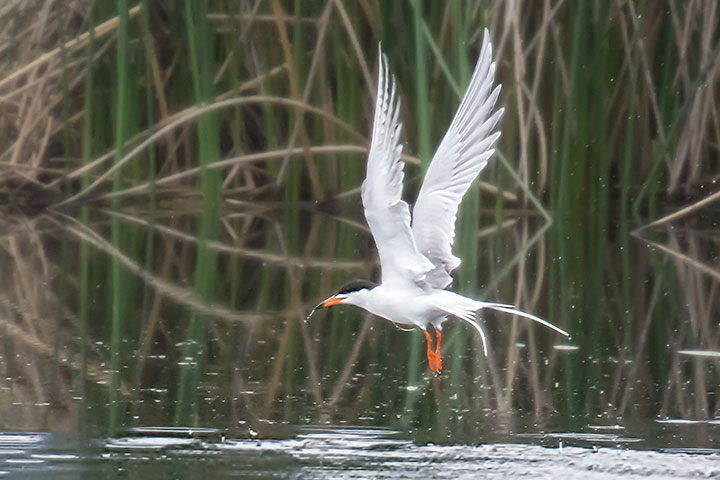
However, after another plunge into the water, it flew off with a meal.

My favourite view shows it rising from the water with its wings and tail spread.

Posted in birds, commentary | 1 Comment

Turkey display


If one believes the promotional art for harvest festivals, wild turkeys display in the fall. The timing is off by about a half year. Now is when toms display; this is the breeding season.

The distinctively spread tail feathers of the Wild Turkey signalled a good reason to pause and watch.

This turkey then obligingly turned sideways. Its head and neck is coloured brilliantly with red, blue and white. The colour can change with the turkey’s mood, with a solid white head and neck representing the most excited state. This bird seems part way there.

Posted in birds | Comments Off on Turkey display

Antler buds


A male moose in a marsh has started this year’s antlers.

Posted in mammals | 2 Comments