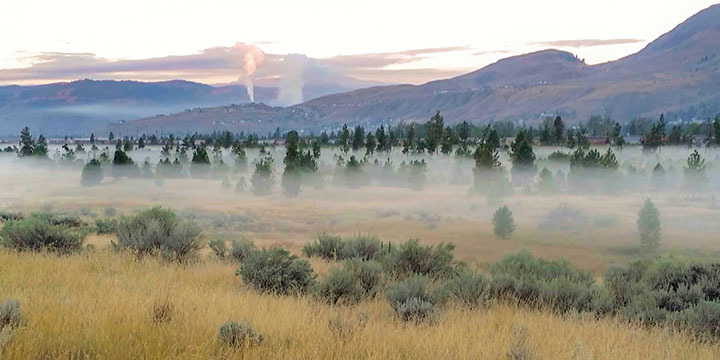
Ground fog


Clear fall mornings are a good time to enjoy the tranquility of ground fog. However, the view from my home is of the Lake rather than of a grassy valley bottom, so I don’t get to see it. Rather, I am more likely to see the frenetic sprites of steam fog. More about this below.

I normally constrain the pictures in this blog to those taken in the vicinity of Kootenay Lake. A picture, rather like the one shown here, could have been taken at either end of the Main Lake, but I am never at those places at the right time. So I am using one taken by Rick Howie near Kamloops, about 300 kilometres to the west. 

The fog in this picture is called either radiation fog or ground fog. The first name implies a process (the discussion of which is usually blotched); the second name simply says where it occurs; (and can hardly be faulted).

Condensation
Fog, clouds, dew, and frost all involve the condensation of water vapour to form liquid drops or ice crystals. There are two processes that give rise to condensation: vapour cooling, vapour mixing. Each is distinct (neither is a consequence of the other) and each is well understood

  • Vapour cooling gives rise to most of the drops that form in ascending air: cumulus, cumulonimbus, upslope fog, and cap clouds. It is also the cause of most of the condensation onto a surface: most dew and frost. Many teachers try to explain this condensation by claiming that it occurs because cold air cannot hold as much water vapour as warm air. For two centuries, this assertion has been known to be nonsense, but it still gets taught.
  • Vapour mixing requires that two volumes of air with different vapour pressures and temperatures are mixed. During this mixing, the average temperature does not change. Vapour mixing produces many of the fogs near the surface, some types of frost and contails. It is responsible for the fog in the picture.  

Typical explanation
A typical explanation of ground (radiation) fog is that offered by Wikipedia in its article on fog.

Radiation fog is formed by the cooling of land after sunset by thermal radiation in calm conditions with clear sky. The cool ground produces condensation in the nearby air by heat conduction.

There are two problems here: 1) The author thinks that the condensation is the result of the cooling of the air (supposedly air is being used as proxy for the vapour); 2) When air is cooled by conduction, it is also dried. Because there is a downward flux of both heat and moisture onto a surface, the result of the described process is dew, not fog. Although superficially compelling, this explanation is physically wrong.

What happens
Notice, when you see such a fog, that it does not actually touch the ground in most places, but appears in layers slightly above it. The formation sequence is as follows:

  • Radiation is certainly involved. A cloud-free night allows a net loss of radiation from the ground: the ground emits more energy in the infrared portion of the spectrum than it receives from the air above.
  • The temperature of the ground decreases owing to the net energy loss.
  • However, the ground not only cools the air above it by conduction, it also dries the air in this thin layer (perhaps a few centimetres) above by diffusion. So far, this explanation follows the typical one, except the counteracting drying of the surface layer is now acknowledged. 
  • The terrain is uneven and this causes the colder air on sloping surfaces to gently drain into the low-lying regions: There is a gentle katabatic wind. 
  • The cold air drains into the valley bottoms and pools there. (This downward flow involves two counteracting effects: adiabatic warming and increased convective cooling from the ground.)
  • The cold air that has pooled in the valley bottoms has flowed underneath the somewhat warmer air above it. 
  • Now comes the condensation mechanism: It is the mixing of the air at the interface between the cool lower air and the warmer upper air that results in the fog. It is a fog produced by vapour mixing, and as the fog forms at the top of the shallow between the pooled colder air and the warmer air above, the fog is often seen slightly above the ground. 

Finally
Why does my home not afford such a lovely view? It looks out over the a water-filled portion of the valley. Convection in the deeper water does not allow the lake’s surface to cool much overnight. So, when katabatic winds bring cooler air from the mountain slopes, steam fog results. Steam fog is also the result of condensation by vapour mixing, but the air is now warm below and colder above which results in the dancing sprites of fog. It is a delight to watch, but clearly different in appearance from the tranquility of a ground fog. 

Ground fog near Kamloops is the result of vapour mixing between the cold air (and vapour) that has drained into the valley and the warmer air (and vapour) just above it. The same thing should be seen at either end of the main portion of Kootenay Lake.
Rick Howie’s picture is used with permission.

Posted in weather | Comments Off on Ground fog

Harrier at Park


So unexpected was the sight of a Northern Harrier at Kokanee Creek Park, that I misidentified it at first. I have occasionally seen harriers at either end of the Main Lake where they hunt small mammals while flying low over grasslands, but much of the West Arm is unsuitable forested habitats. Yet, here was a harrier hunting over the limited grasslands of the Park.

Harriers summer to our north, and winter to our south, so in the fall, these birds pass through our region as they head south, which makes September the best time to see them in the Park. Indeed, this harrier had been reported the day before I saw it. Maybe it will hang around for a few more days.

My first view of the Northern Harrier was of it chasing another bird. At that time, I had not figured out what it was.

It became clear some moments later when it flew close to me,

and a fraction of a second later it flew past.

Posted in birds | 3 Comments

Loons rafting


The Common Loon doesn’t nest on Kootenay Lake. The spring freshet would flood the nests it must make on the edge of the shore. Rather, loons nest on little mountain lakes high above Kootenay Lake. During this nesting time, the bird is territorial and will drive off competitors. 

However, when the breeding season is over and they prepare for their migration to the Pacific Coast, loons are social. They gather in (what are called) rafts on those larger lakes that have abundant fish. Kootenay Lake serves them well as they prepare for migration. We can hope to see rafts of loons here for the next month.

A raft of loons swims by as it hunts for fish.

Posted in birds | 1 Comment

Grizzly family


A family of Grizzly Bears has been spotted high in the southern Selkirks. Do you want to see if we can find them? This invitation from Derek Kite did not require a second bidding.

Alongside a dirt road high in the mountains there was a sow and her three cubs.

The sow slowly grazed her way up the slope, eventually vanishing into cloud.

Her cubs followed.

Posted in mammals | 2 Comments

Small yellow birds


Carotenoids are the answer. The question is: What gives the yellow plumage of birds? (Think, Big Bird.)

Carotenoids are pigments produced by plants. The pigments are transferred to insects that eat those plants and are then available to birds that eat those insects. In birds, these pigments might be signals of fitness because they are derived from special diets which might be difficult to obtain. These pictures were taken this last week.

A juvenile Cedar Waxwing shows a pale yellowish belly, but a distinctly yellowish tail.

The yellow plumage of this immature male Common Yellowthroat will be even more spectacular when the bird becomes an adult.

A Yellow-rumped Warbler eyes the photographer with suspicion. 

Posted in birds | 6 Comments

Merganser retard


The Common Merganser predominantly eats fish, which it catches live, brings to the surface, and swallows whole (see merganser stuffing). Chicks start by catching insects but switch to fish after a few weeks. By the time they become juveniles, their diet should be predominantly live fish. Yet, knowing just what to catch might be a skill mastered slowly.

An adult watches as a juvenile surfaces with an inedible fish carcass. One can almost hear the adult saying: “This training may take longer than I had hoped.” 

Posted in birds, fish | 2 Comments

Otter romp


I have taken dozens of pictures of otters around the Lake. Many of the otters were swimming; Others were visiting docks (where they preened and defecated); Others appeared on ice or snow. This is the first picture I have taken of otters on the ground alongside the Lake. 

Now, it is not as if I doubted that this amphibious animal wandered the lakeshore, but it is interesting just how long it took before I managed a picture of it doing so.

A family of four otters moves along the shore: a parent leads its three pups.

Posted in mammals | 1 Comment

August goulash


This is an end-of-the-month collection of images, none of which rated a posting on its own.

An osprey pauses on the branch of a snag to eat a fish head first.

A sub-adult Gull (Herring? Ring-billed?) is eating something that looks like it might have been another bird.

A Red Squirrel munches on a cone.

A female Downy Woodpecker ponders opportunities.

A Herring Gull runs across the water to take off.

A Belted Kingfisher flies to its next hunting station.

A juvenile Spotted Sandpiper scours the shoreline.

The fawn of a White-tailed Deer stops browsing to consider an intruder.

A Great Blue Heron lands in the rain.

Not all of the heron’s catches are a mouthful, such as that shown in happy heron.

An American Dipper hunts along a creek.

Posted in birds, mammals | Comments Off on August goulash

Happy herons


The Kokanee salmon are spawning and everyone is happy. Tourists come to watch and others come to feed: ravens, gulls, eagles, vultures, ospreys, otters, bears, mallards, mergansers, rainbow trout, and (the focus of this posting), herons.

There are perhaps a half-dozen Great Blue Herons working the creek. They were stationed on trees, rocks, sandbanks and in the water. Now and then one would fly to a new spot.

A juvenile heron stood in the creek eyeing a Kokanee (reddish smudge, bottom centre).

It lunged. Its bill can be seen under the water approaching the fish.

Success. But, the Kokanee is athwart the bill and must be turned before it can be swallowed.

With a flick of its head, the heron rotates the fish and quickly downs the whole thing.

Posted in birds, fish | 2 Comments

Osprey & fish


Not Kokanee: a few correspondents challenged my identification of the fish as a Kokanee. It is now confirmed to be a sucker.

For many years, I have wanted to capture a sequence showing an osprey plunging into the Lake and then rising out of the water carrying a fish. Four summers ago, I managed parts of the sequence, but alas when the osprey surfaced, it had no fish (see, osprey plunge).   

There could be many reasons for my failures: The event is unpredictable; It is fleeting; It is distant. But, the bottom line is that, as yet, I just have not figured out how to capture the moment. Sure, I have pictures of an osprey packing a fish (often headless), but I have had difficulty recorded the moment of capture. 

Although I still lack the whole sequence, progress was made last Monday while walking along a beach near the mouth of Kokanee Creek. I heard a splash and swung around to see an Osprey lifting a sucker from the Lake.

My favourite shot of the capture was taken one second later as the airborne Osprey flew off with its reluctant prize.

Posted in birds, fish | 3 Comments