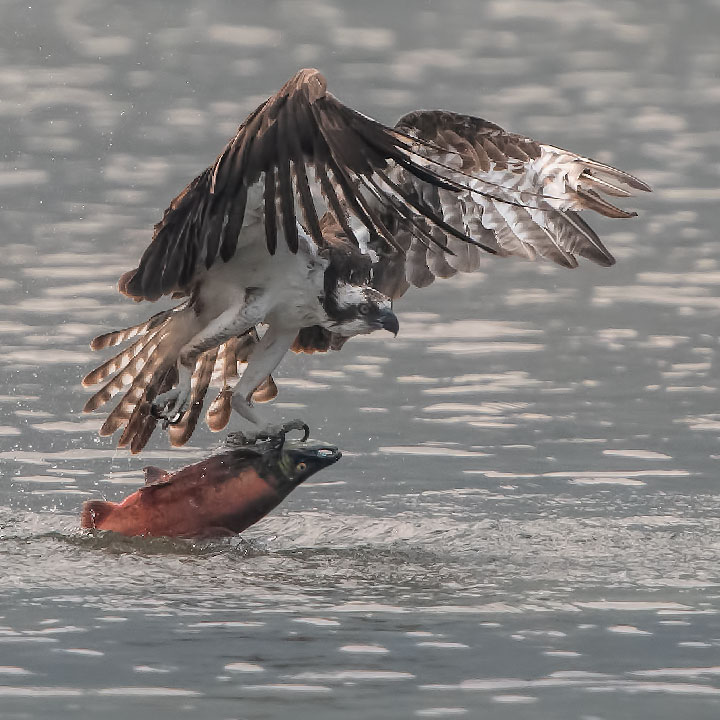
Iconic osprey shot


The West Arm of Kootenay Lake has an unusually large warm-season population of ospreys. As such, they have become a symbol of the Lake, with both a ferry and a community foundation named after them.

Ospreys feast on fish caught live. But, just try to capture a picture of an osprey lifting a fish from the Lake. The problem is that it happens amazingly quickly somewhere over a rather large area.  I have only managed to record the event once before.

Consequently, this morning’s shot of a (male) osprey lifting a (male) Kokanee from the Lake is one of my most satisfying shots of the year.

An Osprey and its catch.

Posted in birds, fish | 16 Comments

Fledged osprey


It seems maybe a week early, but juvenile ospreys have started to fledge.

A juvenile osprey — identified by wing feathers looking as if dipped in cream — flew by early this morning.

Posted in birds | 2 Comments

Juvenile heron


This is the time to see juvenile birds. Although as large as adults, they often look somewhat different.

Today, I saw a juvenile Great Blue Heron standing on a deadhead. The signs were clear that it was this year’s chick. 

This Great Blue Heron hatched this summer. It lacks: the pigtail on the back of its head, a white crown, long shaggy neck feathers. And it has a well developed yellow patch in front of its eye.

This is the same bird flying off. Yet, its colour seems different. The hues here are closer to what would be considered correct for the bird. The previous shot was strongly influenced by yellowish light transmitted through a pall of smoke from distant forest fires. 


Posted in birds | 5 Comments

Baird’s migration


The migration of shorebirds is underway. We have seen the killdeer pass through, however, the killdeer also breeds here. Not so, the Baird’s Sandpiper. It breeds in the high arctic and winters in South America. Baird’s visit to the Lake is brief.

A Baird’s Sandpiper flies to the shore of Kootenay Lake during its migration south. 

Its first act was to bathe and preen.

Then it is time to eat. It seems to have found a yummy dragonfly nymph.


Posted in birds | 3 Comments

Killdeer migration


First there was one killdeer, then two, finally there were five of them.

These killdeers were on the move, probably merely stopping here for refuelling as they migrated from farther north to farther south. While killdeers breed locally, this group was probably just passing through — part of the annual migration of shorebirds.

A lone killdeer was spotted along the shore.

Soon more were seen, but never clustered tightly enough for a good group picture.

They fed. This one seems to have found a caddisfly larva. It was quickly downed.

Looking one’s best.


Posted in birds | 2 Comments

Portrait of a fawn


Posted in mammals | 1 Comment

Western yellowjacket


The western yellowjacket is a versatile wasp. It will nest in the ground, in tree trunks, or under the eves of porches. As with most of the creatures around, I tend to adopt a live-and-let-live approach. However, when this yellowjacket bars entry through an occasionally used doorway by attacking visitors, I draw the line: the hive has to go.

Western yellowjacket wasps are building a hive on the lintel above an entrance doorway, and then terrorizing all who dare to pass by. This is war.


Posted in bugs | 3 Comments

July goulash


This is a collection of a dozen images from July, none of which has had a posting of its own.

Where have all the male Mallards gone? They are here, but are in their eclipse plumage, which makes them look somewhat like females for a few months. That this is a male is evidenced by its yellowish bill. The female’s bill is much darker.

Has the hot dry weather been hard on megafauna? This white-tailed deer looks a tad scrawny. 

A common wood-nymph rests while foraging.

An eagle just ignored the magpie’s request that it find itself another tree.

Some Indian pipe was posted earlier. This is another find.

There seem to be fewer dragonflies this year. This is a cherry-faced meadowhawk.

There were plentiful snowshoe hares last year, but this is only the second one I have spotted this year. Something has taken a nick out of this one’s ear.

The cheetah is billed as the world’s fastest land animal. However, when measured by the biological standard of body lengths traveled per second, the hare is fifty percent faster than a cheetah.

A hedgerow hairstreak stops for a rest.

An osprey frequently flies around with a headless fish. It might be that the male stopped and ate the tasty head on his way back to the nest. However, this fish has already been to the nest — see the grass stuck to its tail. When its nest is threatened by an eagle, the osprey takes to the air with its fish so as to better defend its meal.

A northern crescent feeds on a daisy.

Both Northern Flicker parents tend their chicks. Earlier I showed the mother caring for this pair. Here the father provides a mouthful of ants’ eggs.

 

Posted in birds, bugs, fish, mammals, wildflowers | 3 Comments

Spotties


The Spotted Sandpiper is the first summer bird I became aware of as a small child — the little bird that roamed the water’s edge. Spotties arrive at the Lake in May before school is out for the summer, and leave again as children return to class. Its time at the shore coincides with that of children. While not as spectacular as the Osprey, which maintains much the same schedule, for a child wading in the shallows, the Spotty was more fun to watch.

Mind you, I wasn’t told of the Spotty’s non-standard marital arrangements, nor do I suppose that the adults in my family were aware of them. To make up for this lacuna, this blog has featured Spotty’s antics many times.

July is the time to see the sandpiper’s chicks scouring the shores.

“Just because my wings don’t work yet, doesn’t mean that I shouldn’t flex them.”

This is the chicks’ father — or at least he thinks that he is, so he broods and protects them. (As his mate is highly promiscuous, he probably is wrong.) Here the male is flying past a couple of beach walkers in an attempt to draw them away from his non-flying charges. 

Farther along the beach a juvenile Spotty (hatched a bit earlier) practices its dance routines.

For a week or so, the Spotted Sandpiper chicks rival anything around for cuteness.


Posted in birds | 6 Comments

Past-prime orchid


Normally, I attempt to post a picture that shows something at its peak of perfection. 

I am willing to make an exception. It is, after all, the Giant Helleborine. This flower is one of our local wild orchids, but one that I have not managed to see for eight years. Yesterday, I was told of hundreds of them having bloomed a week ago along the lakeshore. So today, I headed out to see them. They were there, as claimed, but were now past their prime. 

Ah well, it is the Giant Helleborine, I now know where to look for it next year.

These are a few of the many Giant Helleborines that were spotted along the lakeshore.

One of the flowers looked a tad bedraggled. 

As a reference, I include a shot I took in 2010. Maybe next year, I can capture this orchid again. 


Posted in wildflowers | 4 Comments