Katabatic wind: a usually gentle wind of cool air that drains down the mountain slope overnight. When the sun warms the slope and the air above it, a katabatic wind usually stops.
Yestermorn, I was watching the languid drift of steam fog as it was carried offshore by a gentle katabatic wind. On other occasions, I had seen ripples on the water caused by the passage of a katabatic wind, but on this occasion, although there were tiny waves flowing towards the shore from off the Lake, the katabatic wind passed over the water without leaving a trace. If the drifting steam fog hadn’t revealed its passage, I wouldn’t have known there was a wind at all. How can a wind travel over the water without disturbing it? (Continued below the first picture.)
Even though a wind was carrying steam fog across the water, no water waves revealed its passage.

Suddenly, the lightbulb went on. I knew that everything that moves across the surface of water makes waves — well, everything that moves faster than 23 centimetres per second. I already knew that if a bug, such as a whirligig beetle or a water strider, moves very slowly across the water it makes no waves and so avoids both wave resistance and revealing itself to prey through spreading waves. Now, it seems, I can add a gentle katabatic wind to the things that can move over a water surface and neither make waves nor encounter wave resistance.
For there to be a water wave, there must be a force that restores the position of the water that has been disturbed by, say, wind, boat, or swimming animal. If the wavelengths are longer than 1.7 cm, the dominant restoring force is gravity; less than 1.7 cm, it is the surface tension of water. These really short waves are sometimes called capillary waves, but more often they get the name ripples.
The odd thing is that the two types of waves behave differently: the fastest ripples are the shortest ones; the fastest gravity waves are the longest ones. A wavelength of 1.7 cm has a wave speed of 23 cm/s, which is both the slowest ripple and the slowest (gravity) wave. All other waves move faster than 23 cm/s. So a bug or wind moving across the water at a lower speed cannot excite waves.
Gentle breeze: If 23 cm/s (0.23 m/s, 0.8 km/hr, or .5 mph) is the transition speed, just how slow is it? It is about a quarter or a fifth of a typical adult walking speed — a baby crawl.
This seemingly esoteric and curious fact has easily observable consequences, as will be seen.
As a katabatic wind flows down the mountain slope, it is slowed at the surface by the friction of passing over trees and rocks. Assuming it is moving at less than 23 cm/s when it reaches the Lake, it does not disturb the water. However, this lack of wave resistance also means that the drainage wind now begins to accelerate. A short distance offshore, the wind is moving faster than 23 cm/s and now it begins to make waves.
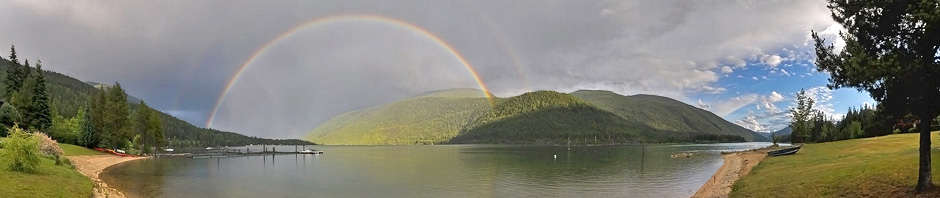
There are katabatic winds on the Lake in this sunrise scene taken a month and a half ago. Disturbed water can be seen in the image below. Katabatic winds have descended the slope on the shady (cool) left side of the picture and have spread over the water. They are also apparent on portions of the right side still in shade, but where the sun has warmed the slope, the winds have ceased. On the left side there is often a gap between the shore and the disturbed water. While there is a wind there, the air is moving at less than 23 cm/s. However, the lack of resistance to the flow allows it to accelerate above the transition speed and start disturbing the water farther offshore with waves.


Fallstreaks
When I was in elementary school, I was taught that when water has a temperature of less than 0 °C (well, 32 °F at that time), it is (invariably) a solid called ice. And I was told that it is a liquid from 0 °C to 100 °C (212 °F), and above that, it is a gas. This was one of a number of misleading quarter truths I was taught about the world.
If what my grade-school teacher told me were true, the scene below wouldn’t be possible. Further, much of the world’s weather would be different than it actually is.
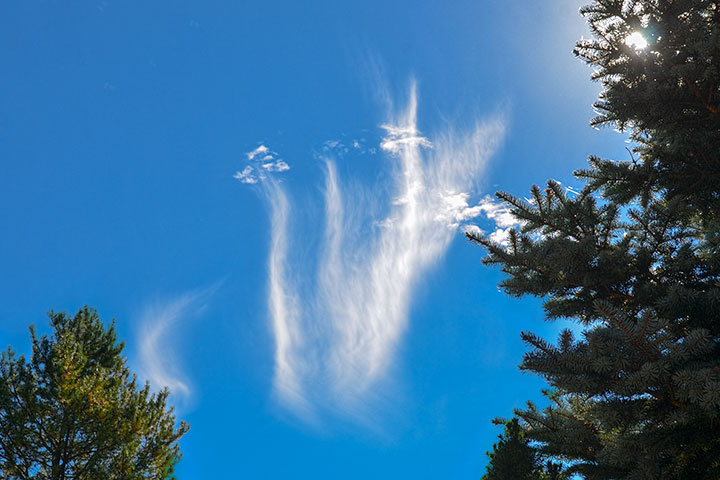
These clouds are cirrus, or more descriptively, fallstreaks. The temperature is well below 0 °C and yet the ragged-looking clouds above the streaks are composed of liquid water droplets, while the streaks are composed of ice crystals. Unseen, but transferring mass between the two is water vapour.
The water droplets are supercooled (still liquid below 0 °C), which is actually a really common state of affairs in the atmosphere. If some of those droplets do freeze, an ice crystal is formed of about the same size. This results in droplets and tiny crystals coexisting in the cloud. This situation is unstable: H2O molecules evaporate from the liquid and condense on the ice crystals causing the water drops to shrink and the crystals to grow. Water vapour is the conduit between the liquid and solid, so all three forms coexist even though the temperature is below 0 °C.
When small, either droplets or crystals have such a tiny terminal fall velocity that the cloud they are in seems to hang in space. However, the ice crystals that have grown at the expense of the droplets have become big enough to have a large terminal fall velocity and so descend in long vertical streaks below the water cloud.
That these fallstreaks are essentially vertical even while the crystals fall through different levels in the atmosphere is a consequence of the lack of wind shear. There is a wind — the streaks are moving across the sky — but it is virtually the same strength throughout the depth of the cloud. If the wind were to change with height, the fallstreaks would assume the shape of a hook.
Fallstreaks contain a mixture of solid, liquid, and vapour, all at a temperature below 0 °C.