Grizzly boar


One’s opportunities to spend quality time with a grizzly bear seem limited to a few times a year and, even then, they are fleeting. Alas, grizzlies like to keep their own company.

So, it was nice earlier this week to spend ten minutes or so with a grizzly boar. Well, I am not sure that he was really aware I was there as the bear’s vision isn’t all that good, and the wind was towards me. 

This handsome grizzly boar is almost certainly the father of the tagged bear discussed earlier.

Posted in mammals | 4 Comments

Sandpiper migration


As the fall looms, many birds migrate. I have shown other sandpipers that were passing through: Greater Yellowlegs, a Solitary and a Least Sandpiper. Here are three more.

The Long-billed Dowitcher breeds along the Arctic coast, but winters along the southern coast of the U.S. and in Mexico. It is just refuelling as it passes through here.

On one occasion it seemed to stumble and had to use its wings to regain its balance.

A particularly uncommon visitor locally is the Buff-breasted Sandpiper.

It breeds on the Arctic coast and islands and usually migrates through the prairies to southern South America. Note its yellow legs.

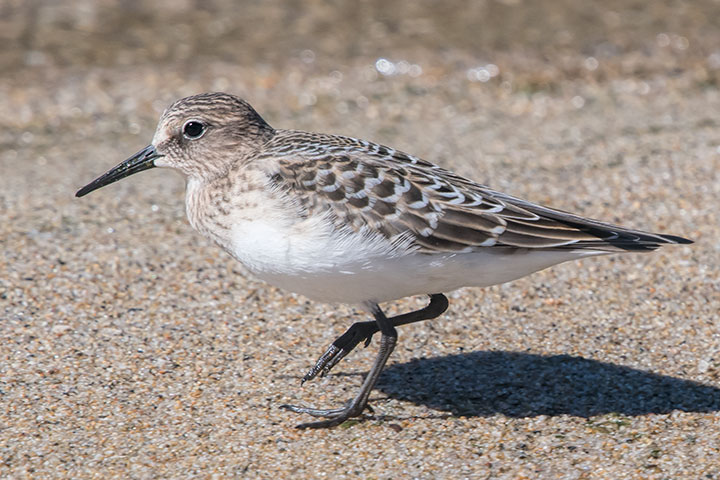
Seen with the Buffy is a Baird’s Sandpiper. Note its black legs.

Both of these two sandpipers are insectivores, but the fact that they hang out together is probably the result of the Baird’s, which often travels in flocks, looking for company rather than the Buffy needing company. The Buffy is in the foreground and the Baird’s is closer to the water.

The Buff-breasted Sandpiper flies down the beach. The Baird’s Sandpiper will follow.

Posted in birds | 4 Comments

Hawks plus


The interesting things one can watch, often changes with altitude. 

Pipits prefer the high country where they travel in flocks scrounging the ground for insects.

Certainly the Red-tailed Hawk can be seen everywhere, but I have only seen one all summer in the valley and three in the mountains within an hour.

The best sighting was of a Cooper’s Hawk, an uncommon bird of open forests.

Posted in birds | Comments Off on Hawks plus

RAPP Grizzly


In my wanderings yesterday, I met a grizzly bear — what a delight.

That delight faded when I realized that it was being used as a promotional billboard for a provincial ministry. It bore ear tags that proclaimed:

Huh? What in the world is RAPP, and why would a grizzly be used to promote it? 

My immediate reaction was that RAPP must be part of a grizzly tracking programme and that the folks that stapled this message to the bear’s ears wanted to know where it was. 

How naive of me. 

RAPP stands for Report All Poachers and Polluters. The number is also used to report conflicts with wildlife. Ok, these are a worthy causes. But, does it merit stapling the message to a Grizzly’s ears? I tried phoning the number, but the recorded message left no option to ask that question of a human.

I invite readers to suggest other worthy governmental promotions that might be stapled to provincial wildlife. I offer a few examples:

• Highways could have deer marked to proclaim: Watch for wildlife.
• All spirit bears could have ear tags that said: Na-na, na-na, you can’t shoot me.
• Forestry could put flags on caribou antlers that said: We support logging.
• Maybe schoolchildren could be used to promote the Education Ministry’s bargaining position.

I chatted with the grizzly about the strange adornments on its ears. It assured me that it was deeply embarrassed to be used as a billboard for any governmental programme. It said, “It just hurts.”

At this point, I remembered Aesop’s fable of the lion and the thorn. “Would you like me to remove them for you?” I asked. “Yes, please don’t let me appear in your blog this way.” I said, “Consider it done.” The grizzly smiled its appreciation. 

Posted in commentary, mammals | 15 Comments

Osprey feeds


It is now the second week of September. Osprey chicks have (substantially) fledged and are hunting on their own. Consequently, the adults have to feed only themselves and, after catching a fish, often stop on a snag to eat. The adults start heading south next week and all soon will be gone.

It is fun to see these end-of-the-season fish feeds.

An adult osprey has paused on the branch of snag to feed on its freshly caught large-scale sucker, which it eats head first. For a short time, it tried to stare me down when it found me watching.

However, I (apparently) was not viewed as a threat, and it was hungry, so, soon it was back to feeding.

Posted in birds, fish | 4 Comments

Window thunk


The predawn thunk of a window collision reminds one that birds rise early. The collision was a consequence of birds flying to an adjacent rowan tree (European mountain ash).

Most of the birds flying to the rowan berries were robins.

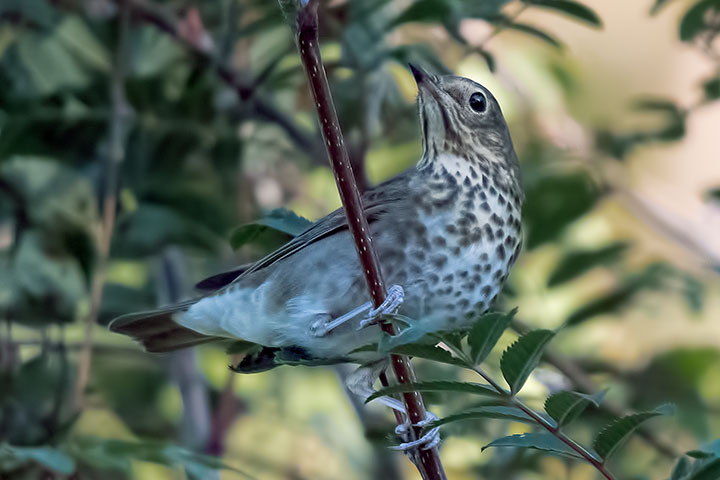
However, a species not immediately recognized has tentatively been identified as a Hermit Thrush.

Also taking part, but spending most of its time preening, was a Yellow-rumped Warbler.

Posted in birds, wildflowers | Comments Off on Window thunk

Raven chases eagle


I know it happens, but I just don’t understand why a Bald Eagle would flee from a Common Raven. 

Once, when I watched a Red-tailed Hawk flee from the harassment of a raven, an experienced birder explained that ravens really do have sharp claws and from the point of view of the hawk, there is no point in risking an injury. Fair enough, the idea is: Just walk away (well, fly away) from a silly fight. But, surely the logic goes the other way around also: The raven would become lunch if the eagle actually chose to take it on.

A juvenile Bald Eagle just flew off when harassed by a Common Raven.

Posted in birds | 4 Comments

Seasonal change


The season is changing. Of course, children are going back to school, but other species are shifting over to the winter residents. Steller’s Jays are back, as are cedar bugs (aka, stink bugs).

A sign of the shift for me is the arrival on August 30th of a Horned Grebe. They are usually present, except during the summer, when they breed farther north. 

The arrival of a Horned Grebe in the dying days of August was welcomed. However, this one has a rather odd extrusion of flight feathers erupting from its side. Can it fly? Well, it did arrive here.

Posted in birds | 1 Comment

Win some …


The spawning season for kokanee brings out both predators and cameras. This combination increases the chances of capturing interesting scenes. Yesterday’s walk recorded winners and losers among the predators and some rather satisfying images.

A Common Merganser chasing a fish produces an impressive burst of speed — and a striking image.

Speed pays. Six seconds after being caught, the fish had vanished down the merganser’s gullet. 

While the merganser was a winner, this osprey lost. It did catch a kokanee now clasped in the bird’s left claws. Alas, catching a fish is only part of the exercise for it has to be lifted from the water and flown to a place where it can be eaten. This kokanee proved too heavy to lift. After three failed attempts, the osprey gave up and flew off without it.

Posted in birds, fish | 3 Comments

Hotspot


Now that the wildfire season seems behind us, no concern is likely to be raised by a discussion of something called the hotspot in the forest.

The hotspot is an optical phenomenon in the form of a diffuse bright region around the antisolar point. This is the point on the celestial sphere directly opposite the sun. It is also the location of the head of an observer’s shadow, if it can be seen. In the scene, below, the hotspot appears in the geometric centre of the picture. However, the hotspot is not fixed to the ground. It moves with the observer and the Sun.

The explanation of the phenomenon, also known as the dry heiligenschein, is remarkably simple. On an irregular surface, such as a forest, the view is of a mixture of the trees (or other objects) and their shadows. The exception to this blend of light and dark occurs at the antisolar point. Here one is looking directly down the sunbeam and here each tree covers up its own shadow leaving that spot brighter than elsewhere.

There is a hotspot in the forest in the centre of this picture of a tree-covered mountainside.

Posted in weather | 2 Comments