For some time, I fancied that I had a residential Ruffed Grouse — or at least my yard lay within its limited range. Maybe it stuck around because it viewed my yard as a sanctuary.
Alas, reality has undercut both conceits. First to go was the matter of a safe haven when a neighbourhood dog executed the bird. Second, was the fact that the grouse continued to appear. Apparently, I was not observing a single bird, but a few of them.
Certainly, I had noticed that the colour of the grouse did not remain constant, but then the lighting varied, and besides all birds moult and sometimes can change their plumage in spectacular ways. The problem was that while the Ruffed Grouse moults, it retains the same look. Further, its breeding plumage is available at any time of the year merely by erecting its ruff and fanning its tail. The variations I was seeing were not a result of moulting.
It turned out that the Ruffed Grouse has two colour morphs (or phases), rufous and grey, where the frequency of each depends upon climate and habitat. We have both morphs here, and this simple fact made it clear that I was seeing more than one grouse in my yard.
The Ruffed Grouse has his display plumage available whenever he wishes to threaten another male or attract a female. He does not have to moult into it. (Oct. 10, 2014)

This is a rufous morph wandering through my yard. (Feb. 2, 2014)
And here is a grey morph seen yesterday. Ah well, I watch; I learn.



Snowberry eaters
What eats snowberries?
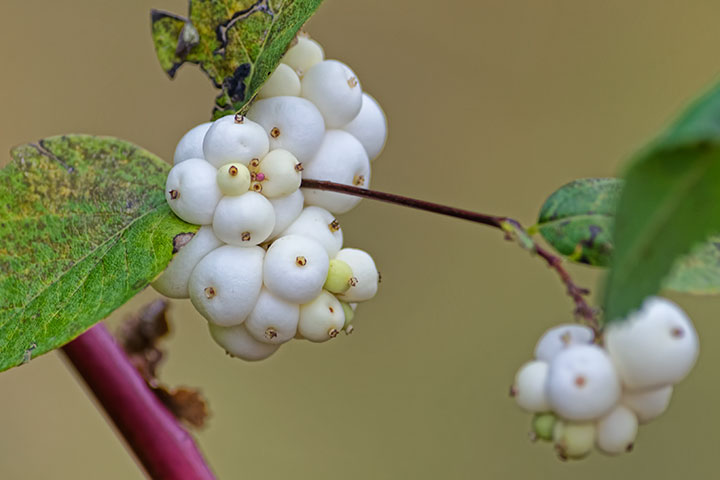
Most types of berries are colourful, sweet and juicy, a persuasive combination that prompts birds to eat them and consequently to spread the seeds. In stark contrast, snowberries (waxberries) are white, tasteless and dry. As snowberries are both widespread and common, they have clearly evolved an effective strategy for propagation, but what is it? What eats snowberries and disperses their seeds?
A web search for snowberry eaters produces a list of frugivorous (fruit-eating) birds. There were also suggestions, such as that of Wayne Weber, that snowberries aren’t the preferred food of birds and that most of them probably fall to the ground before they get eaten.
Terry Taylor takes this idea further and argues that: by not being juicy, they avoid the competition of the fall berry season; by not being sweet, they resist mould and so extend seed dispersal into the hungry time of winter; by being white, they are more readily visible on the ground at night where they can be eaten by mammals. He suspects that the seeds are spread primarily by rodents.
Taken together, these nice bits of biological detection suggest that, while birds occasionally eat them, snowberries evolved to appeal primarily to mammals.
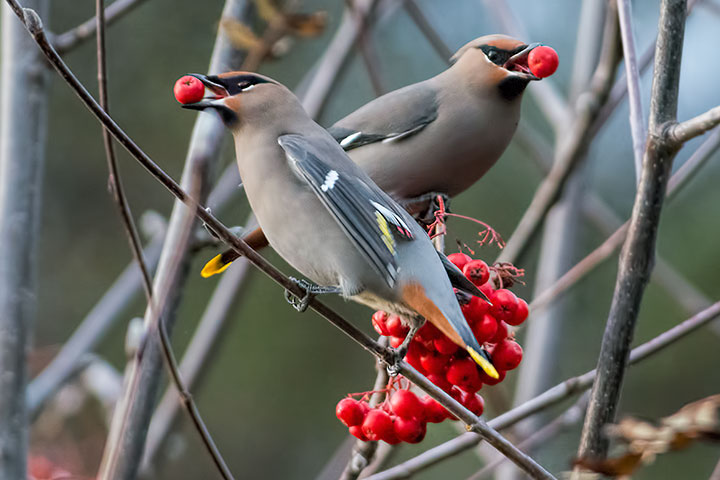
In the fall, most berries compete for the attention of birds by being colourful, sweet and juicy. These rowan berries (mountain ash) have attracted Bohemian Waxwings (November 18, 2014).
Snowberries avoid the fall competition by being white, tasteless and dry, but they last into the hungry season when they have the stage to themselves (October 18, 2012). Although occasionally birds eat them, I have yet to see this.
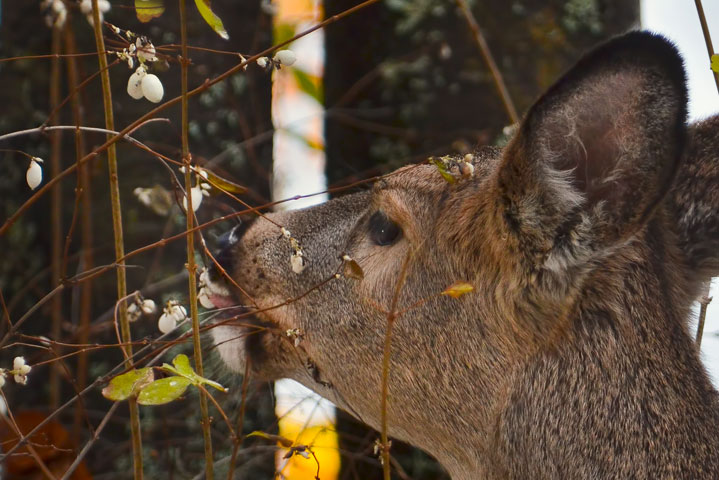
However, I have seen mammals eat them. This is a White-tailed Deer (November 11, 2011).
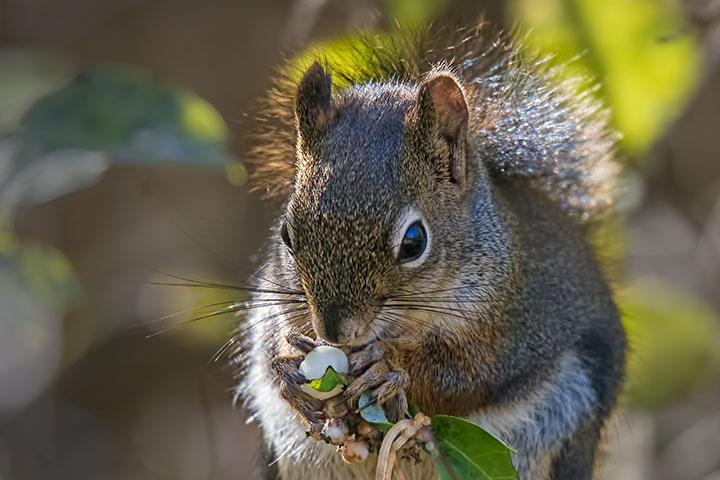
And, here is yestermorn’s observation of a Red Squirrel.