White rein orchid


This has been an unusually good year for finding wild orchids in Kokanee Creek Provincial Park. 

First came the fairy slipper, then the mountain lady’s slipper, then the spotted coralroot, and yesterday, the fragrant white rein orchid.

There is a shot of much of the plant to the right and a detail below. 


Posted in wildflowers | 1 Comment

Chicks abound


‘Tis the season to see chicks. Here are a few seen over this last week. Of the six pictures shown, three were taken by my visiting nine-year-old grandson, Finn. He took them all when nature watching on his own.

Even after fledging, nuthatch chicks do not know how to feed themselves and continue to be fed by a parent. That the bird on the right is a chick is evident not only by the activity, but also its yellow gape and bill.

Finn found a flicker in a nest. Again, the bill and the lack of colouring on the head show this to be a chick.

This is my shot of a mother Bald Eagle and her two chicks.

When I thought that there wasn’t much point in taking yet another picture of geese, Finn tried anyway and turned up something interesting: a leucistic goose—see the white crown of the female. Two years ago I photographed what is probably the same leucistic goose.

This is my shot of a lonely mallard chick. It was wondering along the shore apparently looking for its mother. It has just picked up a leaf off the lake and promptly ate it.

And Finn’s early morning shot of a merganser mommy and her chicks wins the cuteness award.

Finn Fraser Grathwol’s images are used with permission.

Posted in birds | 2 Comments

Inopportune moment


This the sad story of two horny Spotted Sandpipers and one thuggish Tree Swallow. 

“Hey you idiot, you are at the wrong end. And get your feet outta my face.”  

“OK, I’m ready. Now, go around to the back.”

“Crumb, if you cannot get it right, I’ll turn around. Get on with it.”

“Look swallow, this is a really inopportune moment to visit. You ruined it just when he figured out how to….”

Posted in birds | 1 Comment

Spotted Coralroot


Earlier this month, an acquaintance told me where he had found a spotted coralroot in Kokanee Creek Provincial Park. I had not yet seen this wild orchid and so followed his directions carefully. It had vanished and repeated searches turned up nothing.

Nothing, that is, until today when at a different location in the park, I was showing my nine-year-old grandson a mountain lady’s slipper and he spotted another “pretty flower.” It was the first of four spotted-coralroot plants he found.

Here are two views of the seventh local wild orchid I have managed to photograph.

Posted in wildflowers | Comments Off on Spotted Coralroot

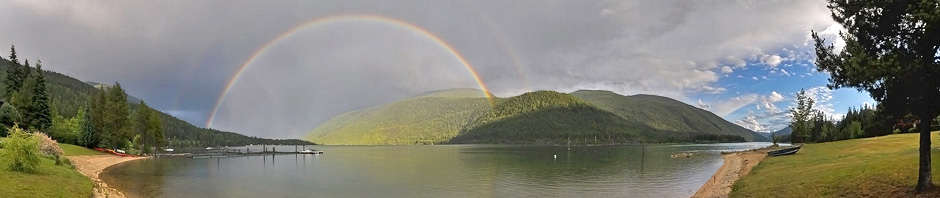
Rainbow notes


I found yesterday’s rainbow picture to be so delicious that it had to be savoured alone: it was the nicest shot I have managed of a semicircular bow replete with its reflection in the calm waters of the Lake. 

Yet, during the half-hour I watched the rainbow, features shifted as the shower moved along the Lake and the lighting changed. There was much to see. 

The colours of the rainbow blend continuously one into another. The crayon-box claim that there are seven colours in the bow is silly: the standard mnemonic, Roy G. Biv (red, orange, yellow, green, indigo, violet) merely gives the order of colours that may or may not be seen, but which are certainly not discrete. Other striking features seen here are that red is on the outside of the curve (not on the inside as much commercial art suggests), and it is brighter inside the bow than outside.

There is a much to discover in the next scene: bright central disk, anticrepuscular rays forming radii to the bow, a larger secondary bow with red on the inside, faint supernumerary bows on the inside of the primary bow, and colours improving as the bow becomes nearly vertical. A particular feature might not be evident in every rainbow, but as one watches the bow evolve, each is worth descrying. The fact that these characteristics are well understood only enhances the grandeur of the event.

Posted in weather | 6 Comments

Sunset shower


Posted in weather | 3 Comments

Mating bugs


I use my camera to record things seen, and this blog to record things learned about things seem.

This normally effective formula failed with these two unknown shield bugs mating on a daisy: I have not even been able to discover their genus. They are probably a type of stink bug, but I did not put them to the test.
They were identified as conspicuous stink bugs (Cosmopepla conspicillaris) in February, 2015.

Posted in bugs | Comments Off on Mating bugs

Porcupine


I have not seen a porcupine in decades; nor had Doug Thorburn who took these pictures earlier in the week. I suspect the reason is that a porcupine is usually active at night, while we are not. 

The porcupine was ascending a gravel bank.

Porcupines are vegetarians that favour tree leaves, buds, and bark. Bank erosion has given it access to roots.

Porcuportrait

Doug Thorburn’s images are used with permission. 

Posted in mammals | 2 Comments

Yellow crab spider


The crab spider (Misumena vatia) can change colour from white to yellow. This allows it to become almost invisible as it sits on similarly coloured flowers while it waits to ambush an unsuspecting pollinator. The favourite local perch of the crab spider is a daisy, a flower that offers the spider a choice: remain white and hunt from the petals; turn yellow and hunt from the central yellow disk. Every crab spider on a daisy I have photographed in past years, has chosen to be white on the petals: see 1, 2, 3 or 4 (read the comment about the colour shift in 4).

This year, for the first time, I saw a yellow crab spider on the central disk of a daisy. Who knows why? The only difference I can see is that these pictures were taken just after a rain. It may be that the drops on the petals were a nuisance for it.

A yellow crab spider hunts from the central yellow disk of a daisy.

A crab spider is skittish and upon spotting me, this one hid under a petal.

Posted in bugs | 5 Comments

Tossed larvae


I see a Pileated Woodpecker only a few times a year, typically when I am running an unrelated errand. Encounters are just too happenstance to plan. Yet, my camera is handy just in case.

I heard an adult male Pileated Woodpecker call from a utility pole; it soon moved to a more promising birch snag.

It spent the first while exploring, broadening, and probing cavities.

Soon it found what were probably larvae of the Bronze Birch Beetle and collected them with its sticky tongue. Some are already stuck to its bill. 

When the woodpecker’s tongue retracts, larvae are tossed in the air and pile up on its bill.

Sated, the Pileated Woodpecker moves on.

Posted in birds | 2 Comments