Camas, et al.


I headed out with Derek Kite to look for, well…, whatever we could find. Certainly, we found mommy marmot, along with ground squirrels, birds and turtles, but the most striking things we ran across were wildflowers.

An interesting flower seen was camas. It reminded me of the Kootenay Camas Project launched by the Kootenay Native Plant Society. As the Society says:

Common camas, Camassia quamash, is a native perennial herb with edible bulbs in the lily family. The beautiful blue flowers grow in moist meadows and prairies in southern British Columbia and the northwestern United States. In the Columbia Basin of BC, camas is a rare find, restricted to low-elevation sites in the West Kootenay.

To locate and document camas is a worthy project. The first two pictures show some we found. These are followed by other wildflowers seen on this jaunt.

Two pictures of camas seen Sunday. They are, indeed, lovely.

We also saw mountain arnica,

smallflower woodland star,

what I think is (the blue-listed) Sutherland’s larkspur,

and finally some indian paintbrush.


Posted in wildflowers | 2 Comments

Mommy marmot


Posted in mammals | 2 Comments

Bee or fly?


A great deal of deception is perpetrated in the fields and woods: camouflage, feigning, mimicking. Fawns sport a dappled coat so as to vanish into the sun-flecked brush. Robins feign injuries to lure predators away from a nest. Flowers lacking nectar attract pollinators by mimicking flowers that deliver.

The topic du jour is the common practice of some types of fly to mimic a bee. A year ago, I treated this same topic, Telling bees from flies, with a more nicely matched pair of images. I now take another run at it using two pictures taken this last week.

A bee has a good defence against a bird that would eat it: it stings. A fly is not similarly armed, but some adopt the survival strategy of looking as if they were: they masquerade as a bee.

Although many flies are remarkably good at such mimicry—good enough to fool birds—differences can be seen. Some are subtle and may not be obvious in the field: bees have four wings; flies only two. Others are easier to spot: flies have larger eyes and smaller antennae than bees. Below is a picture of a bee and a plausible look-alike.

This is a bumble bee, a Bombus vagans (I think). It has long antennae and smallish eyes. This one has alighted on forget-me-nots and is using its tongue to sip nectar.

This is a fly, one of the hoverflies in the genus, Criorhina. Its eyes occupy a much larger portion of the head than do those of the bee. Indeed, this male’s eyes almost touch in the middle of the head. (The particularly large eyes of the male help it to find females). The fly cannot hide is enormous eyes, but it has an interesting way to compensate for its vanishingly small antennae, and it demonstrates it in this picture. The fly will extend its forelegs and wave them about in a simulation of the constantly probing antennae of bees.


Posted in bugs | 4 Comments

Long-faced wasps

Typical oval face of the Polistes aurifer---our local paper wasp.


There seems to be almost as many species of social wasps around here as there are social bees. Most of those wasps have a fairly oval face. Certainly, that is the case for the genus, Vespula—many of the yellow jackets that build nests in the ground—and the Polistes—the paper wasps that build single-layer open-cone nests. Local examples of these can be seen on this website’s page about social wasps.

Then there are the Dolichovespula or long-faced vespula (from Greek, dolikhos = long). They are also the ones who build the large spherical nests that hang from trees and other aerial structures. For years, I have been familiar with Dolichovespula maculata—the Bald-faced Hornet. In the last few days, I spotted my first Dolichovespula arenaria—the Aerial Yellowjacket.


First, two pictures of the familiar Bald-faced Hornet showing its striking long face.

Then, two pictures of the Aerial Yellowjacket—showing its long face.
 

Posted in bugs | Comments Off on Long-faced wasps

Hummingbird Moth


“My, my, who are you?” was my initial reaction to seeing my first Hummingbird Moth (Hemaris diffinis). I had read about it, but as my frequent insect-watching forays had not previously turned one up, this sighting was unexpected.

Also known as a Clearwing Moth, this creature often hovers as it collects nectar from a flower. It is also unusual for a moth in that it is active during the daytime. The adults are mainly on the wing in May, so now is the time to look for them. I show three pictures, below.

Posted in bugs | 5 Comments

5 birds plus…


This is a mid-May catchup of non-arthropods.

The sub-adult loon that was featured earlier was back again and this time it caught a fish.

While I was watching the loon, a Spotted Sandpiper came prowling.

A visit to Kokanee Creek Park produced pictures of three birds. First a goose flew by.

Then a Western Meadow Lark sang.

And a female Brown-headed Cowbird landing in a nearby tree.

Finally, the non bird was a Columbian Ground Squirrel that parked itself in the middle of my pathway.

Posted in birds, mammals | 4 Comments

Rufous Hummingbird


Hummingbirds arrive late April or early May.

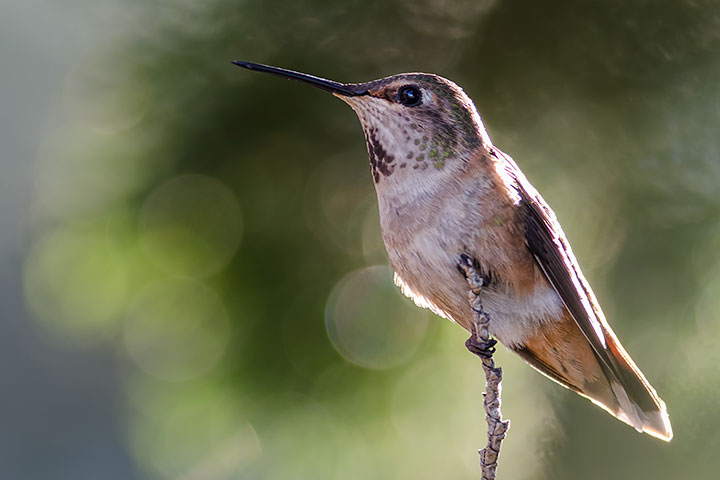
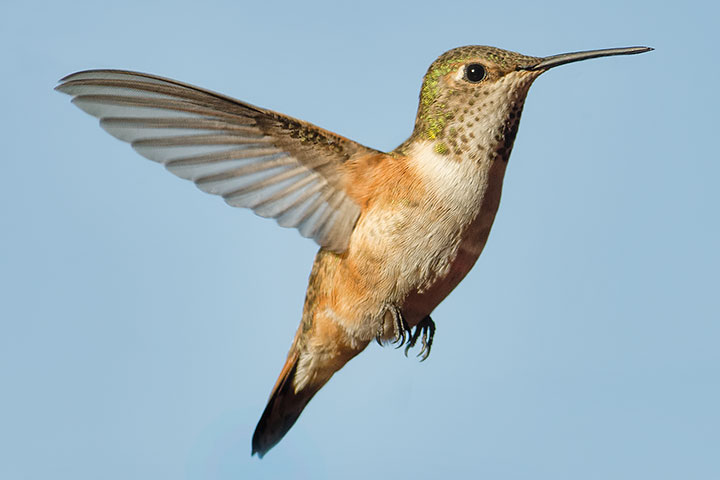
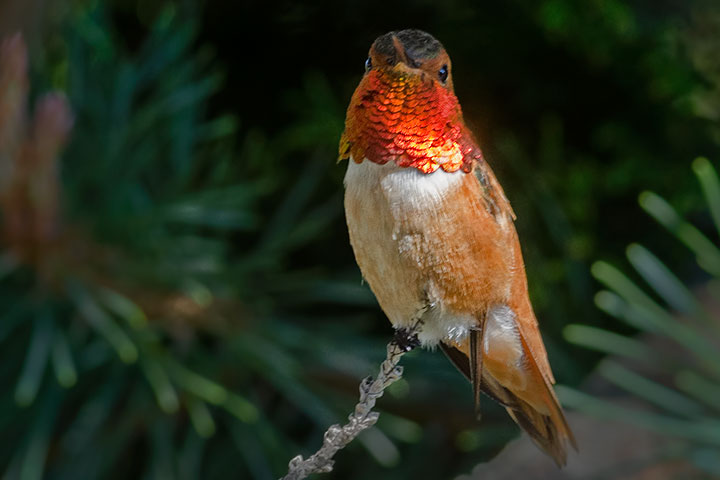
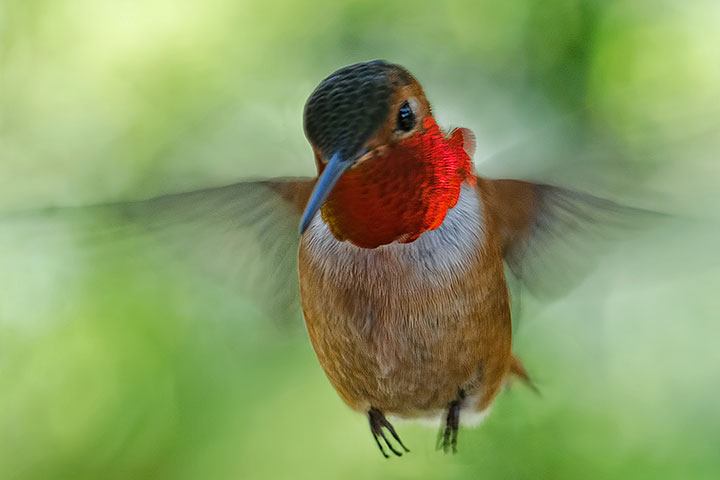
Of the three species we see—Rufous, Calliope, Blackchinned—the Rufous is usually the earliest arrival and the most common thereafter. I have seen the Rufous off and on for a couple of weeks now, but today was the first time I managed to photograph both the male and female in one day.

Below are four pictures taken today: the first two are of a female in a tree and flying; the second two are of a male in a tree and flying.


Posted in birds | 4 Comments

Spring Azure


The Western Spring Azure is one of the first butterflies to emerge from a pupa in the spring. It is tiny—wings barely larger than one’s thumbnail—and easily missed when it is still. When on the ground, it raises its wings to display its camouflaged underside. When it flies—ah, then the beautiful azure topside is shown.

Each spring for a half-dozen years, I have watched this delight and tried to take a picture of it flying so as to capture the azure topside. Time after time, I have had to trash blurry shots. Finally, yesterday, I came close to the objective.

A Western Spring Azure looks inconspicuous when on the ground with its wings raised.

This flying spring azure shows the bluish topside of its left wings, but the monochrome underside of its right.

If this weren’t satisfying enough, it landed and was caught in the instant before the wings were again raised.

Posted in bugs | 6 Comments

Lonesome loon


This is a story of unrequited love—or so it seems.

The story starts with an unexpected and distant sighting of a Common Loon. What was it doing here? This is the breeding season and loons don’t breed on Kootenay Lake as the springtime changes in waterlevel would drown their lakeside nests. And from that point on, the story got more interesting.

(Note: see Rick Howie’s alternative explanation in the comments).

This one-year old Common Loon is not in its breeding plumage. It will not breed until next year and so can hang out on Kootenay Lake even though all the breeding loons have left for smaller adjacent lakes. This apparently left it somewhat lonesome.

About the time I saw the loon farther out on the Lake, a family of geese happened to be heading out into similar waters.

The loon promptly took an interest in them and made a friendly approach. The geese separated: the chicks huddled around the (female) goose while the gander positioned himself between his family and the loon.

Then both adults brought their heads forward in a threatening posture.

Almost simultaneously, the loon dove (to escape) and the gander attacked.

Amazingly, after this confrontation, the loon continued to seek anserine company, sometimes swimming behind, sometimes infront of them. That is one lonesome loon.

Posted in birds | 4 Comments

Pornithology


Derek Kite took this impressive picture of copulating kestrels three days ago. The female’s tail feathers have been raised to the point that they extend past the male’s head. More pictures from his sequence can be seen on his Flickr page.

Derek Kite’s picture is used with permission.

Posted in birds | Comments Off on Pornithology