Hoodie couple

The male Hooded Merganser in breeding plumage is one of the most comely ducks in the neighbourhood. Yet, it is not seen all that often.

The Kootenay Lake website offers other pictures of local mergansers on the page about diving ducks.

Three merganser species have been seen around the Lake. The commonly seen one is appropriately named the Common Merganser. Much harder to find, and smallest of all, is the Hooded Merganser (the hoodie). Only rarely seen is the Red–breasted Merganser.

I was fortunate yesterday to watch a Hooded Merganser couple on a local pond. Sometimes the male had his hood up, sometimes down. I even managed to record them in flight (below).

Male Hooded Merganser in breeding plumage with his hood raised

The hoodie couple cruising across the pond

The couple takes off

Posted in birds | 1 Comment

Stotting gait

Mule deer are the only local wildlife that stot.

Quadrupeds display a variety of gaits: they have various manners of moving, such as, walking, trotting, galloping. To this list of gaits, a handful of animals around the world add stotting (also called pronking). The only local one to do so is the mule deer.

The Kootenay Lake website offers other pictures of local mule deer, some of which show stotting.

When the deer stots it looks as though it is riding a pogo stick: all four legs come off the ground simultaneously, it bounces high, then all legs hit the ground simultaneously. It presents a really striking sight.

The first picture shows some mule deer I watched stotting yesterday. This is contrasted with the second picture where a mule deer employs a different gait—possibly it is trotting.

Two stotting mule deer; all legs move in the same way and the deer bounces.

A mule deer with a conventional gait (trotting?).


Posted in mammals | 4 Comments

Muskrat

The muskrat was the second wild mammal I encountered along this lakeshore when I was a small child: a muskrat often nested in a float from which we swam. (The first encounter was with the squirrel).

The Kootenay Lake website offers other pictures of local muskrats.

Muskrats abound around the Lake, but one of the best viewing places is the Nelson waterfront. The many steep rocky banks provide both a habitat for muskrats and a viewing platform for humans. The adjacent shallows offer underwater plants which provide most of the muskrat’s diet (final picture).

A muskrat foraging along the Nelson waterfront early Friday morning (April, 8).

Posted in mammals | Comments Off on Muskrat

Sleepy swans

Migration is hard work. The Tundra Swans that visit Kootenay Lake have travelled only about 800 kilometres of a 2,800 kilometre journey to the tundra of the Canadian Arctic where they will breed. Feeding and rest stops along the way are needed, and both take place at Kootenay Lake.

The Kootenay Lake website offers other pictures of local Tundra Swans.

Today a flock of over three–dozen Tundra Swans stopped by the West Arm. They settled on the lake between Troup (south shore) and Emory’s Corner (north shore). This is not a shallow area and so there was not much evidence of feeding. Resting was another matter. Look at the final picture: two of the four swans shown have their eyes closed (look at their white eyes). Indeed, at any given moment, perhaps a third of the swans were asleep. How they managed to maintain their position is unclear.

Posted in birds | Comments Off on Sleepy swans

Otters on ice

Kootenay Lake (altitude 532 m) does not freeze over in the Winter. In the past, portions of the West Arm would sometimes freeze over, but that has not happened for a long time. The change had nothing to do with global warming. Rather it was the result of the upstream dams which maintained greater water depths during the coldest times of the year.

The Kootenay Lake website offers more pictures of local River Otters

Other lakes in the region do freeze over, especially the smaller, shallow ones at higher altitudes. On March 22, 2011, Nicole Tremblay took these pictures of River Otters at Summit Lake (altitude 763 m). The otters maintain a hole in the ice so as to gain access to the fish they eat (second picture).


Pictures by Nicole Tremblay used with permission.

Posted in mammals | 2 Comments

Swans, hawk


Swans have been seen at the two ends of the Main Lake for some weeks now. But, prior to this morning, I had seen none along the West Arm.

In April, I normally watch for swans at Robert’s Bay (in front of Blaylock’s), and on either side of Kokanee Creek Park. The extensive shallows at these locations only seem to appeal to swans when the Lake is quite low (as it becomes in April) for then their long necks enable them to forage on the lake bottom.

So far, I have seen swans at neither location, but an early morning phone call from a neighbour alerted me to swans at an unexpected place: along the south shore near the mouth of Laska Creek.

So, which type of swan were they: Tundra or Trumpeter? I could get no closer than a half–kilometre across the water. I took pictures anyway (right, below). There were a dozen of them and they were almost certainly Tundra Swans. Unfortunately, by mid morning they had all moved on.


The Kootenay Lake website offers more pictures of local Tundra Swans and of Red-tailed Hawks.

The great distance to the swans and the fact that it was raining at the time made for rather poor portraits. This was not the case the day before, when I was on a trip into Nelson, a Red–tailed Hawk flew fairly close to the car. What can I say: my camera was ready and produced what I rate as a thoroughly satisfying image (the last picture below). I hasten to note that I was not the driver in the car during this encounter.


Posted in birds | 2 Comments

No (April) fooling

A foray on April 1st, revealed flowers: crocuses, of course. Although the plant is from Europe, it has gone native. It is found in the wild here but it is not considered to be invasive. The pollen–laden anthers did seem to pose the question: I am here, so where are the bees?

Not surprisingly, the foray also revealed a few birds: a Dark–eyed Junco, the inevitable Mallard (sometimes the auto focus does choose the correct things), a Song Sparrow, and a Bald Eagle.

Posted in birds, wildflowers | 2 Comments

Merlin with band

Today I saw my first Merlin of 2011. It was hunting at a place I have seen Merlins other years.  (I thought I had found one earlier in the month, but that bird turned out to be a Sharp-shinned Hawk).

Beyond my interest in just seeing the Merlin was the fact that the picture revealed that it had been banded. My guess is that for a local Merlin to wear a band, it would have received it near Boise where the Idaho Fish and Game has been studying the bird: the Merlin holds Idaho’s ranking of a Species of Greatest Conservation Need. I will try to track this down.

Posted in birds | Comments Off on Merlin with band

Residential grouse

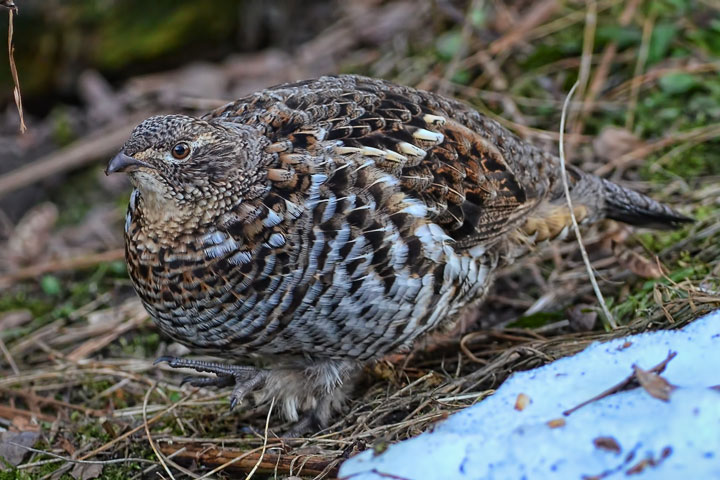
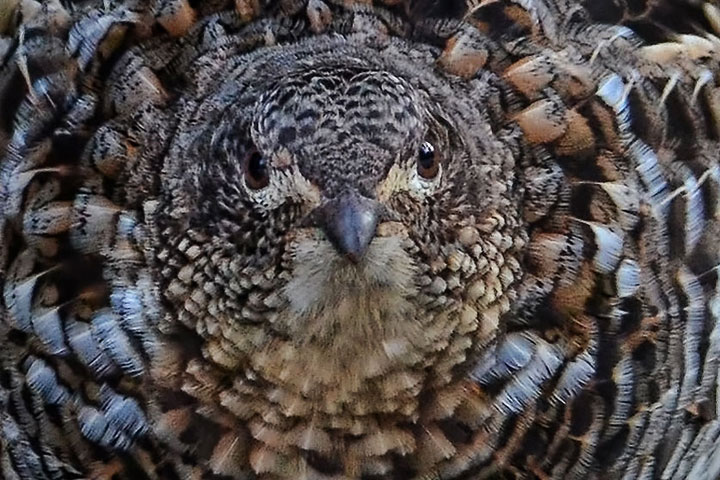
This same grouse has appeared in this blog before as Perfect camouflage. There is also a page on the Kootenay Lake website about local grouse.

I think I have a grouse in residence. I have seen a Ruffed Grouse beside my driveway, in my yard, and even in my trees quite a few times over the last few years and increasingly in the last few months. I am told that an individual grouse needs a space of only a few hectares—it seems that part of this one’s range includes my yard. Well, superb.

Below are two pictures of it this evening. It seemed to ignore (or possibly merely tolerate) me. It wandered around in front of me and even stopped to forage as I clicked away.

Posted in birds | 3 Comments

Grab bag

Herein lies a grab bag of images from this last week: squirrel, robin, eagles, crow, widgeon, nuthatch, mallard, skunk cabbage.

Posted in birds, mammals, wildflowers | 3 Comments