Rufous morph

The Kootenay Lake website offers more pictures of local Red-tailed Hawks.

Spring brings the Red–tailed Hawk to Kootenay Lake. It sits high in trees and intently watches the nearby ground for delectables—especially delectables of the vole persuasion.

At first, this posting guessed the hawk to be a dark morph. Two knowledgeable birders (Rick Howie, Doug Brown) suggested that it is actually a rufous morph, so the page was amended.

The Red–tailed Hawk is a tremendously variable looking bird. It comes in differently coloured morphs: the fairly common light morph, the rufous (intermediate) morph, the less common dark morph. Over a week ago, I saw a light morph and showed it under the posting Killdeer, Hawk. However, today on the North Shore I saw the rufous morph. Compare this bird’s breast with that of the earlier posting. Below is a picture of it in a tree and another of it flying.

Then, just for the fun of it, I included a picture of a Pied–billed Grebe seen soon afterwards at the Nelson waterfront.

And the Pied–billed Grebe.

Posted in birds | 2 Comments

Coyote hunting

At noon on Sunday, I watched a coyote hunting in a large field of snow. I saw it pounce, dig in the snow, and come up with something in its mouth (right). It is likely that it caught a vole. Voles run around under the snow gathering food, and the coyote would be able to listen for them and know where to dig.

I knew about this behaviour, but had never seen it before. I had been running an errand, but had allocated enough time to stop if I saw something interesting beside the road. This was it. This coyote clearly merited taking out a tripod and a longer lens. As I measured it later (using Google Earth), the distance to the animal was about 300 meters.

The Kootenay Lake website offers more pictures of local coyotes.

The sequence of pictures (below) shows the results. They are not superb, but the behaviour was fun to watch. The coyote first looked around (but, did not notice me); it listened intently to something under the snow; it pounced; it dug; it came up empty. I did not see it catch another vole, and eventually we each wandered away.


Posted in mammals | 3 Comments

PIMS’ wrecks

During the low water of March, I like to visit some local relics of the steam age. Some shipwrecks that are usually underwater become visible. Today, however, instead of visiting them physically (it is raining), I explored them virtually. I used PIMS.

PIMS stands for the Property Information and Mapping System of the RDCK (Regional District Central Kootenay). As the RDCK tells us: it offers “parcel, zoning, ALR, floodplain, house numbering, and other data layers. Users can also access zoning bylaws and functions to measure distances, calculate areas and print custom pdf maps.” Clearly, PIMS wasn’t created to explore local history. Yet, it offers a snapshot of the region, and some of that snapshot is distinctly historical. So, let’s see what it presents in the way of ship wrecks on Kootenay Lake—well, the high–resolution LIDAR images are only available for the West Arm, so that is what I explored.

A bit more information on the first two of these wrecks is found at Low Water on the Kootenay-Lake Website.

PIMS gives two clear images of wrecks from the steam age: the S.S. Kuskanook (at Kokanee Landing) and the S.S. Hosmer (between Bealby and Horlick’s Points). These are in shallow water and are easy to see. It also shows one other wreck in somewhat deeper water: the 15–car Railway Transfer Barge (at the Nelson Bridge). There are other wrecks along the arm which are too deep to see with PIMS. And there are other wrecks on the Main Lake, which the LIDAR imaging does not cover.


The S.S. Kuskanook sits along the North Shore at Kokanee Landing just east of the Kokanee Park Marina (accessed by a path at about 5176 Kokanee Landing Road). During the low water of March it is almost all out of water.

To travel to it with PIMS go to:
Easting: 492142.934
Northing: 5495309.739


Here is a view of the Kuskanook as presented by PIMS.


The S.S. Hosmer (the largest steam tug on the Lake) sits on the South Shore in the shallows between Bealby and Horlick’s Points. The boiler always extends above the water, but during low water, more of the hull is visible.

To travel to it with PIMS go to:
Easting: 481439.981
Northing: 5485560.798


Here is a view of the Hosmer as presented by PIMS.

Update: in the original posting, I picked the wrong feature for the barge near the bridge. Lou Coletti pointed out that the barge is actually slightly farther upstream than the location I picked. Lou should know: he is not only a very knowledgable local historian, but he lives beside the RCMP station and the barge is partly on his waterfront. It is now correct.

The 15–car Railway Transfer Barge sits on the South Shore just upstream of the Nelson Bridge and just north of the RCMP station. I don’t have a surface picture showing it. I have looked, but never seen it in the stygian depths. Yet, it does appear in the PIMS imagery

To travel to it with PIMS go to:
Easting: 479762.586
Northing: 5484198.744

A word of caution: this is a modified version of the view presented by PIMS. It is a PIMS image that I have digitally enhanced to show the barge in the murk. At low water, a bit of the barge is exposed.  In this picture, it is the object which is circled in the upper right. The Nelson bridge is in the lower left, and the RCMP station is in the lower right.

Note: There are other historical features that I have seen with PIMS; they might make another interesting posting or two.

If you spot something historical with PIMS, tell me about it.
Posted in history | 3 Comments

One stick at a time

This morning, I saw two eagles sitting together in a tree—ah, it must be nesting time. But, before I could get my camera ready, one took flight and so made for even more interesting pictures.

The first picture of the eagle in the tree was actually taken yesterday (included here just to set the stage).

The Kootenay-Lake Website offers more pictures and discussions of local Bald Eagles.

The second picture shows the eagle as it flew out over the lake. To my surprise it lowered its legs. Usually, if an eagle is merely flying, the legs are tucked up. I guessed that it had spotted something delectable below and was about to dive on it. But no, it flew to another tree and grabbed a branch.

The third picture is a composite of two images showing it flying off with a branch. It almost certainly is building a nest somewhere in the vicinity.

It is slow work assembling a nest one stick at a time.

Posted in birds | 3 Comments

Urban junkies

City dwellers have long been familiar with animals which seem to prefer the urban life style. Pigeons (to the right) are the classic example; they are found almost exclusively in cities. Around the Lake, they are found in Nelson and Balfour, but not elsewhere along the more rural shoreline. (Kaslo has seen them occasionally, but they are hardly residents).

Of course, many wild animals move freely between the city and the country: raccoons, robins, crows, geese, white–tailed deer, barn swallows, and others. Yet, I had assumed that among birds, only the pigeon confined itself to an urban lifestyle.

But, I was wrong. There is also the House Sparrow. Although not really common around here, it is present. Strikingly, it is not only one of the commonest birds across the world, but it, like the pigeon, essentially confines itself to cities.

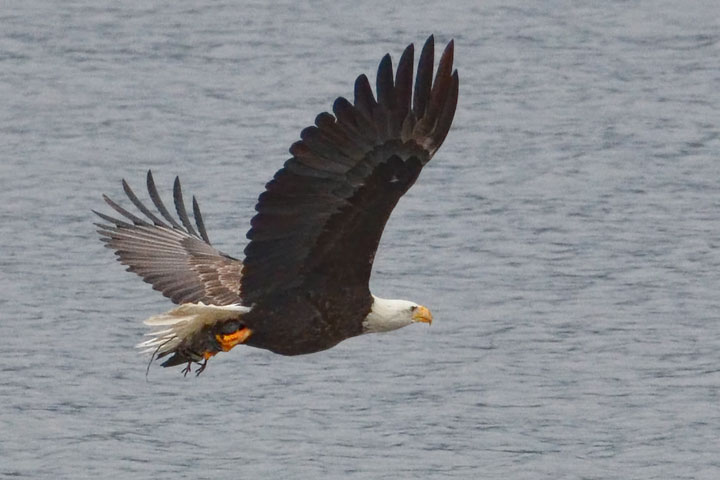
Below are two pictures taken earlier this week, both in Nelson: a male House Sparrow and a Rock Pigeon. And if you think that the second picture doesn’t show a pigeon, look more closely at the eagle’s claws. The eagle is taking the pigeon out for lunch (what a thoughtful eagle).

Posted in birds | 1 Comment

Killdeer, hawk

For the next month or so, new birds arrive weekly. Monday’s observations were of a Killdeer couple (first two pictures) and a Red–tailed Hawk (second two pictures).

The Kootenay Lake website has one page devoted to the Killdeer and another to the Red-tailed Hawk.

Normally there is little in the plumage to distinguish the male and female Killdeer, but the first picture shows a somewhat plumper bird. Could it be pregnant? The second Killdeer seems to have grown a third leg (snicker).

I have a favourite spot to watch for Red–tailed Hawks in the spring. The row of trees still lacks leaves, and the hawk can sit there and watch for voles on a south facing bank upon which the snow melts earlier than elsewhere. The first picture merely shows the hawk in one of the trees. The second picture is a composite of two shots (taken less than a second apart) of it landing in another tree. That the Red–tailed Hawk is well named is clear.

Posted in birds | Comments Off on Killdeer, hawk

In flight


I went looking for the Sharp–shinned Hawk again (the one I had misidentified two days ago as a Merlin). Alas, I did not find it.

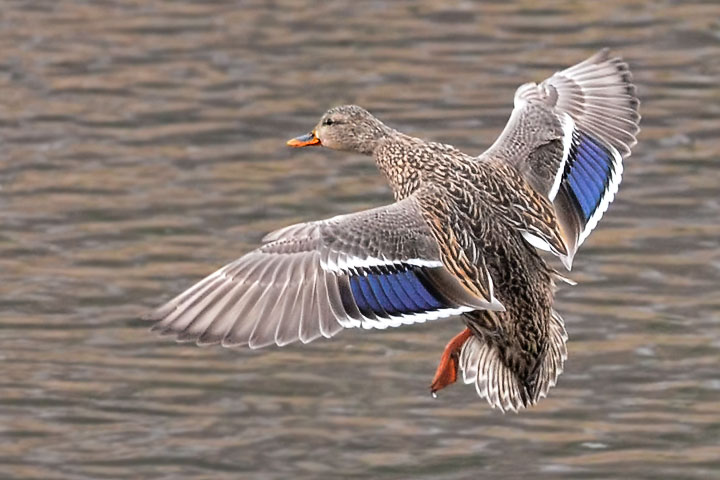
But, a couple of other birds did fly by: a female Mallard and a adult Bald Eagle. The Mallard offered a lovely display of its speculum. The eagle was packing lunch: a pigeon. Oh yes, note that the Mallard is deploying its alulae.

Posted in birds | 1 Comment

Potpourri

Today, it neither snowed nor rained, so I headed out. Apparently some birds also decided that it was a good day to explore the world. I saw many, but show only the four I photographed: a (red–shafted) Northern Flicker (female); a Sharp–shinned Hawk; a Gadwall (male); and a (sub–adult) Bald Eagle. The stories accompany each picture.

The Northern Flicker is a fairly common local woodpecker. In the East, the undersides of the wing and tail feathers are bright yellow; in the West they are red—or so the books tell us. Yet, it is not always easy to see. Here is a female Norther Flicker prominently showing off the red shafts on her tail and wings.

Each spring I watch for Merlins and had mistakenly thought I had spotted one. But, Michael McMann has pointed out that this bird is actually a Sharp–shinned Hawk. My first.

I have never noticed a Gadwall before. But, a friend observed one along the Nelson waterfront, so I had to see it for myself. This one is a male.

A grand drama was the interplay between a dozen Mallards and a (sub-adult) Bald Eagle. The Mallards were quietly dabbling when suddenly they took to the air. Who can blame them for not wanting to be sitting ducks when this predator started circling overhead? The Bald Eagle has not yet attained its adult plumage. By using the diagrams in an article by Mark A. McCollough, it appears that this eagle is two–and–a–half–years old, so it would have hatched in the summer of 2008.

Posted in birds | 5 Comments

Yearning


OK, you have my permission to move on to the next season anytime now.

Posted in birds, weather | 1 Comment

Kingfisher landing

[It] is like a dog’s walking on his hinder legs. It is not
done well; but you are surprised to find it done at all.
Samuel Johnson, 1771

Which is more or less how I felt about my sequence, below, showing a kingfisher landing on a piling: it is not that the picture is done well, but you are surprised to see it done at all.

Pictures of the this bird sitting still and fishing are found at kingfishers on the Kootenay Lake website.

Here is the problem: I see a Belted Kingfisher only every few months, and then only for a few minutes. The bird quickly decides that the local fishing is inadequate and it moves away. So, if capturing a scene of it sitting is iffy (see the link in the box), recording its arrival is more of a trick—especially for a hand-held shot of a small bird some 80 metres distant.

The spacing between images decreases as the bird climbs toward the top of the piling. It is decelerating by using gravity to bring itself to a stop at just the right point. Incidentally, the white flecks in the picture are from a light snowfall.

Posted in birds | Comments Off on Kingfisher landing