Flickers tend chicks


Flickers are now tending chicks in their cavity nests.

When bringing food to its chicks, a flicker usually does not fly directly to the cavity where the chicks are. Rather it flies to some adjacent point and looks around for those who might be tracking its movements. It may not look as if this female is bringing food to its chicks, but the food it has collected is stored in its esophagus. 

A flicker feeds its chicks by inserting its bill down the chick’s gape and regurgitating its food. 

From the look of debris left on the parent’s bill, it was a meal of ant’s eggs, a flicker favourite.

Food is brought in; garbage is taken out. A male flicker flies off with a faecal sac.

Posted in birds | 6 Comments

Heron’s nest


Spotting a heron in its nest is not easy. The nests are uncommon, high in a tree, and generally hidden by the rest of the canopy. A chance opening in the foliage sometimes offers a peek. Rick Greene told me where to look.

A number of herons were flying in and out of this portion of the forest, so there are probably more nests, but only one could be seen from the distant ground.


Posted in birds | 3 Comments

Swallow’s saga


Tree Swallows often nest in the cavities that Northern Flickers have carved in the pilings of docks.

A person commits an offence if the person … possesses, takes, injures, molests or destroys a bird or its egg.     BC Wildlife Act.

But in mid-June, one of those pilings had rotted at the waterline. It then broke in two, and its upper portion began to cant dangerously. The broken portion was only stopped mid-descent by the stirrup that loosely held it to the dock.

However, the Lake was going down. It wouldn’t be long before the dock and its stirrup would drop below the broken piece causing the piling top to fall into the water and drift off. This would be bad on two counts:
    • a broken piling floating among boat traffic poses a danger;
    • the piling’s active nest of Tree Swallows would be destroyed.

Clearly, the broken piling had to be removed before it fell into the water. But, how was this to be done in the light of an active bird’s nest? Moving the nest and disturbing those birds would violate the wildlife act. And if it were moved, would the swallows accept the new location and continue incubating their eggs? Even if the swallows were to accept the new location, would the eggs have survived the double whammy of the break of the piling, and its subsequent move?

This was tricky. Three pictures tell the story. 

A piling had rotted at the waterline, and two-and-a-half weeks ago, a storm had caused it to break. The portion above the waterline tipped but was held precariously by the stirrup loosely adhering it to the dock. As the water level was dropping, this momentary reprieve would soon end causing the piling to fall into the Lake and to drown the nest. A swallow can be seen looking out of the cavity.

A couple of days after the break, the top of the piling was cut off well below the cavity but above the waterline. It was then set on the dock at about the same sloping angle, and loosely attached to the adjacent piling with a collar which allowed it move down as the water level dropped. During the hour and a half it took to do all this, the Tree Swallows agitatedly flew in circles around the operation. However, the following morning, when this picture was taken, the swallows had accepted the new location and were again tending the nest. This part was a success, but did the eggs survived the break and the move? There was nothing to do but wait.

Two-and-a-half weeks went by. Even though the adults continued to occupy the cavity, there was no way to know if the eggs had actually survived. We would have to wait to see if chicks poked their heads out — or that was the thinking until unexpectedly the swallows offered early irrefutable evidence that at least one chick was doing well: a faecal sac. The picture shows the female flying towards the cavity while the male removes the poop from one of the chicks. It will be fun to see chicks when they emerge, but, for now, everything is looking good.

In the time that has passed since the piling broke, the Lake level has, indeed, dropped. Had nothing been done, the piling would have fallen, drifted off, and drowned the nest. Maybe the offence of briefly molesting these nesting birds can be forgiven.


Posted in birds, commentary | 10 Comments

Wild Turkey chicks


This is the season of chicks.

Wild Turkey adults are large and highly visible; their chicks are small and inconspicuous.

Mommy and three of her chicks forage in the grass.

While Wild Turkey adults look almost comical, chicks can look surprisingly noble.


Posted in birds | 3 Comments

Species diversity


A year ago on Canada Day, I posted a collection of my favourite images from the previous decade, and said: “My two-dozen mute portraits offer peeks into the charm and beauty of life in Canada.” Commenting on it, Carlo said that it offered a “somewhat different view of our ‘population diversity’ than what is usually presented.” I liked that.

So, on a day when most people choose to celebrate themselves, I will celebrate a broader diversity with a collection of my favourite images recorded since last year’s July 1st. Some are permanent residents and some are migrants. (Note: No migrant was apprehended, harmed, or separated during these encounters.) 

A Black Bear cub catches its first Kokanee salmon in a local creek.

A Northern Flicker chick welcomes its mummy bringing food. 

A Mountain Bluebird dons a tutu.

A Grizzly Bear sow and her cub graze in a field.

A Golden Eagle scours the valley bottom for comestibles.

Snowshoe Hares were plentiful this last year.

A Great Blue Heron flies overhead.

Looking out from treeline talus, a Hoary Marmot guards his domain.

A Hooded Merganser swallows a sucker whole.

A Mallard demonstrates walking on water.

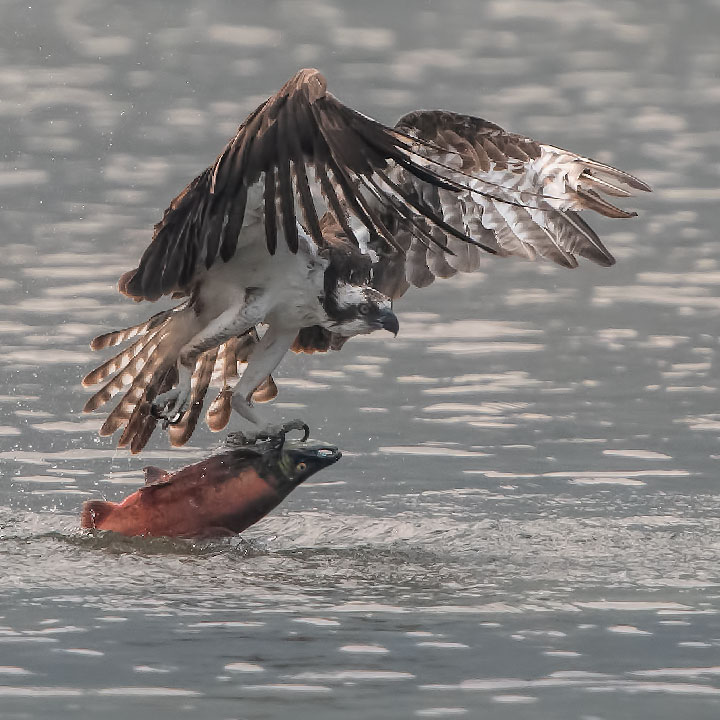
An Osprey flies by with a headless fish.

The Mule Deer is the only local animal that stots.

Two River Otters claim a dock as now belonging to them.

A Pika cries “eep”.

Common Redpolls scrounge seeds in the midwinter.

A male Ruffed Grouse is in full display.

A Red-winged Blackbird announces springtime.

This Wood Duck is confident that it is superior to all the rest of us.


Posted in birds, commentary, mammals | 15 Comments

June goulash


This a collection of June images, none of which has had a posting of its own.

A female Common Yellowthroat watches for insects to eat.
A male Common Yellowthroat has managed to catch a bug to eat.

Two Yellow-bellied Marmots enjoy a friendly tussle.

A female Goldeneye rises from out of the water.

An osprey and her chick look out of a massive nest.

A Pacific-slope Flycatcher incubates her eggs in a tiny nest.

A female Black-headed Grosbeak hunts for insects — she was a grand sight.

A White-tailed buck, with starter antlers, hunts for comestibles in a field.

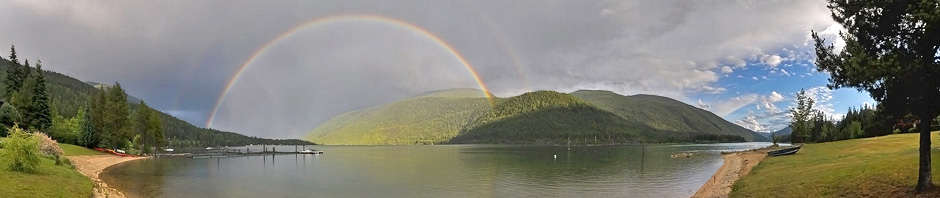
Finally, a panorama from the side of Morning Mountain. On the right is Nelson, the West Arm of Kootenay Lake, and beyond them, the snow-covered mountains of Kokanee Glacier Provincial Park. In the centre is Grohman Creek and (on the ridge) the Baldface Ski Resort. The mountains of Valhalla Provincial Park are on the far left.
Move the cursor to (mobile: tap image at) various places across the frame to see it all.
[photonav url=’https://blog.kootenay-lake.ca/wp-content/uploads/2018/06/morningMtPano180617p.jpg’ container_height=720 container_width=720 mode=move position=left]


Posted in birds, mammals, scenes | 1 Comment

Fat and yellow


As far as I can tell, the daisy is the favourite local hunting ground of crab spiders (Misumena vatia), so when the daisies bloom, I scan them for spiders.

The crab spider is a chameleon: it can change colour so as to match its background, and so be unnoticed by the pollinators it would capture and eat. It has two colours: white is its base colour, but by secreting a yellow pigment into the outer cellular layer of the body, it can turn yellow. 

A white and yellow flower, such as a daisy, is thus ideal. When it hunts from the petals, it is white; when it hunts from the floral disc (centre), it is yellow. Yet, I have almost always seen it white and hunting from the petals — only rarely is it yellow and hunting from the disc. The spider has a distinct bias toward white. 

A white crab spider hunts from the petals of a daisy (2013).

Is this because there is a greater area of petals, or perhaps because it hunts from the sidelines when pollinators head for the floral disc? Possibly both, but there is another possibility: it is not easy to turn yellow. It takes the spider about 6 days to change from yellow to white, but from 10 to 25 days to turn from white to yellow. Producing and infusing its skin with the yellow pigment seems to be hard work. Maybe the crab spider would just rather not put in the effort.

Now, if you start searching daisies for crab spiders, you will probably find that you have to check a few hundred before spotting one — and that spider will be white. I don’t know what the incidence of yellow crab spiders on daisies is, but it is perhaps only one in a few thousand. However, once you find a crab spider on a flower, you can return day after day, and it will still be there.

In a somewhat uncommon sight, a rather fat and yellow, female, crab spider hunts from a daisy. She clearly has been gorging on pollinators. Given her stance, she looks almost as if she is prepared to defend her daisy from the photographer.


Posted in bugs | 4 Comments

Problem hawk


Sometimes I just don’t know what it is I am looking at. 

Consider this hawk seen this morning: what is it?

Suggestions are welcome.


Posted in birds | 5 Comments

Dew, not dew


The web of an orb-weaving spider covered in matutinal drops of water is undoubtedly beautiful. But, is the web really covered in dew — as is claimed by a myriad of photo sites? Alas, this is something for which reason is unlikely to overcome glibness. After all, what could be more obvious: of course those droplets are dew — right?

Dew is not a generic name for water drops that appear early in the day. Actually, a number of processes can cause such drops: along with dew are drizzle, rain, guttation, and the collection of fog drops. 

Dew results from temperature differences that increase with object size
When an object has a temperature lower than the dew-point temperature of the surrounding air, dew will form on it. A net loss of infrared radiation to the sky will drop an object’s temperature, but thermal conduction from the surrounding warmer air will counteract this. For a tiny object (a spider’s thread), conduction keeps the object at the same temperature as the air, and dew won’t form. For a larger object (a flower) the radiation loss will probably win, and dew will form.

Collection of fog drops is greatest with tiny objects
Yet, droplets sometimes appear on a spider’s web. As they don’t result from dew, how do they form? This is a question of how air flows around and past objects. A small object (spider’s thread) does not deviate airflow significantly, so drifting fog droplets just collide with, and are collected by, the object. A larger object (daisy) causes the air to flow around it, and this carries fog droplets around and past it, so their intersection is minimal.

Dew has formed on the sky-facing petals of this daisy. Net infrared radiation loss caused the petals to cool and dew to form. The flower is large enough to be able to sustain a temperature difference between itself and the surrounding air, so dew can form. (The daisy’s stem was protected by the flower from such radiation losses to the sky and so shows no dew.)

It is tempting to think that the same process of dew formation would have caused the formation of droplets on the spider’s web. Yet, the spider threads are so fine that thermal conduction guarantees that they will have the same temperature as the air. So, dew cannot form here. Yet, the tiny threads of the web intersect some of the drops of a steam fog drifting past. (A larger object would merely cause the airflow to be deviated and the drops to flow around them.) The result is that small objects (such as spider threads) intersect passing fog drops, but haven’t sustained the temperature difference that results in dew. Larger objects (such as the daisy) have a dew-producing temperature difference, but don’t intersect fog drops.

Once, while mentioning this behavioural difference during a presentation, I was asked why the drops on the spider’s web were often uniform in size and spacing (as shown in this older picture), despite having resulted from random impacts of fog droplets. I didn’t know the answer. But it turns out that it has to do with regularly spaced sticky balls of glue the spider attaches to the spiral threads so as to trap flying insects. These glue drops absorb the collected water drops and swell producing the both the regularity and the difference between the drops on the spiral and radial threads.


Posted in bugs, weather, wildflowers | 7 Comments

Amplexus consequences


One month after taking pictures of Western Toads in amplexus, I returned to the same shoreline. The consequence of the earlier activity was impressive: thousands of tadpoles.


Posted in herptiles | 2 Comments