There is no love lost between ospreys and eagles, so when one encounters a scene of mutual animosity, it isn’t always clear what was the immediate cause of the confrontation. Indeed, the first sighting was confusing for it looked as if two ospreys were harassing a disabled eagle. Maybe the eagle had broken a wing and the ospreys just chose to taunt it.
The emerging story proved far different: the eagle had stolen a fish from the ospreys, and they were desperately trying to get it back.
Ospreys and eagles have somewhat different capabilities. Ospreys are superb fishers and are able to dive into the water to a depth of about a metre, catch a fish, emerge and fly off with it. As such, they can capture fish over a greater range of depths than can an eagle, which merely sweeps its claws below the water surface as it flies by. However, the eagle is a much larger bird and will often supplement its own food supply by bullying an osprey into dropping its catch so as to steal it. Needless to say, ospreys react rather badly to such treatment. And that reaction is what I encountered. (What the fish thinks about all of this remains undocumented.)
When spotted, it looked as if two ospreys were harassing an eagle that couldn’t fly. Actually, it could easily fly, but had chosen a defensible position on a breakwater with its back to some pilings. The eagle would tuck the fish out of reach between logs, and the pilings prevented an attack from the rear.

The two ospreys made repeated threatening passes, and the eagle always responded defensively while continuing to clutch its prize with one claw.

In my favourite view of the drama, the eagle has secured the fish in a gap between logs and then rears up to defend itself as an osprey screams past with claws extended. Ultimately, the ospreys failed to breach the eagle’s defences and left the eagle alone to feast.





Forster’s Tern
A scan of topics treated here reveals an interest in the overlooked ordinary.
Today’s posting about Forster’s Tern does not fit this pattern. Not only is this bird found at only one location around Kootenay Lake, but it is the only place in British Columbia where the bird is known to breed. Not surprisingly, it is red listed, meaning, in danger of extirpation.
Terns are somewhat like gulls, but are more slender, have longer bills, and narrower wings. They also have forked tails, but perhaps a more important distinction is their hunting style. Like an osprey, but unlike a gull, they plunge dive into the water to capture a fish — albeit a somewhat smaller fish than those favoured by an osprey.
A Forster’s Tern was hunting over the wetlands south of the Main Lake.

Not every dive into the water resulted in a catch. Here the tern lifts off without a fish.
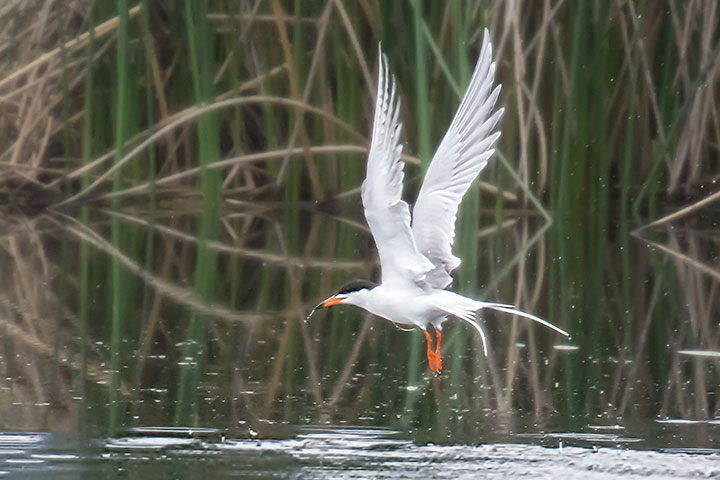
However, after another plunge into the water, it flew off with a meal.

My favourite view shows it rising from the water with its wings and tail spread.
