This is the season to see marmot babies freshly emerged from the den. These are the pups.
This is an adult Yellow-bellied Marmot.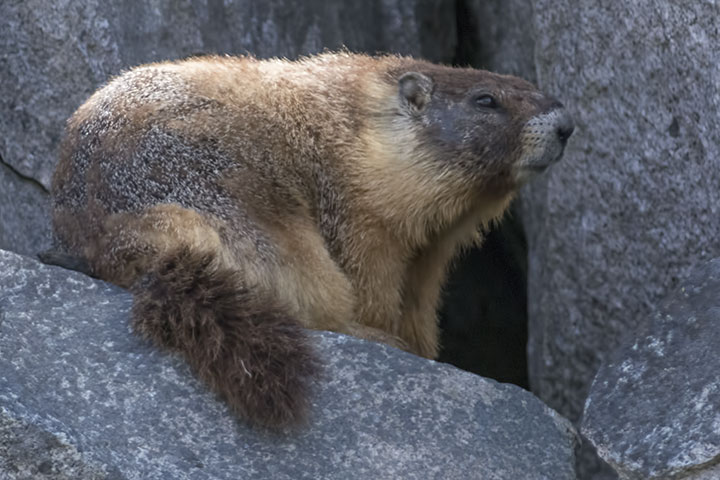
An adult and pup watch the world.
A pup looks around.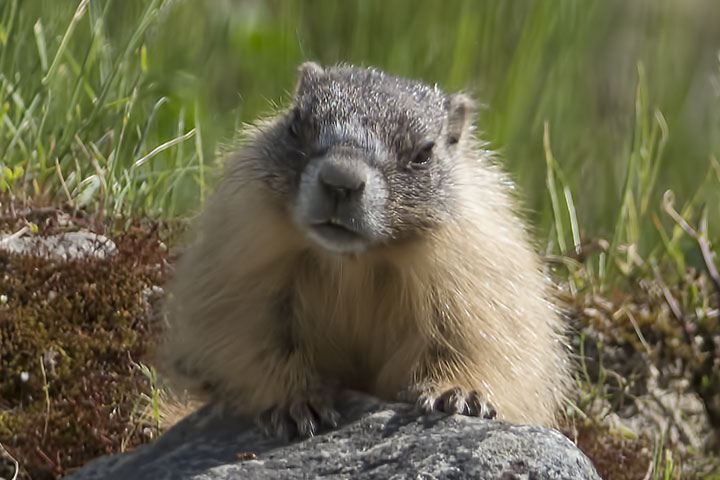
This is the season to see marmot babies freshly emerged from the den. These are the pups.
This is an adult Yellow-bellied Marmot.
An adult and pup watch the world.
A pup looks around.
You just cannot tell by the appearance of some animals, certainly not by that of some birds. As far as I know, there are only a few ways to tell the sex of a Bank Swallow at a distance: song (male), behaviour (burrow digging and mating), and who has a swollen cloacal protuberance (males during breeding season).
The male Bank Swallow often attempts to mate with fertile females other than its mate. That is probably what is happening here, where the sexes of the birds are worked out by looking at a sequence of pictures.
A male Bank Swallow approaches a female waiting invitingly.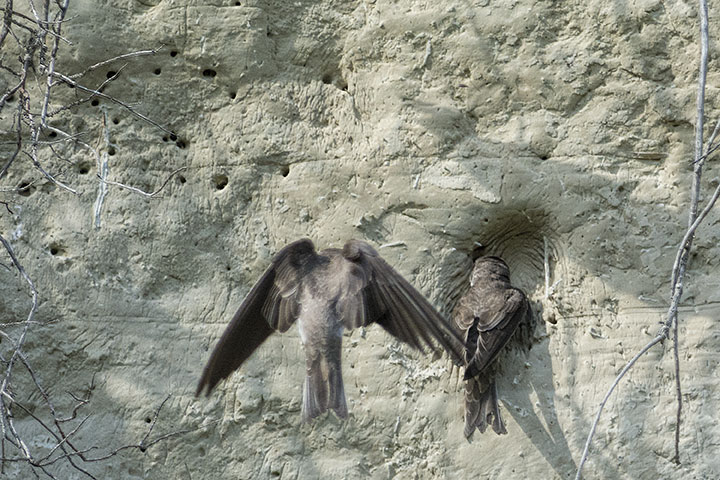
He is about to alight,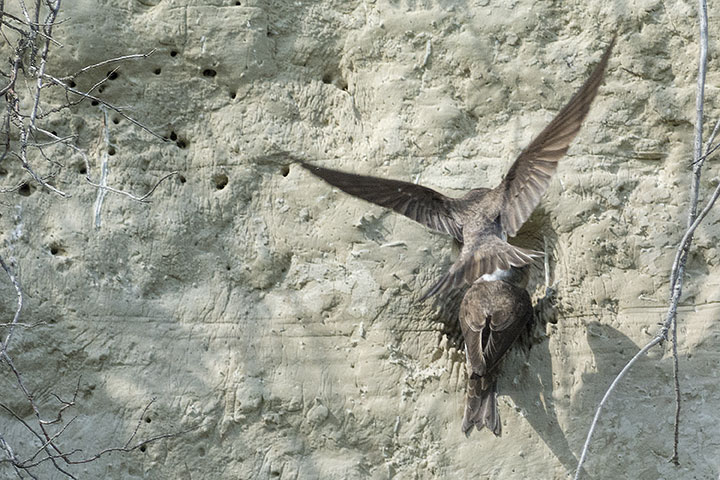
when a rival spots the assignation and drives off the intruder.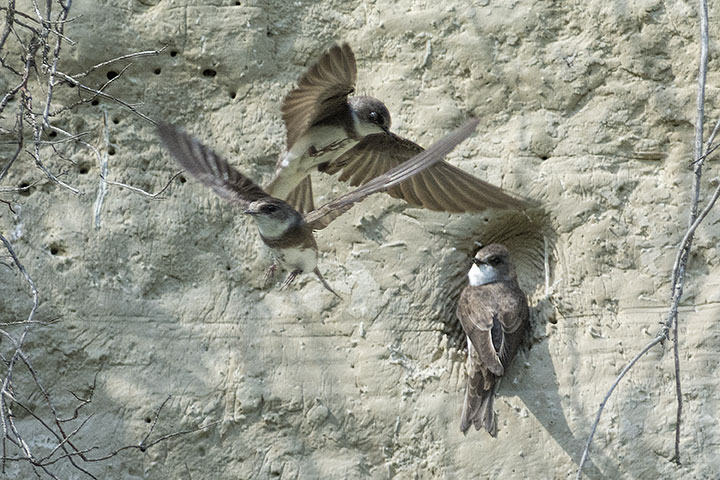
After a short time, the first male returns,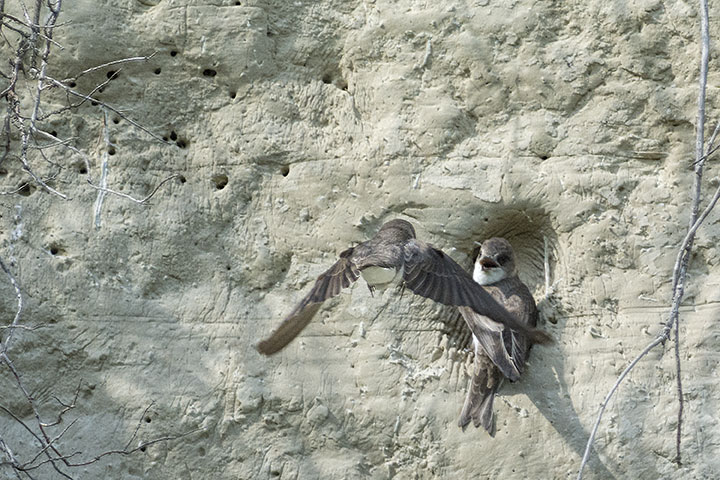
only to be driven off again. This time, his swollen cloacal protuberance confirms his intentions.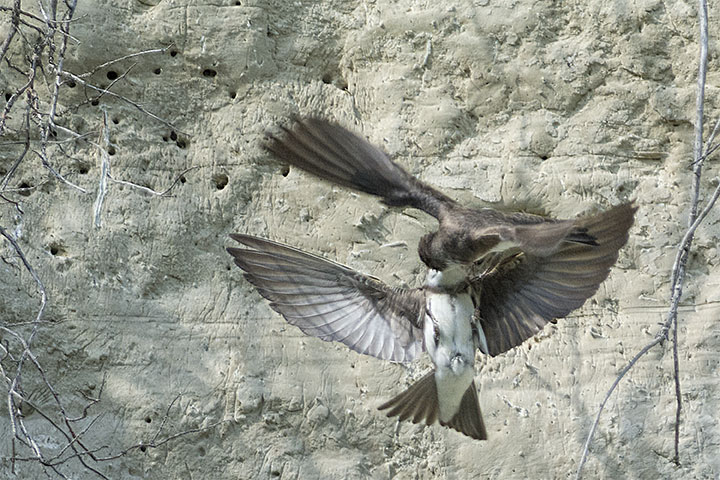
Out of here. 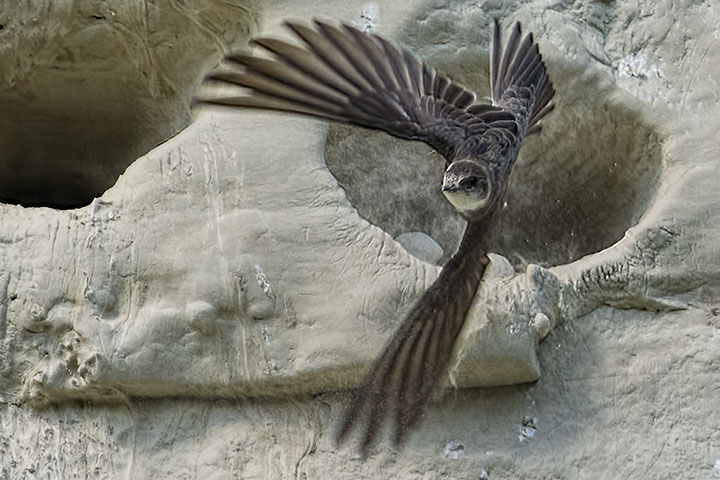
Saturday’s sunrise found me watching an otter sleeping on a local dock.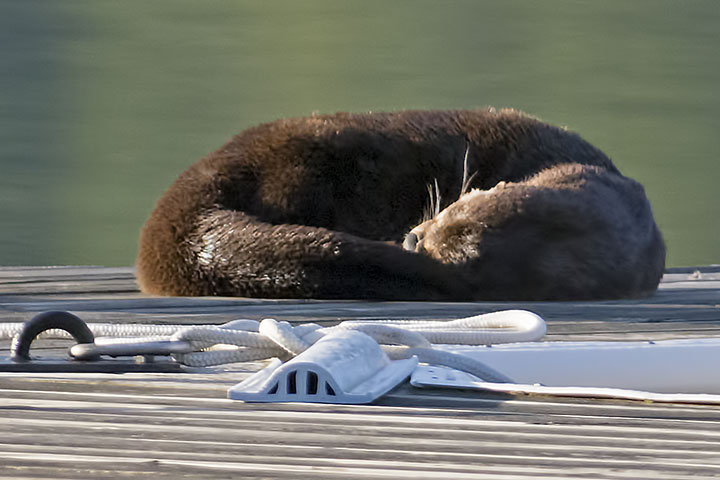
Otters are short-sighted and I maintained a discreet distance, but an inadvertent noise woke it.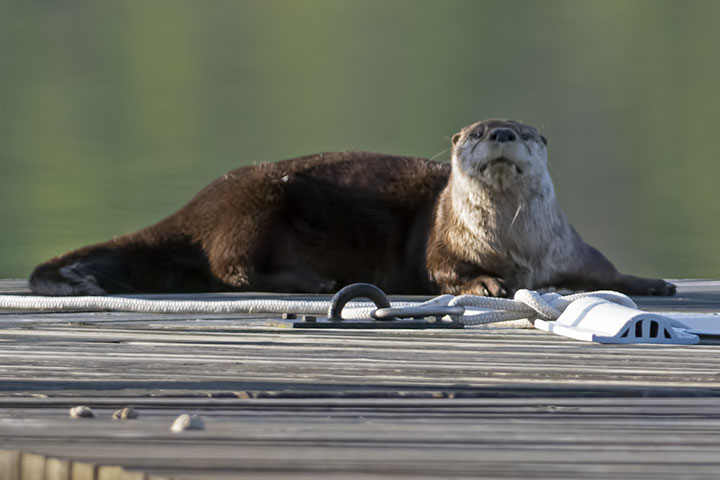
It did not seem to spot me and so set about sniffing to see if any other otters had claimed this territory.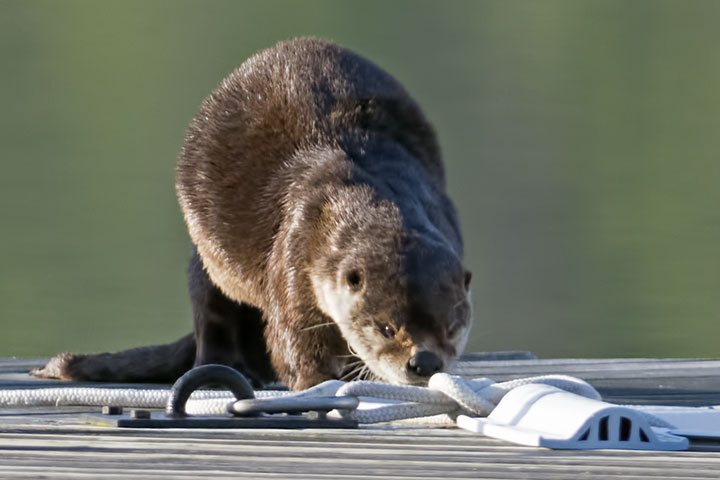
The otter then claimed the dock as its own by marking it with scent.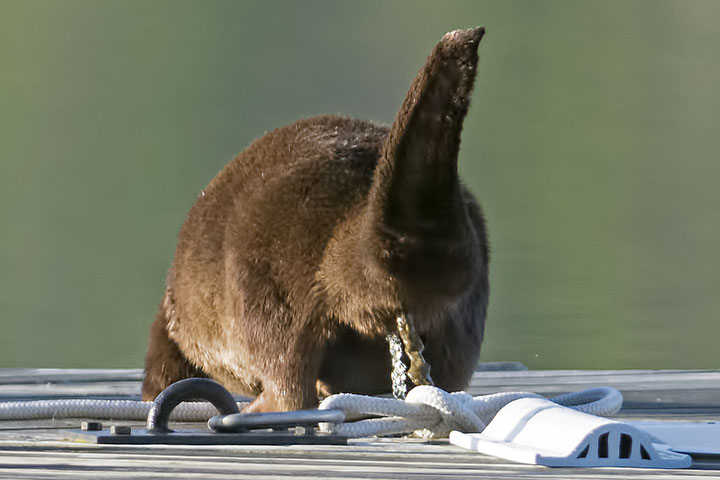
Satisfied that others would now recognize this territory as occupied, it walked to the edge of the dock. Normally, such a side view shows a flat, not bulging, abdomen. This otter is pregnant; it is the season.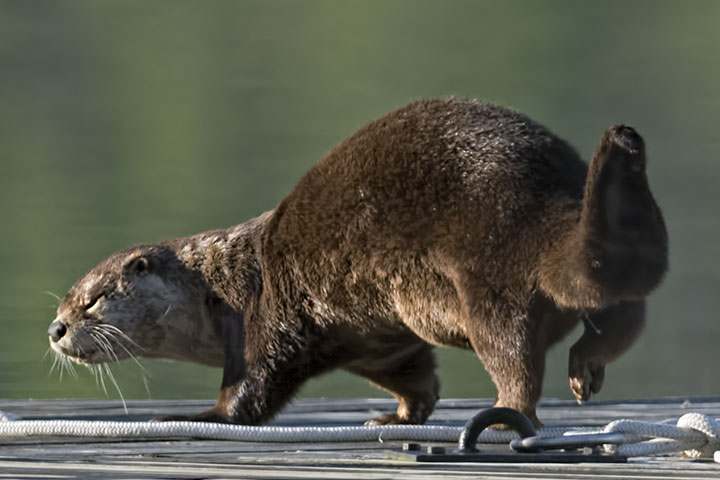
Once in the Lake, it headed off, presumably to catch breakfast.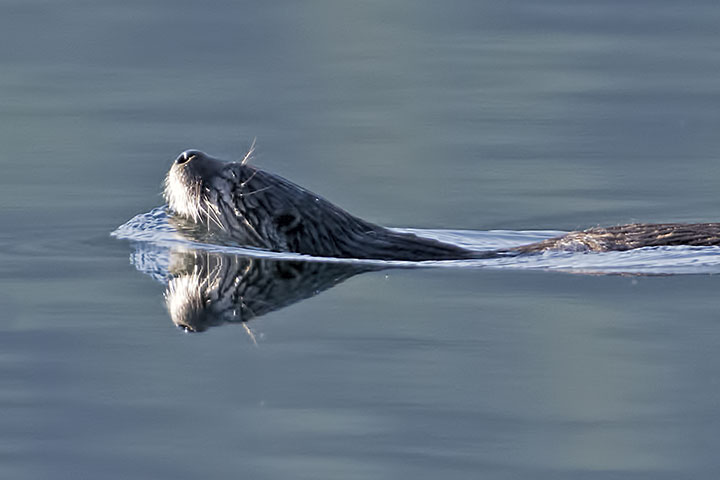
Sometimes a posting has the sole objective of catching one’s breath at the end of the month.
The Lazuli Bunting is a small songbird that comes to this region to breed.
A composite of a single Bullock’s Oriel landing in a tree branch.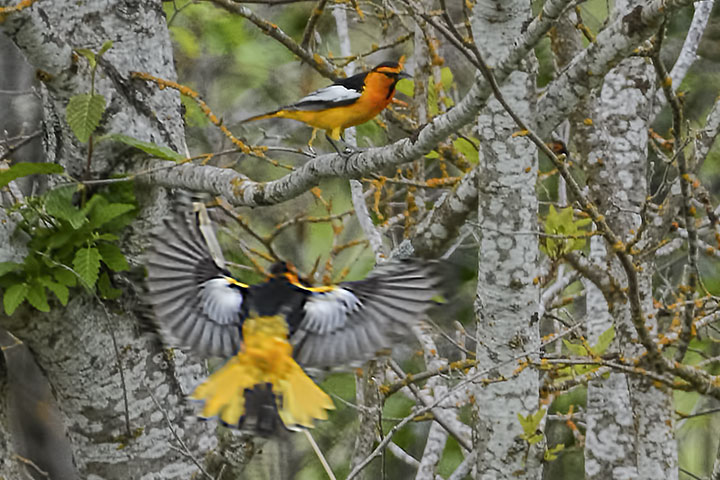
A Common Loon wanders past.
Two male mule deer stare at the suspected intruder.
A Tree Swallow pauses in its search for insects.
This Yellow Warbler perched here only for a moment.
An Eastern Kingbird searches for insects from its perch.
Mommy merganser rallies the troops.
If you cannot see the Red-necked Grebe nesting in the reeds, then maybe she doesn’t want you to.
One female and three male Harlequin Ducks, a female merganser and a dipper share the stream.
A Green Comma sips nectar.
A week ago, Doug Thorburn sent me some pictures of another grizzly bear he encountered in his wanderings in the mountains south of Nelson. There were many fine shots out of which I chose two. Alas, I did not get around to posting them until today.
This side view reveals five distinguishing characteristics of a grizzly bear: prominent shoulder hump, concave face profile, small rounded ears, long claws on the front feet, and legs that are frequently darker than the body.
Ok, slowly backing away.
Doug Thorburn’s images are used with permission.
A slough in a farmer’s field at the south end of Kootenay Lake has an uncanny hold on local bird watchers. An almost preternatural range of uncommon birds visit this isolated patch of water on a regular basis while largely ignoring the surrounding region. What is the attraction of this singular spot?
I have visited the pond a number of times—everyone has—but had previously not thought to ask others: why here? By rooting around through the bird and farming literature, I have produced a speculative answer: a high pH. The insight came when I discovered that two of the visitors seen last Sunday favoured alkaline ponds. From there, I learned that farmer’s ponds are often alkaline. It seems that such ponds, by being unfavourable for fish, typically offer an abundance of tasty crustaceans to birds. In short, these birds have discovered a reliable food source.
Is this why such birds favour this particular pond? It would take a better chemist and ornithologist than I am to properly answer this, but it is a plausible guess. Below are two of a number of somewhat uncommon waders visiting the slough last Sunday.
Unfortunately for birders, but fortunately for birds, the fenced field places the pond far from the road. A minor consequence is that pictures are, alas, somewhat soft.
The pond held teals and shovelers as well as waders, but only the later are treated. These are Wilson’s Phalaropes. The ones in the back are female, the three in the foreground are male.
A male phalarope sits between two females. The duck on the far right is a male shoveler. 
An American Avocet probes the pond for something to eat,
while another peers over the edge of an embankment.
Yesterday morning, I saw an example of polymorphism high in the south Selkirk Mountains. It took the form of different colour morphs within a family of Black Bears.
Colour morphs (also called phases or forms) are found in a number of species. Among Black Bears the colours can range through black, chocolate, cinnamon, cream and white. Furthermore, these various colours can be found within a single family.
One colour morph in British Columbia, the white to creamy Black Bear, is so famous that it has been given the designation, spirit bear. Although found throughout the Province, the proportion of these light morphs varies geographically and is highest along the north coast where it reaches about 10% among the kermode subspecies.
The takeaway message is that while the spirit bear is a visually interesting colour morph of the Black Bear, it is not a subspecies (as many sources claim); rather it is a colour morph found in various subspecies. It is also not a synonym for kermode; it is found everywhere, including here.
Did I see a spirit bear on Sunday morning? Possibly, but its colour seems somewhere between cinnamon and cream.
The first thing spotted was a large chocolate sow. She appeared to be foraging on the bulbs of glacier lilies. What may be her den is in the rocks just above.
Slightly to the east and higher on the mountainside, was a light colour morph cub also enjoying glacier lilies. At first, I thought the dark region in the lower left was the shadow of a rock; no, it is a black colour morph cub.
And below these two was a third colour morph cub. The chocolate sow has three cubs each with a different colour morph: cream, black, and chocolate.
Advection fog is the name given to the fogs that form, usually in the summer, when warm moist air from the land flows offshore (is advected) over a much colder ocean. Simple books will claim that it is merely the cooling of the air that produces the fog. Curiously, this is not true. It is also not true that such fogs are confined to oceans. The one that formed last night was on a lake.
Condensation can result from two distinctly different processes: either the cooling of water vapour, or the mixing of two parcels of vapour with different temperatures and moisture content. The latter process does not involve a net cooling, because at the end of the mixing, the average temperature remains unchanged.
Familiar examples of condensation produced by vapour cooling are found in cumulus clouds, wave clouds and dew. Familiar examples of condensation produced by mixing are seeing one’s breath on a cold day, and the steam fog often seen in the fall when cold air (and so cold vapour) flows over a still warm lake. The colder vapour mixes with that warmed by the lake and the fog appears in the form of tiny convective towers because it is warmed from below (e.g., steam fog).
An advection fog forms in much the same way as steam fog, but upside down. Now the lake is cold and is overlain with warm vapour. Vapour mixing, not cooling produces the fog.
It is spring and the Lake is still cold from the winter. A few warm days were followed by rain which moistened the air at the surface. The layer of fog seen at the water surface is an advection fog caused when the warmer vapour from above mixes with the colder vapour just above the water. It forms a stable layer because, unlike the (convective) steam fog, the layer is cold below and warm above. However, on the side of the mountain, wisps of steam fog rise off the warm, moist trees. Both fogs were formed by vapour mixing, but look different owing to one being convective and the other stable. 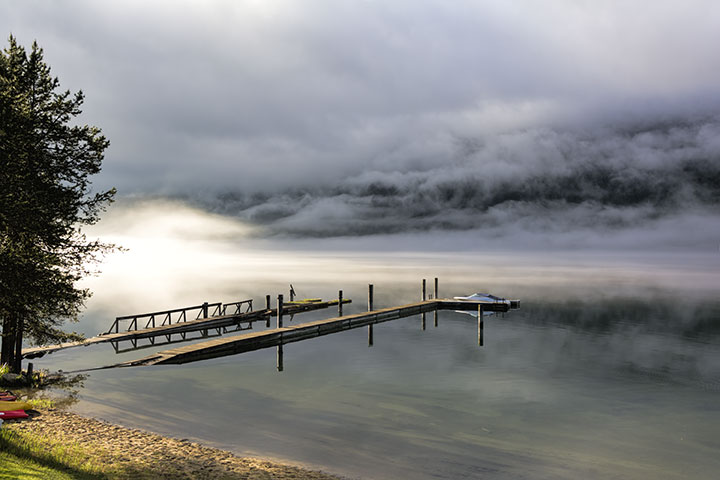
Why is that wasp eating my deck furniture?
Wasps gather wood fibre from dead wood and mix it with saliva to use as a nest-building material. The wood may come from trees or plant stems, but also from a human’s outdoor furniture.
A European Paper Wasp (Polistes dominula) chews wood of a weathered deck chair and will use it to build its nest.
Four days ago, I spotted a rather large Rainbow Trout which had washed ashore. I wasn’t the only one who noticed it. Over the next few days, it was scavenged by a crow, a raven, a sub-adult Bald Eagle and an adult Bald Eagle. Whenever the carcass was contested, the adult bald won. But, when it wasn’t around, others would sneak in and have lunch.
A crow was the first to start nibbling at the rainbow.
The sub-adult Bald Eagle eyed it hungrily from above, but was unable to snack while the adult was feasting.
Early this morning, the adult bald moved the fish a bit offshore to a floating log and finished it off.