Seen gronking


I have heard them; I have seen them; but, this was the first time I watched as a heron called.

The Great Blue Heron is usually quiet, but when it speaks it does so with a loud low-pitched GRONK—a sound that one might imagine emanating from a Pterodactyl, some hundred and fifty million years ago.

Almost touching the lakesurface, a juvenile heron opens its bill wide and emits a resounding gronk.

Posted in birds | 1 Comment

Baldfaced Lodge


Around here, if one uses the term, baldface, the assumed referent is the Baldface Lodge and ski resort high in the Selkirk Mountains just north of Nelson. Yet, this picture shows a baldfaced lodge and it certainly has the appearance of the folds and faults of a mountain landscape of metamorphic rock, but it is unrelated to skiing.

This is the lodging of the Baldfaced Hornet and it is located in my yard. The paper-like nest is made of chewed wood fibre mixed with saliva. The different coloured strata merely reflect different sources of wood. If they feel threatened, Baldfaced Hornets will aggressively defend their territory. Further, they can sting repeatedly. Justin Schmidt, an entomologist who offers a Sting Pain Index, colourfully describes its sting as: “Similar to getting your hand mashed in a revolving door.”

The nest, above, is not the only one in the vicinity. Nearby is this smaller one that looks as if it would fit right into a craft fair—minus its lodgers, of course. Incidentally, the Baldfaced Hornet is not the same species of wasp that has gained recent notoriety (see bountiful nuisance). That was the Western Yellowjacket and it nests in the ground.


Posted in bugs | 2 Comments

Bald Eagle, HY


With the recent emphasis I have given to Ospreys (It’s time you wentGrowing up Osprey, Bountiful nuisance, Osprey family), it is easy to forget the even larger raptor in our midst: the Bald Eagle.

Indeed, the Bald Eagle is the largest permanent resident in our local avian world. Other large birds pass through our region: the White Pelican is larger, the Trumpeter Swan is comparable in size. Certainly, such birds are fun to descry, but they are transients; the Bald Eagle is a permanent resident.

Many people are familiar with the adult Bald Eagle, with its distinctive white head and tail. Alas, they regularly imagine that the juvenile Bald is actually a Golden Eagle.

The bird flying overhead is a HY—birding gobbledegook for Hatch Year, that is a bird hatched earlier that summer. This is indeed a Bald Eagle—Golden Eagles don’t have white wing pits. This bird will take another four years before it will make the full transition to the adult’s plumage, with which most people are familiar.

Posted in birds | Comments Off on Bald Eagle, HY

Trouble with rainbows


The trouble with rainbows is, frankly, all that rain.

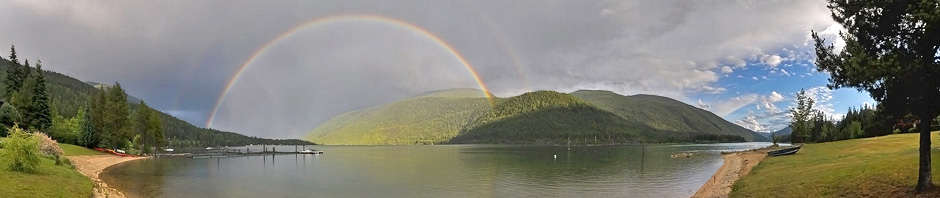
Within minutes of my camera begging me to take it out to see the rainbow, we both were soaked. I could not wipe its lens quickly enough to keep drops off. Further, I could not protect the lens with a cover as it would have eclipsed portions of this wide angle view. Ah well, the picture is what it is.
rainbow130903cs

As the shower moved up the Lake, raindrops on the lens no longer sullied the skyscape and my camera felt better about its decision to chase rainbows.

Posted in weather | 4 Comments

It’s time you went


Imagine the problem faced by osprey parents when it comes time to boot the chicks from the nest. Winter is coming; chicks must learn to fend for themselves; soon they must migrate thousands of kilometres on their own. Time is short—they must leave the nest. (These chicks will return as adults in a couple of years when they are ready to breed.)

Left to their own devices, osprey chicks would hang around and live off their parents for a few months longer, which is what they do do in tropical climes. Local parents cannot afford to let that happen: children must be persuaded to leave home.

Starvation is the main tactic. Enticement is another.

As the time for fledging approaches, parents decrease the number of fish being brought to the nest. Indeed, the chicks even begin to lose weight.

Parents now taunt their hungry chicks with a couple of tactics: They bring inedible things to the nest; They catch a fish and then repeatedly display it by flying past the nest and even dropping it nearby—but do not deliver it to the nest.

The increasingly desperate chicks respond by exercising their wings in the nest, and eventually by heading out on their own.

A parent returns to the nest carrying only a stick. At this time of year, I have also seen them merely deliver leaves. This famished chick looks up as if to say: “What the heck? Bring me something I can eat.”

Besides starving their chicks, parents taunt them by flying past the nest with a fish that is never delivered. Here, an adult flies towards the nest with a fish, but did not share it.

The taunting tactic of displaying a fish during a flyby enabled me to get my best ever shot of an osprey packing a fish. A male kokanee was used for this tease.

The increasingly desperate chicks respond by exercising their wings in the nest. “We will show those stingy parents of ours; We will head out and get our own food.”

“Just before we separate, let’s pose for a farewell family portrait.” Ah, the memories.
ospreys130902as2


Posted in birds, fish | 9 Comments

Kokanee spawning


One of the grand events of the year is the late-summer spawning of the Kokanee. These landlocked sockeye salmon are native to the myriad lakes of western North America. They are plentiful in Kootenay Lake, particularly around the eponymous Kokanee Creek.

The name Kokanee comes from the Okanagan language and refers to the silver colour these fish have for most of their lives. Yet, when spawning their bodies turn red and their heads turns green. [On the etymology of the word, Kokanee, see the comment by Eileen Pearkes, below.]

So far, this year’s run seems to have been later and smaller than usual. Below are some pictures.

Kokanee maintain their positions by gently swimming into the current.

While most fish have red bodies and green heads, a small number have yet to make the full transition from silver.

Males develop brighter colours than females, a hump, hooked jaws, and teeth used for fighting.

This group seems to be peeking out of a shaded portion of the stream.

The Kokanee are not alone in the stream. Here is the parr of a rainbow trout swimming with them. When big enough, the parr will feed on Kokanee eggs, just as the adult rainbows feed on the Kokanee themselves.

And just because the underwater perspective is uncommon, here is another picture.


Posted in fish | 6 Comments

Yellow pond lily


There is local wildflower that grows in water, but not in the water of Kootenay Lake. There, its growth would probably be disrupted by the large seasonal changes in lake level and by stormy waves. The yellow pond lily favours ponds and slow-moving streams, of which there are many in the vicinity.


The latter picture was taken by Cynthia Fraser and used with permission.

Posted in wildflowers | Comments Off on Yellow pond lily

Waves in air


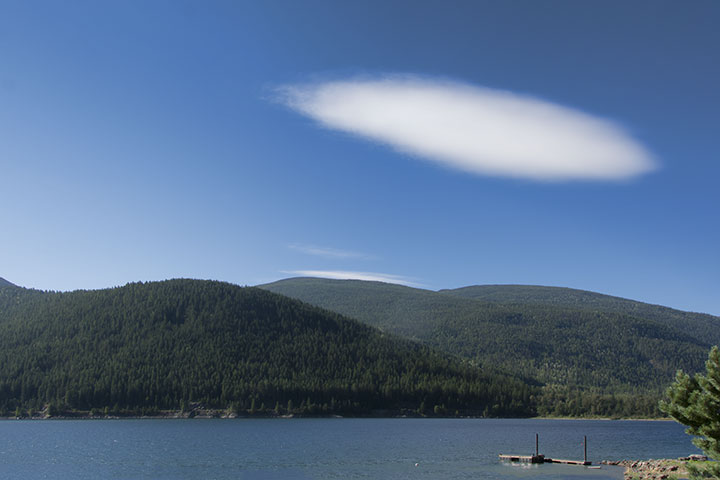
For the last week I have delighted in the adornments accompanying mountain waves.

Just as a moving boat will leave waves in its wake, so too can a mountain—although in this case, the air moves, not the mountain. Unlike a boat’s wake, waves in the lee of a mountain are not a feature of every wind blowing across it: the atmosphere must be statically stable and the wind must increase with height. At such times, undulations in the atmosphere can substantially outdo a tsunami in amplitude—albeit in a more etherial medium. Such waves are most common in the winter, alas a time when stratus often inhibits the view from valleys.

A smooth, often featureless, wave cloud forms on the crest of mountain waves when the air is sufficiently moist. As air ascends to the crest of the wave, vapour cools and condenses to form a cloud. Cloud droplets quickly evaporate on the descending side of the crest, leaving the cloud hanging in one spot as the wind whistles through it. The wave cloud is also called a lenticular cloud owing to its resemblance to the lentil seed (after which optical lenses are also named).

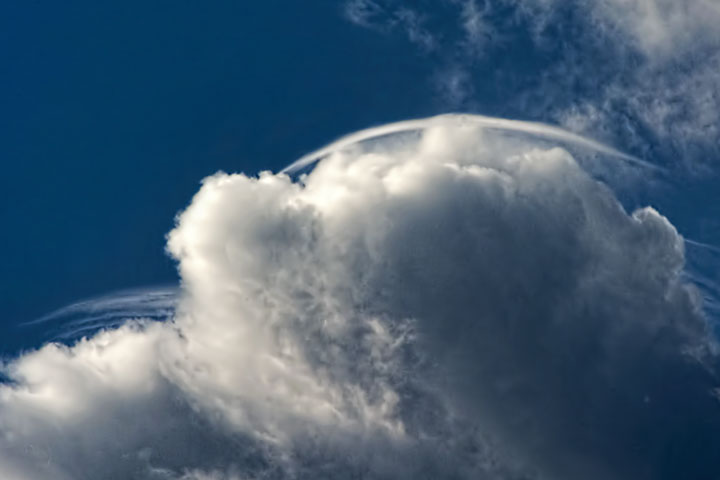
Curiously, a mountain is not always needed for such a cloud to form; a cumulus cloud will sometimes serve as a mountain and present sufficient displacement of the wind that a wave cloud will form over it. This cloud is called a pileus—literally, a cap. The cumulus often grows right through the pileus and destroys it.

The wave cloud is not always featureless. Depending upon the wind and temperature structure in the wave, smaller-scale rollers, called billows, may form within it.

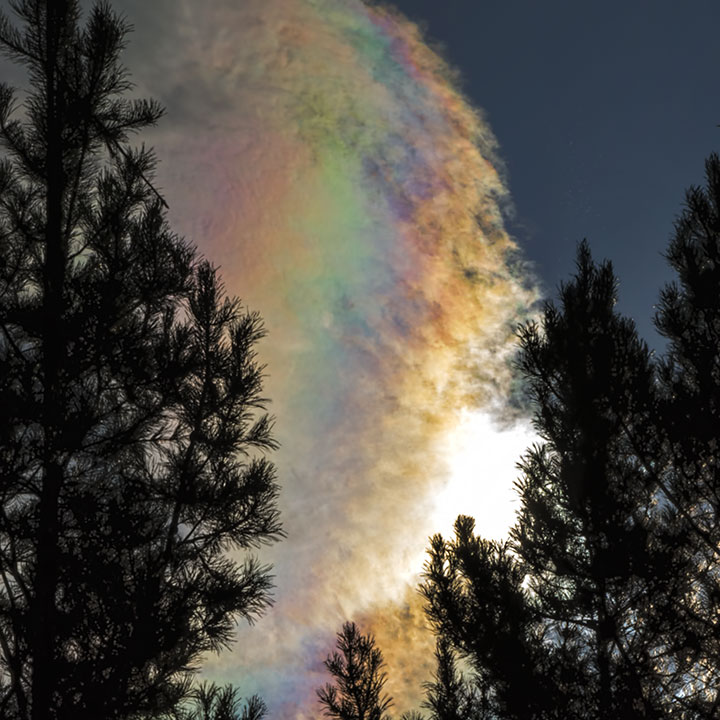
One of the grandest wave-cloud embellishments is iridescence. The colours can be seen in thin wave clouds near the Sun’s direction. Unfortunately, the colours are so dazzlingly bright that they are rarely noticed, despite their beauty.

Posted in weather | Comments Off on Waves in air

Otter gaze


Posted in mammals | 5 Comments

Kingfisher


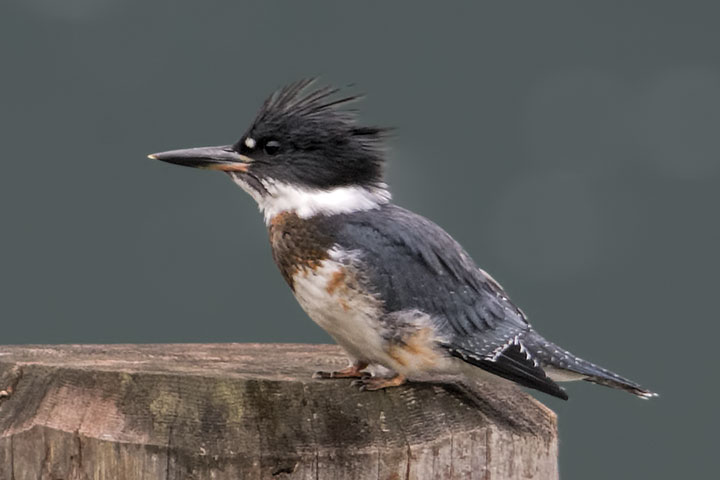
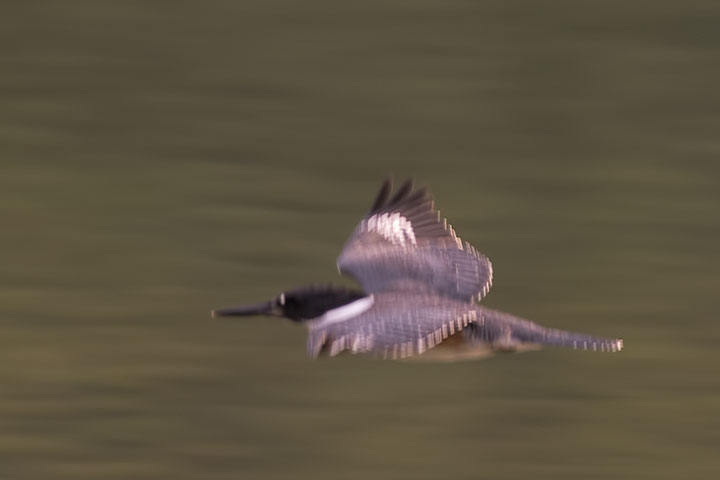
I find it is difficult to photograph a kingfisher.

Is the difficulty because a kingfisher doesn’t like to be approached by land mammals, even from a distance? Possibly, but I think that most of the problem comes from the bird’s fishing strategy. If nothing edible is immediately apparent from one perch, another is quickly sought. Almost as soon as the kingfisher is spotted, it is gone.

(It is much easier to photograph a heron, for its typical fishing strategy is to linger and let fish come to it.)

A juvenile kingfisher was spotted…

but was soon off.

Posted in birds | 2 Comments