Bow on drumly water


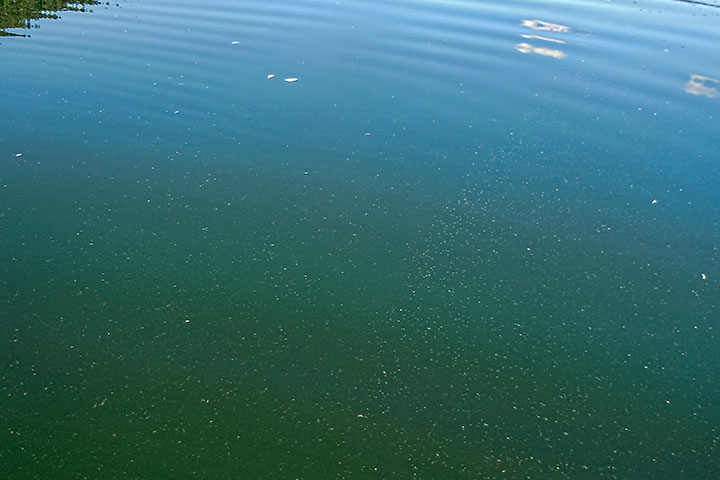
The waters were drumly. Ok, you won’t find the word, drumly, in most dictionaries. It is an old Scots word meaning turbid or murky. Drumly is not how one would normally describe Kootenay Lake—a remarkably transparent, indeed potable, body of water. Yet, biological debris does settle on the Lake, and now and then it becomes locally concentrated.

I encountered such a concentration when kayaking yesterday morning. This enabled one uncommon sighting (well, uncommon around here), and one distinctly rare sighting (apparently, for anywhere).

First, a bit of background on why debris will sometimes collect in a small area.

The West Arm of Kootenay Lake is composed of a series of lakelets—wide regions separated by narrows constricted by the deltas of creeks. These lakelets are rather like pearls on a necklace; when you are in one, you have your own little lake, but a passage connects you to another pearl.

The main flow of the water through any lakelet generally follows a fairly narrow channel. Elsewhere on the lakelet there may be a backflow. Certainly, that is the case on my lakelet where the channel and the backflow forms a large gyre. Now, a gyre is an area of convergence: water drifts towards the centre and sinks. In the absence of wind and waves, all manner of debris—pollen, leaves, bugs, driftwood, lost water skis, escaped boats—collects in the centre of the gyre.

Yesterday morning, I noticed a region of my lakelet where biota seemed to be collecting, so I kayaked away from the pristine waters and into its midst. Normally when one’s shadow is cast onto clear water, it is barely visible. But, in drumly water, the shadow becomes obvious. Further, the shadow is three dimensional and looks as if it sweeps down into the depths. For this picture, I held a camera over my head. This is an uncommon view for the Lake as the waters are normally clear. Such a view is, alas, normal for people of many other places.


Now for the truly unusual: a rainbow formed by the bodies of tiny insects floating on the surface of the water. A likely insect, Peter Wood tells me, is the clear larva of a midge. Truth be told, a rainbow formed by a millimeter’s depth of this biota does not produce as striking a pattern as does a kilometre’s worth of raindrops. Nevertheless, a rainbow it is.

I had heard about the phenomenon of multitudinous transparent insect bodies producing a rainbow. I had even seen a picture of it taken elsewhere. Before this morning, I had not seen such a thing myself.

Alas, my picture is not nearly as good as the one of my memory, yet, the bow across the water is evident. It is the bright band sloping diagonally from the centre bottom to the upper right. To its left is a darker region; in the argot of rainbows, this is Alexander’s dark band. To the left of the Alexander’s band is another bright region: the secondary bow. Is this bow formed by midge larvae? At this stage, we just don’t know. I went out again this morning. I could still find the drumly water, but whatever had caused the bow had come and gone.
Posted in bugs, weather | 1 Comment

Pump it up


First, a dragonfly larva—it’s called a nymph—climbs out of the water. Second, the dragonfly adult climbs out of its the larval exoskeleton—it’s called an exuvia. Doing this is quite a trick, for once it emerges, the adult will become much larger: longer abdomen and expansive wings. All of this content was initially scrunched up inside the exuvia.

The exuvia splits open, the adult pulls itself out and then begins to pump fluid into its collapsed wings and abdomen causing them to gradually expand to full size.

This Pale Snaketail had already pulled its abdomen out of the exuvia by the time my grandson, Finn, pointed it out to me: “Granddad, do dragonflies moult?” The wings are still collapsed and the abdomen is not yet fully extended. The exuvia is the dark shape to the lower right of the dragonfly, and a few minutes before, it fitted inside this.
Gradually the wings and the abdomen expanded as fluid was pumped into them.

Expansion continued and now the wings extended beyond the end of the abdomen.

Suddenly, the wings swung out to the sides. Even so, they have creases in them and haven’t hardened.

Nevertheless, the dragonfly tries a short flight. It is still weak and quickly lands again to continue the expansion and hardening of its wings. An hour later it will be off on its way.

Posted in bugs | 3 Comments

Bat’s back


The bat’s back. Mind you, there is no way I can be sure that it is the same one as was discussed under sleepy bat earlier in the month. Yesterday’s bat arrived in the afternoon and hung from a bargeboard of my roof. Today, twenty hours later, it is still sleeping there.

An interesting thing about watching nature is that often one sees the unanticipated. In this case, it was a bat (apparently) sleeping with its eyes open. So, I searched on the Web for insights into this. Most sites that discuss bats do not mention it one way or the other. Yet, some people have posed the question as to whether bats can do this. The answers vary: some categorically say that a bat can sleep with its eyes open; others assure me that it cannot. When it comes to information on the Web, the rule is clearly caveat emptor.

A sleeping bat hangs from the bargeboard of my roof. Its fur is brown, but its flesh looks bluish.

It was difficult to find a view that revealed the bat’s face. This one seems to show it sleeping with its eyes open; this morning it was still sleeping with its eyes open.

Posted in mammals | 1 Comment

Flycatcher family


Human parents easily relate to the frenetic activity of bird parents as they attend to their chicks. The next generation is relentlessly demanding. Recently, I showed family pictures of White-breasted Nuthatches, Killdeer and Robin, Common Loons, Canada Geese, Bank Swallows, Northern Flickers. Today it is the Pacific-slope Flycatcher.

Last year, I visited a flycatcher family at the home of the Welwoods. A couple of days ago, the flycatchers were back and I visited again.

Although the birds are called flycatchers, they don’t restrict themselves to flies. This one seems to be ferrying a crab spider to its chicks.

And this one has an indeterminate winged creature.
Either way, the chicks are very appreciative.


Posted in birds | 1 Comment

Hitchhiking fish


Fish:
Oh, oh…, the view is sooo lovely from up here.
Thank you for showing it to me.
Now, if you will kindly just drop me off in the Lake.
Right down there will do just fine.
No, no, not in that nest; in the Lake, the LAKE. 

Posted in birds, fish | 2 Comments

one BIG moth


When a moth is named for a mythical giant, one has to suspect that it will be large. Indeed, the Polyphemus Moth is the largest moth in British Columbia, and one of our largest insects of any kind.

Polyphemus, the gigantic cyclops, lived on an Aegean island and ate humans—two for breakfast, Homer tells us.

Polyphemus, the gigantic moth, lives in southern BC forests (and elsewhere) and eats nothing—yes, nothing, the adult’s mouth is vestigial, and this results in a rather short lifespan.

The only function of the adult male Polyphemus Moth (Antheraea polyphemus) is to find females and mate. The finding is facilitated by his large feathery antenna; they are scent detectors tuned to the female’s pheromones.

Polyphemus Moths have a wing span of 9 to 14 cm; this one spanned about 12 cm. It did not stay on the spruce branch for long, but soon flew off on its quest.

Posted in bugs | 4 Comments

Flicker chicks feed


Of all the local woodpeckers, the Northern Flicker is the one I see most often.

The male flicker’s springtime hammering is intended to impress the females. His successful wooing has resulted in chicks to feed.

Among bird species there are different tactics adopted to ferry food to chicks. Some carry it to the nest in their bills, some carry it in their claws. The flicker adopts neither of these approaches. It first swallows the food, say, an insect, and then regurgitates it into the throat of a chick.

Flicker chicks jostle for position as they beg food from an adult returning to the nest.
Although the adult flicker does not appear to be carrying anything, the food has been swallowed. It looks as if a drop of regurgitated food is just appearing at the tip of its bill.
Food is regurgitated directly into the chick’s throat.
Now the adult leaves the nest again on its seemingly endless round of food gathering.

Posted in birds | Comments Off on Flicker chicks feed

Beetle bonk


I watched a (female) Bee-mimic Beetle (Trichiotinus assimilis) forage for pollen on purple yarrow.

I was not the only watcher. As you can see in the pictures below, a male Bee-mimic Beetle also spotted her.

A female Bee-mimic Beetle is collecting pollen from yarrow.

The male lands on top of her.

And, we have contact.

Posted in bugs | 7 Comments

Finn’s water birds

Guest posting Finn is my seven-year-old grandson. I played consultant, but Finn took and edited his own pictures using his own equipment. I helped post them.
Alistair


While visiting at Kootenay Lake, I get to wander around with Granddad as he looks at nature.

These are some things that I have seen.

These are some mallards on the dock preening.

This a mallard mama duck with her 7  chicks.

How many mallard chicks are there?

Now I know why the spotted sandpiper is called what it’s called.

These are some geese in the fog.

This fog tower is the water part of the water birds.

Posted in birds, weather | 14 Comments

Some skimmers


Dragonflies are grouped into seven families, each of which contains many members. Skimmers, one of the biggest of the families, prefer marshy areas and so are not often seen around the well drained portions of the Kootenay Lake shoreline. Yet there are marshes around here and it is there that one goes to see skimmers. Yesterday, I saw these three skimmer species around the pond at Grohman Narrows Park.

An Eight-spotted Skimmer has, as its name suggests, eight promenant black patches spread over its four wings and sometimes white patches between them. Mature males, such as this one, also have a dusty blue-grey pigment (a pruinescence) on the abdomen.

Not quite as spectacular, but perhaps more common is the Four-spotted Skimmer. The dark patches (one per wing) are much smaller. The little black streaks (the pterostigma) near the wingtips are common to many dragonflies and aren’t counted in the tally. Here are two views.

Also skimmers, but smaller than the spotted ones, are the meadowhawks. This is a White-faced Meadowhawk.

Posted in bugs | 1 Comment