Feed me


A title such as “feed me” could apply to any of a wealth of animals with young. On this occasion it applies to Bank Swallows. I had visited them in May and had another occasion to do so today. In May, there were no chicks; now there are.

Three pictures are below.

Feed me: a chick begs as an adult approaches.

Parents are kept busy shuttling food back to the chicks in the nest holes.

Every so often, one manages a family portrait.

Posted in birds | 2 Comments

Balalaika heron


Why is this heron pretending to be a balalaika?

I have watched herons stand in shallows, and perch on trees, pilings, docks or rocks. But, this is the first time I have seen one adopt this pose: up-stretched neck and the underside of its wings displayed to the sunlight. It stood in this way for perhaps a half hour. Odd, what was it doing?

A search of the internet revealed only a handful of pictures of this stance amid a barrage of normal poses. The stance is sufficiently uncommon that many experienced birders have never seen it.

First the picture; then a plausible explanation of this known, but uncommon stance.

It would be nice to be able to merely ask the heron what it was up to, but, in my experience, herons ignore even polite informational requests.

At first, I thought the bird was drying its wings in a manner similar to the way cormorants do. But, I didn’t see the heron dive, and the picture shows no evidence that the feathers are wet. Drying does not appear to be the motivation for the heron’s stance.

Maybe the heron has its wings spread so as to cool itself. There is evidence of cooling: the up-stretched neck, the open bill, the expanded throat (the gular pouch) all suggest the bird is trying to cool. (More about this, below). Yet, the heron has turned its wings to face the Sun as if to heat them. If it had wanted to cool off, its wings would be turned to offer as little exposure to the Sun as possible.

Robert Butler is someone who has written extensively about herons and has seen this stance a few times before. He suggested to me that the behaviour is probably therapeutic. Just as the human body fights infection by increasing the body’s temperature, some birds fight parasites by heating them. By facing its wings to the Sun, the heron is raising the temperature of its wings to drive out parasites. However, it is not desirable to have the heated blood from the wings circulate to the brain, so the neck and head of the heron are vigorously cooling any blood that is passed to the head. The heron appears to be heating its wings and compensating by cooling its head. Supporting this interpretation was the heron’s activities afterwards: it shook itself vigorously, likely to dislodge parasites, and then preened its feathers with both bill and claws.

While this interpretation is somewhat conjectural, the uncommon stance of the heron seems to be therapeutic. It would have been much easier had the heron been willing to just explain all of this to me.
 

Posted in birds | 7 Comments

Slides on mountains


People, around Kootenay Lake and beyond, have been concerned about the massive slide that destroyed lives and homes at Johnsons Landing (North Arm of the Main Lake). The event has been reported extensively in the media (e.g. the CBC) so will not be treated here.

Yet, this slide and others before it underscore an occasional hazard for mountain dwellers, particularly after a period of heavy rain. Famous regional slides were the Frank Slide (1903) in the Crows Nest Pass and the Hope slide (1965) on the Hope-Princeton Highway. Now we have the Johnsons Landing slide (2012) at Kootenay Lake.

Once again, I dip into my Grandfather’s photo album of his visit to the West Kootenay in 1909. He was here for only a few months, but photographed three slides, two of which appear below. It seems that mountains have long offered hazard as well as beauty.

This picture was labeled: “Debris of a snow slide at Sandon, BC, May, 1909”. The appearance of the debris field is strikingly similar to that of the slide at Johnsons Landing

Pictures of the Johnsons Land slide show mud and trees piled against homes. This image shows mud against what looks like a work train. It is labeled: “Derailed by mud slide Crow’s Nest Pass, April 1909”.

Posted in commentary, history | 1 Comment

Cicada


It is amazing what one can see around here by taking the time to look. Or as Sherlock Holmes (Sir Arthur Conan Doyle) observed: “The world is full of obvious things which nobody ever observes.”

Consider the cicada. When compared to bees, flys, and beetles, this is hardly a conspicuous member of our community. It is here, but I have only seen one twice in the last five or so years.

I first saw one two years ago. It turned out to be the amazingly rare, Platypedia putnami, last reported in British Columbia (indeed, anywhere in Canada) in 1942. Pictures of P. putnami appear on my page about true bugs.

What about this most recent cicada? Andy Hamilton, an expert in such matters, tells me that it is one of the whip cicadas, genus “Okanagana, and probably O. vanduzeei (which is also rare).” It is unclear why both of my cicadas would turn out to be rare. Alas, small-number statistics aren’t a good basis for generalizations.

The cicada would be a strong contender in a contest to pick our ugliest bug. Not that it is vicious—it neither bites nor stings—just that…, well, the picture says it all.

Posted in bugs | 7 Comments

Miner’s candleholder


I began scanning more of the pictures from my Grandfather’s photo album from the time he was in Silverton, New Denver, and Sandon, 1909.

Here are four mining pictures, three of which are from the album.

Here is his view of the Standard Mine, located between Sandon and Silverton, but closer to Sandon.

There were two pictures of visitors to the mines at Silverton. Of great interest to me is what they were holding in their hands (revealed only upon the image being scanned): a prospector’s hammer and a miner’s candleholder.

The miner’s candleholder had four features: a holder for a candle, a handle, a sharp point for driving it into a mining timber, a hook for hanging on a miner’s hat or on a jagged piece of the rockface.

Here is a miner’s candleholder that was passed down in my family. Such candleholders were used extensively in western hardrock mines from the 1860s to the early 1900s.

Posted in history | 4 Comments

Feisty swallows


A week or so ago, I watched some Tree Swallows bully an Eagle. Ok, that makes sense, an eagle would happily eat a swallow chick, so clearly it must be vanquished.

But, what about a heron?

Today, I watched some Tree Swallows mercilessly attack a Great Blue Heron. It was not the same group of swallows as I had watched the last time. Further, a heron is not partial to eating swallows. Yet, the attack was relentless.

Unlike in the case of the eagle bullying, the heron did not retreat—well, at least it did not retreat before I had retreated. For once the swallows spotted me watching from the shore, the attack shifted. Now, the swallows set to driving me off. They succeeded: I slunk away.

One of the many Tree Swallows dives at a Great Blue Heron in an attempt to drive it away from their nests.

Posted in birds | 3 Comments

Sandon, 1909


Greg Nesteroff posted a story in the Nelson Star yesterday: Sandon photo sale causes a stir.  Sandon is our local quasi-ghost town, and the controversy centred on who actually owned the picture, circa 1900, being sold. The picture in question can be seen here.

This reminded me of my grandfather’s picture of Sandon. His picture was taken in May 1909 from about the same place as the controversial picture and shows many of the same buildings. My grandfather’s picture does not have the high quality of the professional one.

My grandfather, Rev. Thurlow Fraser, had been sent to Sandon by the Presbyterian Church in Ontario. It is a measure of the smugness to be found in Ontario that he had been sent to British Columbia as a missionary to convert the heathen miners, rather than as a minister to support the faithful.

As I look at his photo album now, I can identify eighteen shots taken around Silverton, New Denver and Sandon in 1909. They show buildings, people, sternwheelers, rail lines, a mud slide, and a mine. I may have to scan some more pictures.

This is clearly a picture of Sandon, although my grandfather’s caption describes it as a spot “Back of Silverton”. Near the centre of the picture is the shell of a recently burned building. My higher-resolution version shows the Canadian Pacific boxcar to be number 46980 and the building between it and the burned one says: Red Cross Drug Store. The big church in the earlier picture is now missing—maybe Sandon did need missionaries.


Posted in history | 4 Comments

Old Growth walk


A late-May attempt to walk the Old Growth Forest trail (eleven kilometres up the Kokanee Glacier Road) was thwarted by snow.

The trail was fine yesterday. The four pictures along the trail show trees, the creek, and a feature called split rock.

Posted in scenes | Comments Off on Old Growth walk

Sleepy bat


Bats sleep in the daytime. Their drowsiness enables me to get close enough to take a picture whereas I have never managed a picture of one flying in the evening.

Bats make a wonderful countermeasure to any mosquitoes that will have resulted from the moist spring.

This sleepy bat is probably a male Little Brown Myotis.

These three loons are included for no better reason than that they swam by before sunrise.


Posted in mammals | 4 Comments

Summer begins


Summer began today.

After an unconscionably wet spring, the Sun rose to a clear sky and estival forecasts.

Of course, when I say summer began, I am offering an observation, not a proclamation. Alas that was not the case, when two weeks ago, the news media (CBC and others) offered pap about the “official” start of summer.

Official? What official ever proclaimed such a thing? None!

It is an interesting question as to why so many people in the news media insert the gratuitous word, official, when discussing seasonal changes? In most cases where something actually is official—Canada is a country; the speed limit is 80 km/hr—no one bothers to use the word, official. It seems that official is only used when it is needed to bolster a silly claim.

Let us imagine that a minor official in some foreign land did proclaim that an astronomical marker produces a globally fixed date for a shift in the weather. Wouldn’t the rest of us merely treat it the same way King Cnut treated the silliness of his courtiers? Those sycophants claimed he was powerful enough to command the tides. Cnut’s response was that this was demonstrably untrue. Yet, the demonstrable silliness of summer officially beginning on the solstice persists in the news media—a millenium later, Cnut’s courtiers live on. I am sure with the next astronomical marker we will be told about the official start of fall. Sigh….

Summer begins when it begins. It has no beginning fixed by any official; besides, weather doesn’t listen to officials. Today, without the help of any official, summer began.

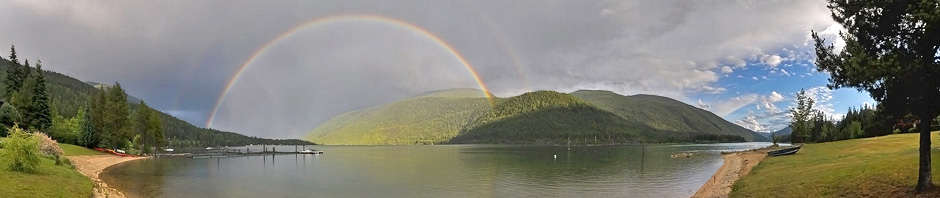
This was dawn on the Lake yesterday: rain, wind, and waves.

This was dawn on the Lake today: merganser chicks rushed to greet the arriving summer.

Posted in commentary, weather | 4 Comments