Brown Creeper


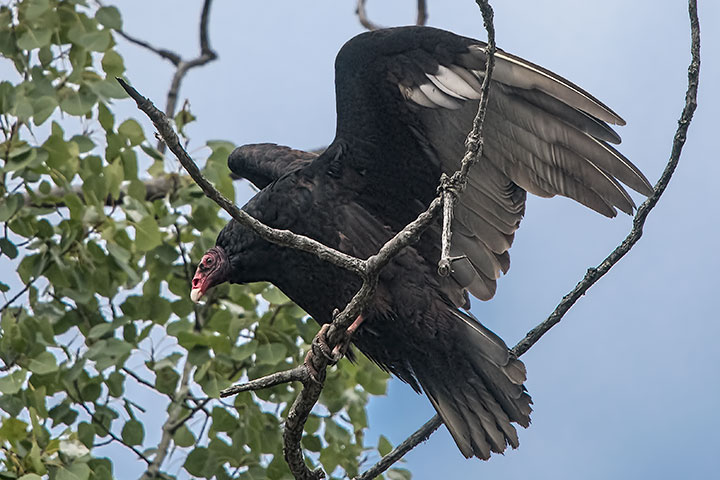
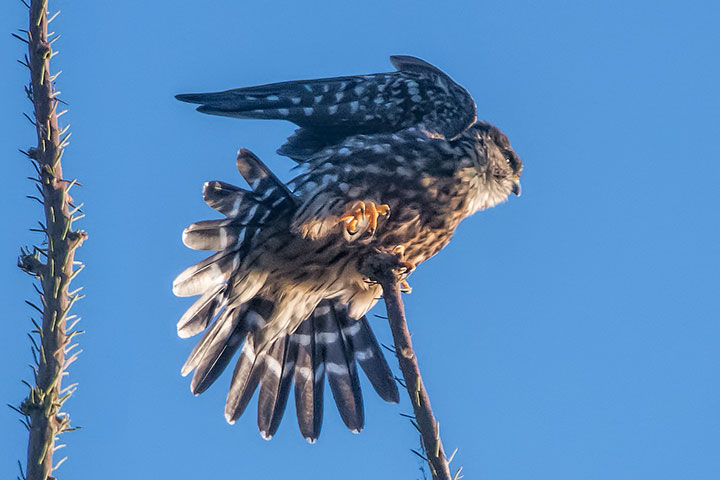
The Brown Creeper has to be one of the most cryptic of our local residents. I have yet to spot one on my own. On the rare occasions when I have seen it, someone else found it for me. My response tended to be: “Huh? Where? I don’t see anything.”

The bird inhabits forests with many large live trees, which it scours for insects. That it blends in with the tree bark is a given.

“There is nothing to see here folks, I am just another bit of tree bark.”

Posted in birds | Comments Off on Brown Creeper

Menu addition


My father’s Shaeffer fountain pen.

Essays, has been added to the above menu bar. 

As the linked page notes: Sometimes a series of blog postings congeals into an essay. The page links to PDFs of recent ones.

Some of these have been published elsewhere; some are just too eccentric to appeal to most editors. 


Posted in commentary | Comments Off on Menu addition

Mach bands


Local wildfire smoke from this grim season had all but vanished when more flowed in from the south. As uncomfortable as it is, the smoke provides the hazy air that easily enables the identification of Mach bands.

Mach bands are not a feature of the external natural world. Rather, they arise in the eye and are an optical illusion first explained by Ernst Mach (1838–1916). The bands result from a process in our retinas that enhances contrast. Consequently, they appear subtly in everything we see, whether it is a view of the external world or just a picture of that view. However, the bands are never so apparent as when looking at step-like transitions in brightness. A succession of distant ridges seen through a smoky haze provides an ideal place to examine them.

Consider the receding ridges in the centre of this scene looking across the Lake. Each ridge seems to be edged with a thin diffuse dark band which contrasts with an adjacent brighter band on the ridge beyond it. Neither band is present in the external world; they are creations of our eyes.

Here is a detail from the centre left of the picture where one ridge passes behind another. The picture has been rendered in black and white, but the thin Mach bands are readily apparent.

When the brightness is plotted for the picture detail, the two cliffs marking the shift from one ridge to the next are apparent. Yet this quantitative analysis does not show the bands that the eye perceives: there is no small trench on the dark side of the cliff or small ridge on the bright side. Mach bands are an illusion created by one’s own image processing. Our subjective view differs from the objective scene.

Posted in commentary, scenes | 3 Comments

Not a chipmunk


Two years ago, I noticed a touristy website that tried to pass off a Golden-mantled Ground Squirrel as being a Chipmunk (posting). Fascinated by this ineptitude, I searched stock-photo sites and discovered that it wasn’t uncommon to label pictures of a Golden-mantle Ground Squirrel as being a Chipmunk. As I noted at the time, one should not turn to stock-photo companies for biological insights. 

The mistake is easy to make if the viewer applies an algorithm for squirrels: stripes mean chipmunk. The problem is that it isn’t true. While the chipmunk has multiple white stripes that extend from its back to its head (another example), the much larger Golden-mantled Ground Squirrel has two white stripes, one on each side, and neither extends to its head. 

A Golden-mantled Ground Squirrel enjoys a snack high in a subalpine forest. The single white stripe on either side does not extend to the head.

The reason for the designaton of golden mantle isn’t always obvious, but here the golden pelage on the head and shoulders is abundantly clear.

Posted in mammals | Comments Off on Not a chipmunk

EEEP


… Now I remember only
The long ascent of the lonely valley, the live
Pine spirally scarred by lightning, the slicing pipe
Of invisible pika…. 
                            David, by Earle Birney (1942)

The slicing pipe of the pika (invisible or not) is: “EEEP”.

Birney’s reference to the call of the invisible pika resonates with hikers adjacent to talus in the subalpine of Western North America: the furtive pika is heard much more often than it is seen.

A pika issues its call of EEEP upon spotting an interloper in its world.

Another pika doesn’t seem to know it is being watched when it presents its profile to the camera.

Apparently secure in its invisibility this pika strikes a hero’s pose.

Posted in mammals | 2 Comments

Mating swarm


How do a lovelorn insects find a mate?

There are various strategies, but one of them is to gather in a mating ball or mating swarm. Such swarms abound at this time of year, hanging over fixed references such as a tree or post, or marshalling along the edge of a sunbeam.

In the swarm the insects perform a dance which involves flying to the top and floating down. When they find each other, they will mate in the air.

A mating swarm of mayflies had anchored itself along the edge of a sunbeam.

Posted in bugs | Comments Off on Mating swarm

Fledgling heron


A fledgling Great Blue Heron performs its matutinal callisthenics.

Posted in birds | 3 Comments

Wet bear


The kokanee are spawning in local creeks. Bears come to feast upon them. Locals and tourists come to delight in both.

There is a family of black bears with two cubs working a spawning channel. However, getting a good picture through the intervening brush and trees was difficult. The best I managed yestermorn was a portrait of the sow.

A black bear sow lifts her head from the water after failing to catch the fish she was after.

Posted in mammals | 5 Comments

Sun pictures


During the solar eclipse of August 21, 2017, telescopes looked up; I looked down.

Well, fair’s fair, I looked up also, but I concentrated on the ground. Let me explain. 

I leave it to the folks with good equipment in the path of totality to take the inspiring images of the corona. However, my title, Sun pictures, does not refer to such pictures of the Sun, itself, but to pictures made by the Sun. 

The first hint I had that the Sun could paint pictures on the ground came from a book I read as a student. M. Minnaert’s book, Light and Colour in the Open Air, told of the way the gaps between tree leaves behave as pinhole cameras and projected images of the Sun on the ground. Normally when projected on a horizontal surface, these images would be elliptical. However, during a partial solar eclipse, they match the appearance of the Sun and become crescents.

I first saw these crescent Sun pictures during the solar eclipse of 1970. I wanted to see them again.

Sunlight passing though the gaps between tree leaves normally project elliptical Sun pictures on the ground. The lawn provides an uneven screen.

This is a shot of the Sun just as the partial eclipse was ending (the Moon still takes a tiny bite out of the Sun at seven o’clock), but the Sun is essentially circular and would produce elliptical images on a horizontal surface. The picture shows both sunspots and limb darkening.

Here is the Sun at about the greatest extent of the eclipse at my location.

Sun pictures are projected through the gaps between tree leaves during a partial solar eclipse. A less cluttered image was obtained by placing a kitchen mat on the grass.

Posted in weather | 3 Comments

Skunk


“Please go away. Producing butyl mercaptan is expensive, and I don’t want to waste it on you.”

Posted in mammals | 2 Comments