And now there came both mist and snow,
And it grew wondrous cold:
And ice, mast-high, came floating by,
As green as emerald.
Samuel Taylor Coleridge (1798)
The Rime of the Ancient Mariner
Green ice holds an almost mystical status among aficionados of cold. Coleridge mentions green icebergs in 1798, and there have been a handful of similar observations through subsequent centuries.
Although green ice is uncommon, it can be seen locally, not in icebergs, but in anchor ice.
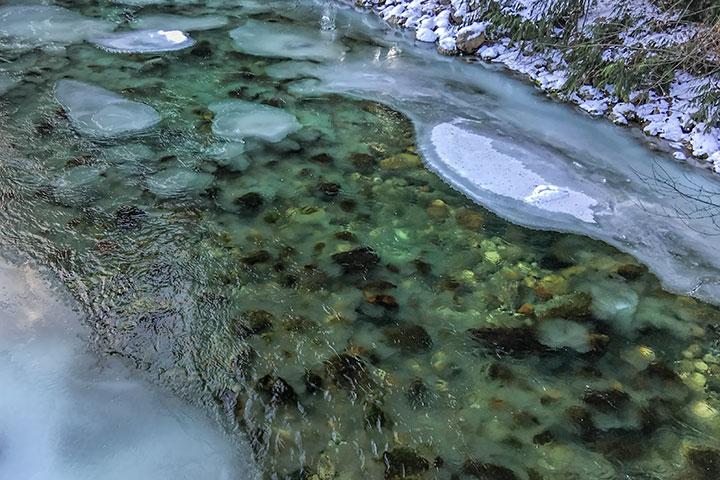
The recent cold snap brought anchor ice to local creeks. I offered an explanation of how ice forms on the creek bed three years ago, so that need not be repeated here. However, an explanation seems in order for the fact that on both occasions the ice on the stream bed appeared jade.
How can ice be green? The explanation offered below involves two processes: one that primarily absorbs light at the reddish end of the visible spectrum; the other that primarily absorbs light at the blueish end. What remains is light from near the spectral middle: green.
Specious guesswork
It is worth dismissing the standard glib suggestion that such an unusual colour arises from embedded impurities. All the water from which this ice formed is remarkably clean and free of sediments and biota (it is winter). The colour seen is a characteristic of the ice and lighting, not suspended dirt.
Facts
Begin with what is known: both water and ice are intrinsically blue. This might seem at variance with common experiences of seeing a glass of water or an ice cube, but each has a rather small volume. To see the blue, a light absorption path of metres (not centimetres) is needed. Look down a deep hole punched in snow. It is blue, as is the light in an ice cave or that which reaches the bottom of a lake. (Of course, the light seen when looking down on top of a lake or glacier is complicated by surface reflections.) When visible light passes through water or ice the greatest absorption is at the red end of the spectrum. There is a progressive decline in absorption through the orange, yellow and green with the least absorption being at the blue end. Energy remains throughout the spectrum, but the eye perceives the composite as blue.
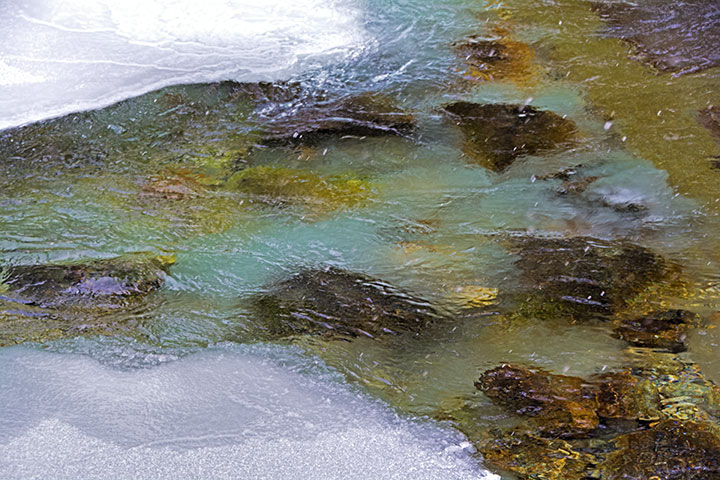
Anchor ice is resting on an ochre stream bed (2013).
Path-length problem
Leaving aside that the aim is to explain green, not blue, it would seem that the anchor ice in the picture below is too thin to give the long absorption path needed for seeing colour. However, anchor ice is rather porous (see previous explanation), having many internal surfaces between ice and water that scatter the light to and fro as if in a pinball machine. So, light travels a tortuous path that is vastly greater than the ice thickness and certainly sufficient to give the transmitted light a bluish cast.
Ochre stream bed
The bluish light that passes through the anchor ice reaches a characteristically earthy coloured stream bed. While absorption in the ice largely removed the reddish end of the spectrum, absorption by the stream bed now largely removes the bluish end of the spectrum. The dominant light that re-emerges from the ice is in the relatively undiminished middle of the spectrum: green.
Last Saturday at the height of the cold snap, anchor ice offered the best local example of green ice.
Green icebergs
Offered was a plausible explanation of the green of anchor ice. However, is it in any way applicable to the icebergs described by Coleridge and others? Yes, somewhat. What was apparent with the anchor ice was that it involved two counteracting processes: ice that absorbed the reddish end of the spectrum and something else that depleted the bluish end. With anchor ice, that something else was absorption by the ochre stream bed. For green icebergs, this is replaced by atmospheric scattering that reddens the illumination from the low polar Sun. The result is much the same: green ice.


Santa Claus
When out on the roof there arose such a clatter,
I sprang from my bed to see what was the matter.
Just as the poem says, early this Christmas morning I really did hear a clatter on my roof and I sprang from my chair to see what was the matter.
There he was on my chimney, replete with a white-trimmed red cap. I’m not making this up — I took a picture.
The truth is out: Santa Claus is a Pileated Woodpecker.