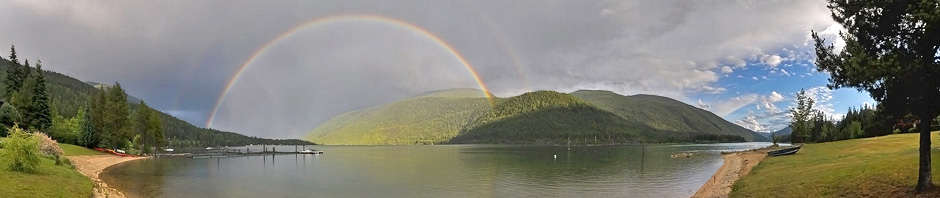
Mule deer


I see perhaps 20 to 50 white-tailed deer for every mule deer spotted. This was not the deer frequency during pre-settler times when mule deer dominated. But, white-tailed deer moved in with the settlers. Certainly, we now have both species locally, but I live at the valley bottom, a region favoured by white-tailed deer. Mule deer are usually found higher on the mountain sides. One must head uphill to see mule deer, and even there, they can be sparse.

As distinct from white-tailed deer, mule deer are characterized by:

• somewhat larger body sizes
• more greyish than tannish pelage in winter (both are reddish-brown in summer)
• larger antlers that are dendritic rather than single branching
• large ears (which gives them their name)
• black-tipped rope-like tail, as distinct from a broad tan tail
• when escaping, they often stot
• a much larger home range
• don’t do well around people (unlike the white-tailed)
• inhabit the higher elevations

Two mule does were seen today at an altitude of about 680 m.  

The mule doe was feeding on leaves. Her large ears and rope-like tail are evident.

Two doe were foraging together. Here is a problem: Can you match the heads to the butts?

 

Posted in mammals | 6 Comments

Snipe’s snag


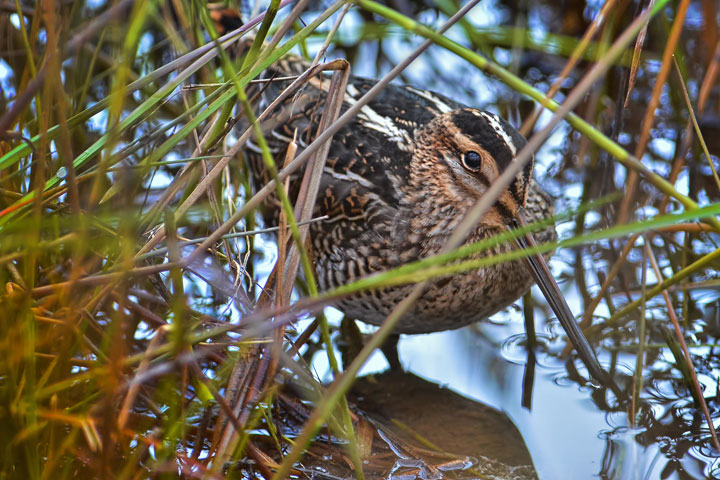
I went looking for grizzlies, but found a snipe.

The Wilson’s Snipe is a secretive shorebird that probes the water’s edge to capture and eat invertebrate larvae. When approached, it flushes with a rapid and erratic flight. This is not a bird that wants to be noticed — it wants nothing to do with you.

A Wilson’s Snipe hides along the shore.

Yet, in late May for three years running, I have seen one perched prominently on a snag (and the same snag) next to a wetland. What prompts this abrupt change in behaviour from introvert to extravert?

On May 29, 2019, a Wilson’s Snipe perched prominently on a snag next to a wetland. 

Then on May, 23, 2020, the Wilson’s Snipe was chattering away from the same snag.

Again yesterday (May, 25, 2021) the snipe was back on the same snag.

What prompts a normally timid bird to become an extravert each May? The answer came from the Audubon Society, which explained:

The Wilson’s Snipe becomes more flamboyant in the breeding season, when it often yammers from atop a fencepost or dead tree.

Ah, this seems to a case of how a compulsion for courting can alter one’s behaviour.


Posted in birds | 1 Comment

Mating moths


Nature Canada bills the hummingbird moth as one of Canada’s coolest creatures. But, who could have guessed just how cool it would be on this occasion?

With spring, I often look for this moth. I rarely find it. Our local one is the Rocky Mountain Clearwing (Hemaris thetis) and you are lucky to even spot one, let alone watch it mate — and in midair.

This moth not only flies by day, it sips nectar as it hovers over flowers in the manner of a hummingbird. This one was visiting lilacs.

Amazingly, it was soon joined by another and they mated. The two of them continued to fly haphazardly about the lilac, seemingly using it as a sort of reference.

I believe the male is on the left. They never strayed far from the lilac during their aerial bout.


Posted in bugs | 7 Comments

Two wild orchids


I have been watching for, what I expected would be, the second wild orchid of the season. However, the mountain lady’s slipper has yet to appear. Instead, I found two others. 

This month opened with pictures of the fairy slipper. So, why am I showing another one? Well, the fairy slipper comes in two varieties: eastern and western and we get both. The previous posting showed the western. Here is the eastern. There are a number of differences, but the large lower petal (the lip or bee’s landing strip) shows much of the variation. Its fake stamens deliver no pollen, but in the western they are white and in the eastern they are yellowish. Also, the lip in the western is extensively speckled, but largely plain in the eastern.

The striped coralroot is an interesting orchid for even though it is a plant, it lacks chlorophyll. Indeed, its leaves are vestigial, having been reduced to tiny scales. It has adapted to living on the forest floor where not much sunlight penetrates and so obtains its nutrients from fungi. This one was found only a few metres distant from where others had grown in previous years.


Posted in wildflowers | 2 Comments

Goshawk


What does one say about a close observation of a Northern Goshawk?

Maybe just, Wow!

We certainly have goshawks, but they are uncommon. I have only seen one (at a considerable distance) once before. This one was found by my daughter. It was unconcerned about the two of us standing beside its tree and clicking.

The goshawk is a forest hawk that is spread across Canada, parts of the U.S., also Europe and Asia, yet the bird is distributed sparsely. Its name implies that it eats geese. Actually, its tastes are broad, essentially eating anything it can catch. 

Here are two views of today’s Northern Goshawk deep in the forests of Kokanee Creek Park.


Posted in birds | 12 Comments

Rufous


It is May and the hummingbird season has begun with the Rufous — the scrappiest of our three regular hummingbirds. I look forward to seeing the other two.

A female Rufous Hummingbird stops by.

A male Rufous Hummingbird does so also and displays his iridescent orange gorget.


Posted in birds | 1 Comment

Buddies with buds


Three months ago, I posted Antler rhythms, a discussion with pictures of the white-tailed deer’s annual cycle of: antler buds, velvet covered growth, hardening and loss of velvet, and antler loss. Concluding it was a picture of a buck showing the recent scar of a shed antler. A few days ago. three bucks visited, each showed fresh antler buds. The cycle begins again, and Cynthia Fraser recorded it.

A young buck bends down to graze and reveals its antler buds.

Indeed, there were three buddies each with antler buds.
v

Deer are a skittish lot and something spooked them.

With white tails raised, off they go.

Cynthia Fraser’s pictures are used with permission.


Posted in mammals | 5 Comments

Grizzly feeding


When May arrives, I like to see if I can spot grizzly bears feeding as they attempt to restore their weight following hibernation. Doug Thorburn beat me to it. He sent me some shots of grizzlies at the north end of the Lake.

Two young grizzlies, likely siblings, were feasting on forest greens.

One of the grizzlies looked up at the interloper.

Douglas Thorburn’s pictures are used with permission.


Posted in mammals | 6 Comments

Barrow’s Goldeneye

The Common Goldeneye male has a circular cheek patch and more white on the back. The female bill has less yellow.


Occasionally when I manage a reasonably good shot, I use it as an opportunity to discuss the species. Such is the case with the Barrow’s Goldeneye couple, below; they are one of our two goldeneye ducks. The other is the (ironically, less common) Common Goldeneye. Which brings me to the quirky characterization of our Barrow’s found on the Audubon website:

The less numerous of the two goldeneye species [is Barrow’s], found mainly in wild country of northwestern North America….

Okay, the Common Goldeneye is distributed across much of North America, while the Barrow’s Goldeneye is largely confined to the western cordillera. Here, in wild country (huh?), the Barrow’s is about four times as common as the Common, so hardly the less numerous of the two. 

The Barrow’s Goldeneye is a diving duck that mainly feeds on arthropods on the lake bottom.

A Barrow’s Goldeneye couple swims by. Soon, it will likely head north to breed.


Posted in birds | 4 Comments

Coyotes in forest


I am used to seeing coyotes, if I see them at all, as solitary predators. Occasionally, I have seen two hunting together. However, this weekend was the first time I had seen them in a pack. It was probably a family. There were four, possibly six of them. It was hard to tell as they were in the forest ducking behind brush and trees and they vanished quickly. My attempts at photography produced little other than frames showing out-of-focus legs and tails behind bushes. However, one member of the pack did stand still in the open long enough for a picture.

A coyote stands in the forest and looks around.


Posted in mammals | 3 Comments