Pika predator


The pika is generally acknowledged as an adorable creature. Beyond its native cuteness, it is a herbivore and so is appealing because it feeds on nothing but plants.

Yesterday, I revisited the pika colony discussed earlier. Snow had fallen and the pikas obviously struggled with snow having cut off access to food.

Yet, a much greater threat than a seasonal change beset them. They had to face a new, and effective, predator: a long-tailed weasel. 

A pika forages for vegetative delectables in the snow.

A long-tailed weasel moved into the pika colony. Its slim body enabled it to enter the cavities between the rocks where pikas lived.

The weasel arrived and began to prowl for comestibles.

“Why are you terrorizing us? We have done you no harm.”

“I am unconcerned with whether you are nurturing, only that you are nutritious.”


Posted in mammals | 1 Comment

Pikas prepare


Pikas do not hibernate, so during the summer, they collect and store food for the winter. As winter approaches, preparation becomes intense. These pictures were taken two days ago. Yesterday, snow fell on the pikas. 

Dyslexia: Pikas normally live in talus, but these ones live in tailings. Are pikas dyslexic? Chuckle.

This was a large colony of pikas, with frenetic activity on every side.

A pika announces interlopers with an “EEP”. However, all quickly returned to foraging.

A pika forages vegetation beside the rocks.

And carries it back to its lair for the winter.

Some leaves are consumed on the spot.

As are stalks.

“Looking good in my winter pelage.”


Posted in mammals | 10 Comments

Mystery bird


Is the identity of this bird actually a mystery? Well, I know what it is.

However, the Sybley Guide to Birds offered no guidance. And, Cornell’s Merlin Bird ID (an avian-recognition app) made a number of guesses, all of which were wrong.

So, I thought that others might enjoy the challenge of identifying this large brownish bird.

What is this late-summer bird?


Posted in birds | 12 Comments

September goulash


This is a compilation of a few images, none of which had its own posting in September.

Ospreys have now almost vanished from the Lake by migrating far to the south. However, through September, they were still here fishing. 

A Merlin chases dragonflies.

Four wigeons fly by.

While one of the most abundant terrestrial birds that winters in North America, the Lapland Longspur is downright scarce around Kootenay Lake. It is only seen here in its non-breeding plumage (it breeds in the Arctic). Last year, I thought I had spotted one, but it turned out to be a Savanah Sparrow (sigh…). With luck this year’s composite does show two Lapland Longspurs.

The White-winged Crossbill is a strange bird that is distinctly uncommon. Its peculiarly crossed bill is adapted for prying open spruce cones to get at the seeds. Here are two of them feeding.

Throughout August and September, I watched for black bears. This is only the second one spotted. This scene makes one wonder if bears have an aesthetic sense of the autumnal beauty of a hillside covered in fireweed.


Posted in birds, mammals | 1 Comment

Cormorants

Showing the crests (Mar. 5, 2018)


Double-crested Cormorants can be seen around Kootenay Lake throughout the year. Unlike Mallards and Canada Geese, the cormorant is a somewhat uncommon sight. While a few breed at the south end of the Lake, they are primarily seen twice a year during migration.

Our local cormorant is named, double-crested, yet, the crests are only seen briefly early in the breeding season.

Cormorants are water birds. They are adapted for underwater swimming where they prey upon swimming and bottom fish. Unlike many other water birds, their feathers are wettable, an adaptation that prevents excess buoyancy when diving for fish. Consequently, when swimming on the surface, they float rather low in the water. They also often carry their bills tipped up.

Following a dive, cormorants will sometimes face into the wind and spread their wings so as to dry them. Usually done on land, it is uncommon to see them do this while still in the water.

Cormorants have relatively small wings, which gives them a fairly high flight speed.

The speed of a cormorant makes it a challenge to obtain a detailed shot of one flying.

Juveniles have a pale neck and breast that gradually blends into its darker belly.

A cormorant expressing its opinion.


Posted in birds | 4 Comments

Mountain goat


When compared to the satisfying closeups of local wildlife posted of late, today’s image of a mountain goat is, er…, only so-so. 

Alas, mountain goats live in a world that rarely intersects my own: They habit the steep faces of rocky cliffs. Not often am I near their world, and when there, I rarely see one. 

A mountain goat briefly looked down from the top of a cliff over 300 metres above me.


Posted in mammals | 2 Comments

Falcon feeding


A falcon is a small raptor that uses speed to prey upon insects, rodents, and small birds.

We have two falcons present year round (plus three occasional visitors). The smallest of our regular falcons is the Kestrel (80–165 g). Slightly heavier is the Merlin (160–240 g). This last week I watched each of them feast on insects.

A Kestrel chased, caught, and consumed, what I suspect, is a sawfly.

A Merlin chased, caught, and consumed a dragonfly (a darner).

If a dragonfly sees this, annihilation is at hand.


Posted in birds, bugs | 3 Comments

Darner mating


One might think that the dragonfly season would be over — not so.

Seen here are (what I believe are) lance-tipped darners mating three days ago. The male (more bluish) is the one above, while the female (yellowish head and thorax) is the one below.

He is holding her by the back of the head, and she has placed the tip of her abdomen at his secondary sexual organs.

A couple of darners coupling.


Posted in bugs | 1 Comment

Waltz of wind, water, & waves


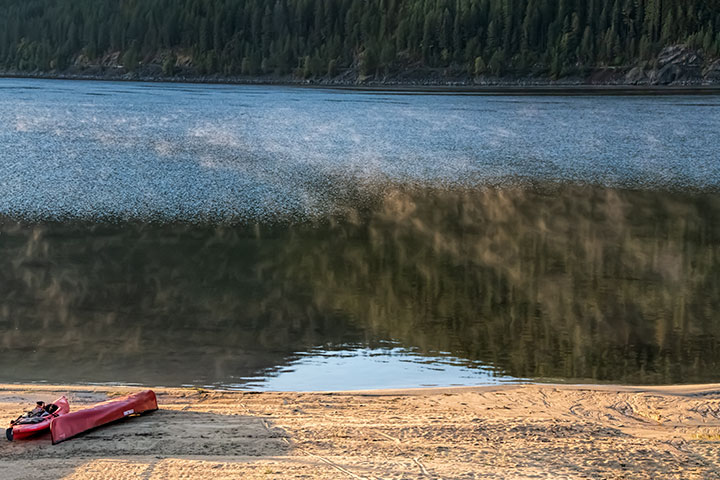
As the sun rose yesterday, a neat choreography of a katabatic wind created ephemeral sprites of steam fog, and abruptly ruffled calm waters farther offshore. In fifteen minutes, it was all over.

Katabatic wind
The night had been clear, so the infrared radiation lost by the ground was not offset by compensating radiation from the clouds.  The mountainside cooled, which in turn caused the adjacent air to cool and begin to flow downslope. This drainage wind is called a katabatic wind, but it is usually so gentle as to be almost undetectable. Upon reaching the valley bottom, the air moved out over the Lake. 

Temperature difference
The katabatic air flowing out over the Lake was cooler than the centimetres-thick air already over the water. Certainly, the Lake had also lost energy by infrared emission, but convection in the water had brought warmer water from below to the surface and kept the adjacent air warm. It also kept this thin layer of air moist.

Steam fog
There are two distinct mechanisms that can produce condensation. The best known is vapour cooling. This is responsible for the formation of cumulus clouds and wave clouds. (It is usually explained by saying that cold air cannot hold as much water vapour as warm air, but this glib assertion has been known to be nonsense for over two centuries.) The mechanism for the formation of the steam fog seen here was that of vapour mixing. There was no net temperature change as warm and cool vapour from two sources mixed. (This mechanism also gives rise to the contrails trailing the engines of jet planes.) As the katabatic wind, with its cool vapour, flows over the surface air of the Lake, with its warm vapour, the condensation forms little convective towers of steam fog that drift with the wind.

Surface transformation
As if the katabatic wind and the formation of steam fog were not interesting enough, something else odd took place. Lines of the steam-fog sprites trace the air flow offshore. Initially the wind does not ruffle the water’s surface — then abruptly, a little way out, it does. This pattern is strikingly consistent across the Lake: smooth water abruptly transforms into ruffled water. 

Wave threshold
We are used to seeing the wind drag on a water surface and raise waves. However, waves on water have a minimum speed of 23 cm/s. If the wind is gentler than this (or if a swimming bug moves slower than this), no waves are created. The katabatic wind flowing down the mountainside has been slowed by trees. But, as the air moves out over the water, it accelerates and at the threshold number of 23 cm/s, it begins to abruptly ruffle the water’s surface as it can now create waves.

Termination
This waltz between wind, water, and waves originated with a cooling of the mountainside by the net loss of infrared radiation. It ended quickly when the rising sun began to warm the mountainside. This killed the katabatic wind, and over a period of only a few minutes, the air stopped flowing out over the water, the steam fog vanished, and the Lake became calm.

Thank you for the dance.

A katabatic wind flows over warmer water making steam fog and ruffling the water offshore.
 

Posted in weather | 5 Comments

Osprey fattening


Ospreys are now eating as many fish as possible in preparation for their long migration.

Ospreys have been present since April. They built nests, mated, laid eggs, brooded chicks, and their chicks fledged. Now, mid-September, all are getting ready to migrate to Central America and points south. Preparation for this long flight requires building fat reserves. 

Consequently, a number of times each day, ospreys bring a fresh fish to a perch and feast.

An adult osprey arrives with a sucker (and a bit of salad).

It lands on a piling.

In an act repeated around the Lake, the osprey feasts. Soon, all will migrate.


Posted in birds, fish | 2 Comments