HY Bald Eagle


For many years, I have been used to Black Bears turning up in my yard early in August. Alas, none have (apparently) done so this year. The berries must be good at higher elevations resulting in a scant need for an early descent into the valleys.

There have been scattered reports of bears visiting the spawning channels, yet my frequent visits to these spots have yet to reveal anything other than one uncooperative and distant cub.

However, during this morning’s sortie, I did have an interesting encounter: a close flyby by a hatch-year (HY, i.e., this year’s) Bald Eagle. 

A hatch-year Bald Eagle flew by so closely that it did not all fit into the camera’s frame.

Posted in birds | 2 Comments

Feasting on fish


Fish are a staple food for much of the wildlife around the Lake — we are, after all, dealing with a lake — so, I show wildlife feasting on fish.

This posting was prompted by recent pictures, but these images have been supplemented by shots drawn from earlier occasions. The reason for this is that some of the events are so fleeting that few have been recorded, and one can only show what one has.

There are about two dozen species of fish in the Lake. Rather than try to show all, I illustrate only the spectacular spawning Kokanee. Most spawning creeks are well shaded, but for a shot of the Kokanee in their dazzling redness, one must find a spot where they pass through sunlight.

The raven is an inveterate predator upon the spawning Kokanee.

During much of the warm season, ospreys specialize in suckers, but come the time of Kokanee spawning, preferences change. Notice the two wasps taking an interest in the Kokanee.

The Bald Eagle is a versatile eater, so during Kokanee spawning, it takes advantage of them.

The mallard is a flexible feeder that often poaches Kokanee eggs, but here it eats a carcass.

A perennial favourite of wildlife is the sucker. Here a Hooded Merganser downs one.

Most birds must swallow their meal whole, so the size of the prey changes with the size of the predator. This Belted Kingfisher is limited to rather small fish.

A Pied-billed Grebe can handle a modestly larger fish.

A Great Blue Heron can swallow a rather large one.

A gull can pick a fish apart, yet, this fish was swallowed whole as the bird flew.

The fish being consumed by this Common Merganser is unidentified.

A loon swallows a fish far out on the lake.

A lesser known fish is the Slimy Sculpin being consumed by this Horned Grebe.

One might imagine that fish are the preserve of birds. Not so, here a Black Bear eats a Kokanee.

And a River Otter eats a sucker.

I have failed to show a Turkey Vulture eating anything. That they hang around and feast on fish carcasses is clear, but I have yet to catch them in the act. It remains something to look for.

 

Posted in birds, fish, mammals | 6 Comments

Raft of loons


This is the time of year to see rafts of loons on Kootenay Lake.

Often, the loon is a solitary bird, accompanied at most by a mate and chicks. But prior to migration, numerous loons gather in social groups. 

The sequence is roughly as follows: loons winter at the Coast; they fly to the Lake in early May where they fight rivals and meet with mates; they fly to smaller lakes high in the mountains to breed and raise chicks; they gather again on Kootenay Lake; they fly back to the Coast to winter. 

A raft of seven Common Loons meets on Kootenay Lake prior to their migration to the Coast. The five on the right are still in their breeding plumage, while the two on the left have transitioned into non-breeding plumage.


Posted in birds | Comments Off on Raft of loons

Sandpiper migration


This is the season to visit the lakeshore to see sandpipers that have stopped by to feed on their journey south. Already shown have been the Killdeer and the Baird’s Sandpiper. Here are three more.

The Lesser Yellowlegs breeds throughout the Arctic and the northern portion of provinces from British Columbia to Quebec. It winters along the coasts of the US and Mexico. 

The Stilt Sandpiper breeds along the Arctic coast and winters along the Gulf of Mexico. It has a long way yet to go.

Similarly, the Long-billed Dowitcher breeds along the Arctic coast, but winters in Mexico.

A skittish bird, the Long-billed Dowitcher takes to the air when approached.


Posted in birds | 4 Comments

Perplexing sky


Down here on the surface of the earth, we are used to judging distance with the help of contrast: distant objects have a lower contrast than those in the foreground. This insight works for solid objects with sharp boundaries. So, with each successively distant ridge, the trees lose contrast as dark objects become lighter and bright objects become darker.

This is so much a part of our experience that we don’t give it any thought while using it to judge relative distance. It is illustrated with a picture taken through the smoky air of last summer’s fire season (right), but the behaviour is the same, only more gradual, in clear air.

The guideline that contrast decreases with distance can be problematic when dealing with clouds, which range from the opaque to the diaphanous. Consider this morning’s sunrise shot. (The yellowish cast results from the smoke of forest fires farther east, and while the colour adds to the drama, it is not the point of this discussion.)

Rather, look at the contrail on the right side of the picture. We percieve it as being in front of the higher cloud because of its higher contrast. Alas, our perception is wrong. 

Consider the geometry of the scene. The sun is above the horizon and so must be shining down on all clouds. However, the contrail is casting a shadow on that supposed higher cloud. Ergo, despite perceptions, the contrail must be above (more distant than) the high cloud.

A contrail (right-hand side) looks as if it is lower than the high cloud, but it is actually higher.


Posted in commentary, weather | Comments Off on Perplexing sky

Horaltic vultures


If one wants to watch vultures, a good tactic is to hang out in the vicinity of carrion (sigh).

For most of us, finding carrion before a vulture does is not easy — except possibly during a seasonal die-off, such as what happens with spawning Kokanee. The carcasses of spent fish attract bears and birds for weeks on end.

However, merely spotting vultures does not guarantee that they will be seen in their horaltic pose, and that is what I set out to see. The horaltic pose of vultures (and a very few other large birds) involves perching in the sunlight with spectacularly spread wings. There are questions about this pose, none of which is easy to answer.

• Why do vultures do this?  Speculations are that the pose might facilitate: drying the wings, raising the temperature of the bird after a cold night, baking parasites. At one time or another, the purpose probably involves any of the three reasons.

• Why is the pose given the odd designaton, horaltic? The etymology of the name is obscure, although I suspect that it refers to the Egyptian god, Horus, which is sometimes represented by spread wings.

• Why did I want to see it? Well, it is an unusual pose for any bird and a spectacular one at that. It is certainly worth seeing.

I finally learned when and where to look in the trees above a local spawning creek.

A hint as to forthcoming vulture scavenging is the sighting of a kettle of vultures.

The dorsal surface of the Turkey Vulture looks black from a distance, but is actually a deep brown. Along with that, the adult vulture’s head is red and its hooked bill is ivory.

The underside of the vulture’s flight feathers are light, making the ventral surface two toned. 

A Turkey Vulture strikes a horaltic pose as it rests on the branch of a red cedar. It is early morning, and this pose seems to be struck to warm the bird with the first rays of sunlight following a cool night.

Sometimes the brownish dorsal surface of the wings is exposed, sometimes the two-toned ventral surface is exposed.

Here a juvenile vulture (grey head) warms its dorsal surface, while an adult (red head) exposes its ventral surface in a somewhat different stance. The adult’s pose is reminiscent of that of a heron, which sometimes uses this stance to raise wing temperature so as to allow sunlight to kill its parasites. Indeed, the adult vulture on the right was seen to be picking things out of its feathers.

An adult Turkey Vulture faces the sun and adopts a pose apparently used to cook its parasites. 


Posted in birds | 2 Comments

Osprey harassed


This has been a really good year for wasps — not so good for the rest of us. Ospreys feed on fish, and wasps really like that.

An osprey has taken a fresh fish to the top of a piling to devour. However, wasps quickly gather around, behind, and on the fish. A bite into the fish holds the risk of downing an angry wasp.

Frustrated, the osprey vents. (OK, it was probably just lightening the load before takeoff, but it is pleasant to imagine that the wasps were being targeted.)

“I’m outa here, and you guys just cannot keep up with me.” 


Posted in birds, bugs, fish | 4 Comments

Young bucks


I am so used to seeing white-tailed does and fawns, that seeing a buck is unexpected — let alone three of them. But, there they were along the water’s edge.

The buck in the front is the only one still in velvet. But, the rather sparse growth of the antlers of the two behind suggests that they may be in their first-year as adults. Can anyone tell?

A close shot of a Janus buck gives a comparison between antlers in velvet (left) and those without.


Posted in mammals | 2 Comments

Ecotone walk


I could have merely spoken of a walk along the beach, but, I wanted to emphasize something subtly different than such a stroll.

An ecotone is a place where ecologies are in tension (in Greek, the word is tonos). It describes the boundary between two communities of plants or animals with differing characteristics. The ecotone is where the disparate communities meet, allowing an ecotone walker to witness the variety that comes with different wildlife communities. In particular, a beach walk can enable wildlife sightings of creatures that favour the lake, the shoreline transition, adjacent grasslands, and even the forest. The creatures shown, all seen this last week, are but a sample of the rich life to be seen on such a walk.

First, a view over the water.

The osprey and its captive Kokanee are both endemic to the lake. 


Then there are the creatures of the ecotone, those that live and hunt in the boundary between water and land.

A Lesser Yellowlegs Sandpiper grabs arthropods from the shallows along the shore.

A killdeer hunts along the shore side of the water’s edge.

A Northern Rough-winged Swallow forages for insects on the wing, sometimes doing so over the water and sometimes over the adjacent land.


One can also see creatures that specialize in the land side of the ecotone.

The Cooper’s Hawk is a forest raptor that eats small birds. Here it is hunting in the grasslands between the water and the forest. 

And a peek into the forest reveals the dark eyes of a fawn looking back.


Posted in birds, commentary, fish, mammals | 3 Comments

Iconic osprey shot


The West Arm of Kootenay Lake has an unusually large warm-season population of ospreys. As such, they have become a symbol of the Lake, with both a ferry and a community foundation named after them.

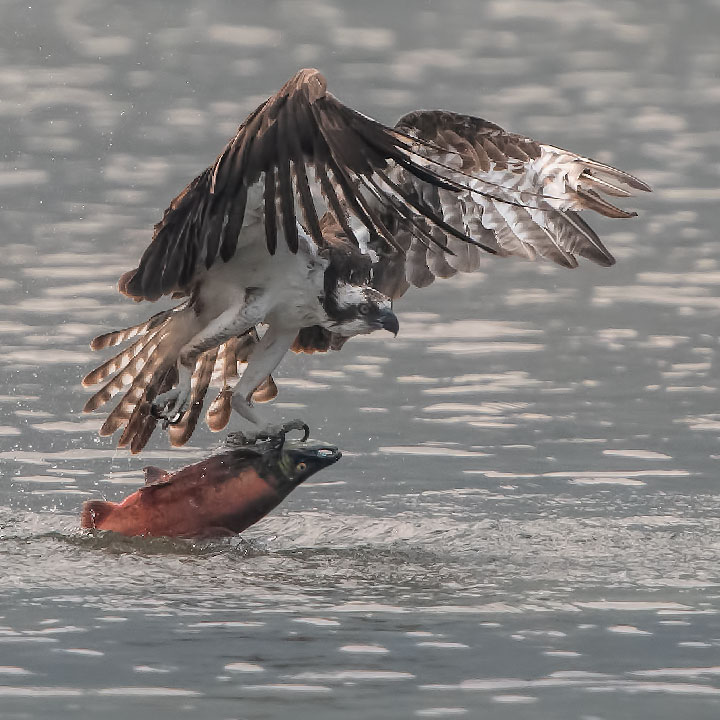
Ospreys feast on fish caught live. But, just try to capture a picture of an osprey lifting a fish from the Lake. The problem is that it happens amazingly quickly somewhere over a rather large area.  I have only managed to record the event once before.

Consequently, this morning’s shot of a (male) osprey lifting a (male) Kokanee from the Lake is one of my most satisfying shots of the year.

An Osprey and its catch.

Posted in birds, fish | 16 Comments