Alula: A structure on a bird’s wing occasionally deployed to limit stalling at high angles of attack.
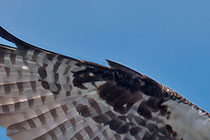
It is fun to discover something on one’s own — even if it is already in the literature. Such was the case this morning while I watched a hummingbird: I realized it lacks alulae.
Most birds have and make good use of alulae. However, alulae are unseen when a bird isn’t flying and only momentarily seen when it is. Consequently, the lack of visible alulae would normally merely be a sign that they aren’t deployed, rather than that they don’t exist. Well, that is my excuse for having taking so long to realize that hummingbirds lack alulae.
Hummingbirds have a different style of flying than other birds. Most birds only obtain lift when their wings are extended during a downstroke, not when wings are somewhat folded during an upstroke. Hummingbird wings are extended during both downstroke and upstroke. During downstroke, most of the lift is obtained, but during upstroke lift is increased by a further third when wings are twisted.
Most birds must have a rapid flow of air against sloping wings to stay airborne. But, when such a bird lands, it must slow. This requires an increase in the slope of the wings (the angle of attack) for it to remain airborne at the lower speed. However, this increases the likelihood of a stall. A solution to this problem is to deploy the alulae which force the airflow back over the wing’s upper surface allowing continued lift and control.
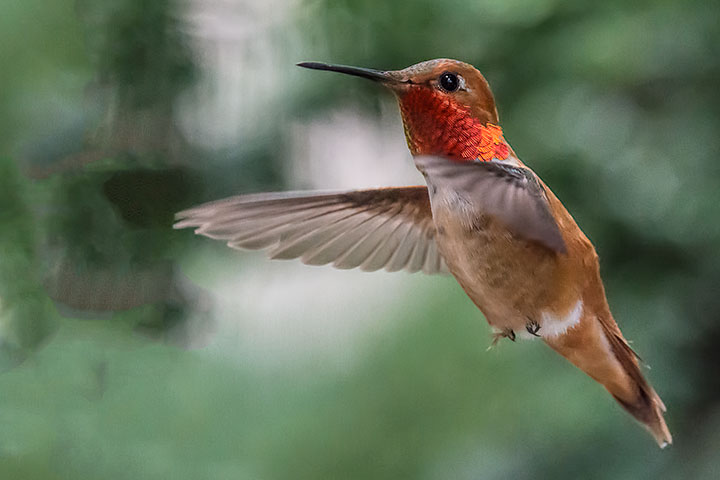
As a hummingbird’s flying style enables it to hover, it does not need to constantly move through the air. It has no need of alulae to prevent stalling, and being extra baggage, evolution has removed them.
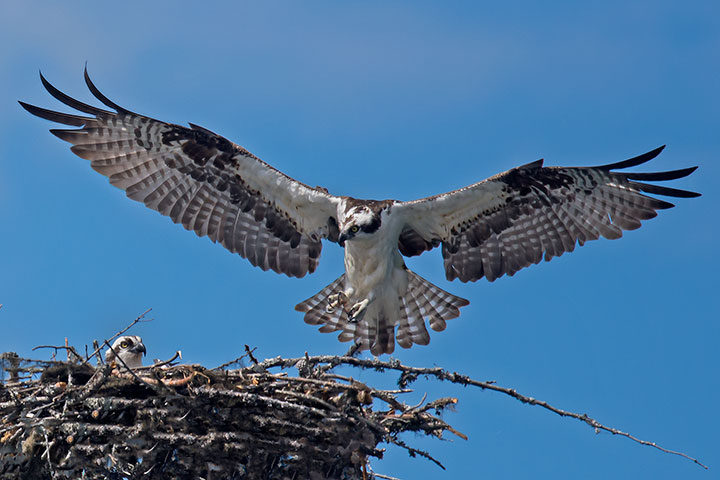
It was the juxtaposition of watching an osprey deploy its alulae and a hummingbird not do so that finally made me suspect that the latter actually lacks them. A literature search confirmed the insight.
An Osprey deploys its alulae (the small extra feathers at the bend of the wings) as it lands at its nest.
A hummingbird can hover and so is unconcerned with stalling. It lacks alulae.


Bird collisions
Do birds collide in flight?
Yes.
Unfortunately, this question is often begged (question’s answer assumed rather than sought), so it is often phrased as: Why don’t birds collide when flying close together? A responder then must struggle with the daunting task of explaining the truth of something that is false.
Now, birds are remarkably good at avoiding collisions and this fact does merit an explanation. However, they are not perfect at it. While avoidance is important, equally important seems to be the rapid recovery from inevitable collisions.
This shot into a flock of Snow Geese shows two collisions. In the upper centre right, two birds are colliding, while in the lower centre, three birds are.

Earlier this week, I was watching Cliff Swallows coming and going from the nests they had built on a human structure. While ascending to adjacent nests two of them collided.

Interestingly, a fifth of a second later each bird had recovered and continued on its way.

Of course, I have been discussing inadvertent collisions. During an attack, a raptor frequently collides with another bird. Indeed, falcons will purposely collide with prey so as to kill it. I lack a picture showing this, but do show one of an eagle about to collide with an osprey in its (successful) attempt to steal the osprey’s fish.
