When a Song Sparrow chases a Mayfly, the match is uneven — the bird will win.
A tenth of a second later, the bug had been captured and swallowed.

When a Song Sparrow chases a Mayfly, the match is uneven — the bird will win.
A tenth of a second later, the bug had been captured and swallowed.
Yesterday was a two-lagomorph day.
Lagomorphs are an order that includes hares, rabbits and the pikas. The rabbit is not found here, but we do have the snowshoe hare and the American pika. Neither is seen often, so how likely is it to see both the same day?
The pika is usually found in subalpine talus — which is where this one appeared.

A snowshoe hare was feeding on forbs when it bolted, thus showing its signature hind legs.

It is difficult to take any good picture of a loon on this lake, let alone a frontal portrait:
• Loons need clear water to spot prey, so they avoid humans, who typically befoul waterways.
• Loons seem to prefer the larger fish found in deep water, so don’t often approach the shore, from which vantage, pictures are easily taken.
• The high contrast of the loon’s plumage presents exposure problems.
• The common practice of waterbirds is to view potential predators sideways rather than head on. This limits the opportunities for frontal portraiture.
• To top this off, the striking red eye of the summer loon is not apparent from every angle.
• All of these problems are exacerbated on Kootenay Lake, because loons do not choose to breed along its shores owing to the variation in water level.
• Strikingly, I have been much closer to grizzly bears than I have been to loons.
I was reminded of these issues while searching for a portrait of a loon to include in the posting, Canadian life, and only found a somewhat acceptable one. The odd thing is that one day after that posting, I managed better portraits when two loons did swim close to the shore.
Two loons offer simultaneous frontal and profile views, even including red eyes. To view the full width of the picture, the cursor must be moved to various places across the frame. (A mobile device uses a tap.)
[photonav url=’https://blog.kootenay-lake.ca/wp-content/uploads/2017/07/loon170702as4.jpg’ container_height=720 container_width=694 mode=move position=center]
A Snowshoe Hare has occasionally visited over the last few months. When first seen, it had already started its transition from the white of winter to the brown of summer. The transition progressed slowly. Three days ago, I saw it in its summer pillage.
The resident Snowshoe Hare stopped by to feed on forbs.

Today — July 1st, 2017 — marks the sesquicentenary of the creation of Canada as a nation.
My two-dozen mute portraits offer peeks into the charm and beauty of life in Canada.


Each year, I try to watch flicker parents flying in to feed their chicks. This year, a Merlin has intimidated our local flickers, so I had to go along the shore to find some other pilings in which flickers were in cavity nests. Finally, on the third visit, there was some action.
A Norther Flicker female flies towards a cavity nest bearing food for its chick. Flicker parents swallow the insects they find, then regurgitate them for the chick. This explains why there does not appear to be anything in the parent’s bill.

Feeding is not impressive; the parent sticks its bill down the throat of the chick and regurgitates.

I had no idea what I was looking at.
The plant was the wild rose (Rosa woodsii), but what were those spiky red balls on its leaves? Adjacent clues — spider’s threads, spittlebug’s froth — turned out to be irrelevant.
Rather, these are galls provoked by the rose-leaf gall wasp (Diplolepis polita). The wasp lays eggs on the leaf and the leaf responds by encasing them in a gall, inside of which grow one or more wasp larvae. The gall provides the larvae with both protection and food. What chemical stimulus would prompt the wild rose to respond in this way seems to be a mystery.
These spiky red galls are the plant’s response to the eggs of the rose-leaf gall wasp.

Predators have various hunting styles: some wait in ambush, others search. I watched each style yesterday. In these cases, the prey were insects. One predator was a bird; the other, a spider.
The Western Tanager (this is a female) flies from branch to branch in a canopy. At each stop, it scours leaves for insects and larvae and then eats them.

Restlessly, the Western Tanager never stays long on any branch and is soon off to another one.

The hunting style of the crab spider is different. It waits on a flower until a pollinator comes by, grabs it, and eats it. The pollen spread around it on the daisy petal testifies to a recent conquest.

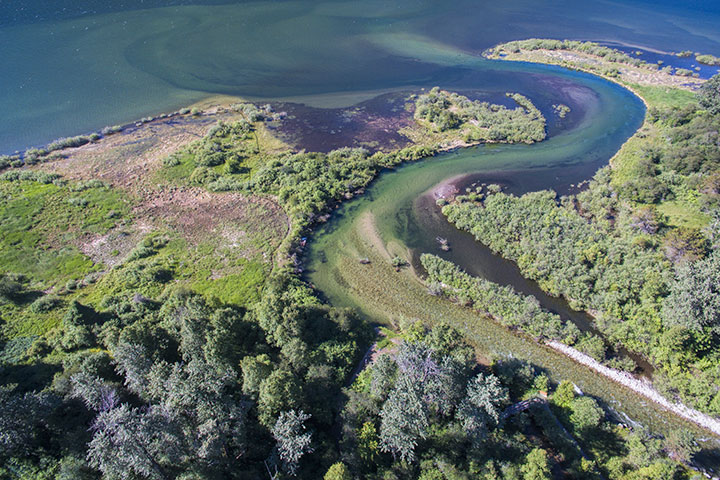
It has happened before, and it will happen again: The mouth of Kokanee Creek will (abruptly) shift to the east.
The portion of the delta immediately to the west of the creek mouth is strewn with gullies and ponds. These are the older channels of the creek. Two years ago (February 2015) I wrote about this and showed pictures of this terrain under the title, wandering creek. I also showed pictures of the bank slump along the berm where, I believe, the creek will, in a few years, break through and flow into the grasslands to the east.
Since that time, this berm of soil and brush between the creek and the grasslands has become thinner and thinner as the creek has continued to erode it.
Such erosion is a natural process when a creek or river flows through gentle terrain: Material on the outside of a bend is transferred to the inside causing the channel to shift. When flowing down a steep mountain valley, the stream is constrained. But, on a delta, the creek bed wanders. Of course, around Kootenay Lake, there are settlements on most creek deltas, with the result that humans use concrete or riprap to prevent such wandering.
To a good extent, the stewardship of Kokanee Creek Park has been left to the devices of nature. One result is that near its mouth, the creek occasionally shifts course. When the next big course change takes place, I suspect it will happen fairly quickly. It will be fun to be able to watch geology in action as the creek breaks through into the grasslands on the east side (left) of the picture and leaves behind more ponds on the west side (right).
This is a view of the mouth of Kokanee Creek as it flows into Kootenay Lake. The region of interest is the outside of the bend that appears in the centre of the picture. It is here that the berm of dirt and brush protecting the grasslands is eroding rapidly and will soon break.
Like a bird on a wire
There is something unsettling about seeing a bird on a wire — possibly this arises from the juxtaposition of wild and processed.
The memorable line, like a bird on a wire, came from Lenard Cohen. In the 1960s, he was living on the Greek island of Hydra when the beginning of electrical distribution resulted in a disturbing sight: Birds began to perch on the newly installed wires. This shift in the landscape prompted his iconic song about the freedom to choose. From the bird’s point of view, a wire was just another available perch, which was maybe what Cohen was getting at when he wrote:
Like a bird on the wire … I have tried in my way to be free.
In his song, Cohen used like as a comparative. However, I use it as a verb when I say: On balance, I don’t “like a bird on a wire”.
All of which makes the line ambiguous. Four birds on wires follow.
Mountain Bluebird

Tree Swallow

Rough-winged Swallow

Common Yellowthroat
