Thicket trail


This is an experiment: I want to be able to display a navigable full-sphere image.

For the meaning of full sphere, imagine that you are at the centre of a sphere, but can look in any direction whatsoever. You can scan 360° around the horizon (and so come back to where you started); you can also lift your eyes to the zenith or look down at the nadir. In short, you can examine everything within the sphere centred upon your eyes.

By navigable, I mean that, by clicking and dragging, you control where you look. By clicking on the icon on the lower right, the navigable image becomes full screen.

The picture for this experiment was taken alongside the Thicket Trail in Kokanee Creek Park.
[vrview img=”https://blog.kootenay-lake.ca/wp-content/uploads/2017/06/thickettrail_equi170619bs2.jpg” width=”695″ height=”480″]

Yikes, the experiment worked during the preview, yet failed in Safari, but worked in Chrome and Firefox. Sorry for the inconsistency.

Posted in scenes | 11 Comments

Owl, toad, rainbow


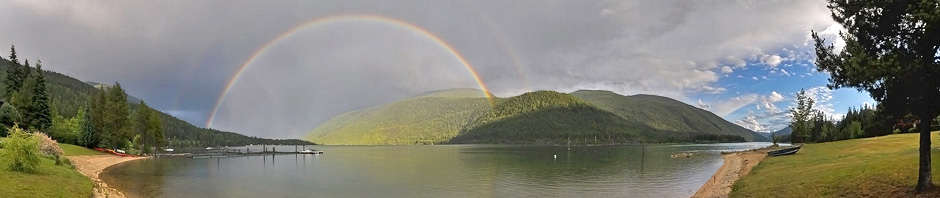
Seen yesterday: a Great Horned Owl chick, a Western Toad, a double rainbow.

A recent posting showed a Great Horned Owl parent and one of its chicks. Here is the other.

Lest one be called a speciesist, we must recognize this Western Toad as one handsome fellow.

Things to notice in last evening’s double rainbow:
  • the darkest region of the sky is between the two bows;
  • red is on the outside of the primary bow, but the inside of the secondary bow;
  • the colours are best near the horizon;
  • the supernumerary bows (faint bows inside primary) are best near the top of the primary.

To view the full width of the picture, the cursor must be moved to various places across the frame. (A mobile device uses a tap.)
[photonav url=’https://blog.kootenay-lake.ca/wp-content/uploads/2017/06/rainbow170616s3.jpg’ container_height=480 container_width=695 mode=move position=right]

Posted in birds, herptiles, weather | 5 Comments

Worm for lunch


One does not have to spend much time in the company of robins to realize that earthworms have an uneasy friendship with them. Each time a robin invited one to lunch, the worm demurred.

This worm clung to its home so strongly that it took multiple invitations and much effort before the robin persuaded it accept a luncheon invitation.

However, in the end, the worm was persuaded to come for lunch.

Posted in birds | Comments Off on Worm for lunch

Chicks’ water behaviour


Who can resist the sight of mommy duck parading her ducklings across the water? It is especially cute when the chicks hitch a ride on mommy’s back, as merganser chicks do.

However, this is not the only neat behaviour that these merganser chicks exhibit. In addition to hitching a ride, chicks both draft and plane.

Merganser chicks ride on mommy’s back as a way to keep pace with her swimming. 

While some of the chicks are hitching a ride on mommy, many of them are following behind in the water. Keeping pace with mommy in free swimming is a problem for, due to their lesser length, the chicks have a lower hull speed. The solution is to draft mommy. By travelling in a group behind her, water resistance is lowered and they can keep up. 

There is another way the chicks can keep up with mommy: They can plane. This is another method of getting around the problem of the speed limit imposed by their hull speed.

At a speed somewhat below the swimmer’s hull speed, the swimmer is in displacement mode, where support is (primarily) a result of buoyancy. When planing, support is (primarily) provided by the rush of the water against the tipped-up hull. However, to attain this new state requires considerable energy (as any pleasure boater will confirm).

It is true that owing to a lower threshold speed, planing is easier the smaller you are (chicks are better at it than adults), but it is also the case that a particular hull configuration is needed. In displacement mode, a rounded stern (for a boat) or butt (for a bird) is desirable: In planing mode a sharp underwater transition between the hull and transom is necessary. A bird normally has a rounded butt, so how does it make the sharp underwater transition it needs to be able to plane? Answer: It forces its tail feathers down into the water.

This picture shows two merganser chicks in planing mode (left) and one in displacement mode (right). The chick on the right has its tail feathers lying along (slightly above) the water surface. The two chicks on the left have forced their tail feathers as deeply as they can into the lake. Also the wakes look different whether the swimmer is in displacement or planing mode.

This image shows all three behaviours. There are chicks that solve the problem of the speed mismatch by riding on mommy’s back. There are also chicks that are keeping pace by drafting mommy. Finally, three chicks (upper left, centre, lower centre) are planing.

Posted in birds | 3 Comments

Great horned chick


A birding guidebook says that the Great Horned Owl is a common resident of almost all habitats in our region. Fair enough, but just try to find one.

So, it was a delight to encounter one, and its chick, in the last few days. (OK, I didn’t find it on my own; Joanne Siderius, the senior naturalist at Kokanee Creek Park, showed me where to look.)

A Great Horned Owl perches high in the forest and watches trail walkers far below.

Nearby is one of its two chicks on its first day out of the nest.

Posted in birds | 7 Comments

A few birds


Four species seen during a walk.

Usually found flitting about bushes, the Grey Catbird is named for its cat-like call.

This is a robin. The speckled breast reveals it to be a juvenile.

Two male Barrow’s Goldeneye Ducks seem to synchronize the examination of an intruder.

The Red-naped Sapsucker is a woodpecker that carves horizontal lines of holes in the bark of trees. Later, it returns to collect the sap and insects attracted to it. Earlier holes can be seen as a line of scars on the tree trunk.

Posted in birds | 2 Comments

Wildflower walk


A forest walk revealed wildflowers.

The Tiger Lily likes sunshine and so favours clearings in the forest.

Also a member of the lily family, the Queen’s Cup favours the dappled sunlight of moist woodlands and was strewn across the forest floor in the hundreds.

Far more picky than the two lilies in its choice of habitat is the Mountain Lady’s Slipper. This wild orchid seems to favour deep-forest slopes where the soil has been made alkaline by seepage. Although it is possibly found in a number of locations around the Lake, I know of only two, and each of them may have as few as a half-dozen flowers.

Posted in wildflowers | 3 Comments

Spring Odonata


The Odonata season has begun. This order of carnivorous insects includes dragonflies and damselflies. These three early-season members were seen in wetlands around the Lake.

Previously, I have seen a Four-spotted Skimmer Dragonfly in mid-May, but early June works.

A male Pacific Forktail Damselfly rests on a leaf. This is a common and widespread little damselfly that frequents marshes throughout the summer.

This is likely a Northern Spreadwing Damselfly. The interest here is that this is the first time I have watched either a dragonfly or damselfly eating another insect.

Posted in bugs | Comments Off on Spring Odonata

Dimorphic parenting


This is the season to see chicks. This is also the season to notice a rather odd behavioural difference between birds that show sexual dimorphism and those that don’t.

A species with sexual dimorphism exhibits different characteristics beyond the differences in their sexual organs. Indeed, the male and female often look markedly different. In a species with sexual monomorphism the male and female are difficult to distinguish.

Some birds are monomorphic; some are dimorphic. Among dimorphic species, it is usually the male that has the brighter and fancier plumage, but now and then it is the other way around (kingfisher). Sexual differences in appearance seem to have evolved as a result of the mate selection by females.

Curiously, the visual difference is accompanied by a behaviour difference in parenting:

The lesser the similarity in appearance, the lesser the involvement in breeding duties by the more colourful bird (usually, but not always, the male). The greater the similarity in appearance, the greater the equality in breeding duties.

I was reminded of this yesterday while watching an impressive group of Wood Duck chicks and someone in the group wondered why the chicks weren’t accompanied by both parents. The short answer is the Wood Duck is sexually dimorphic.

The first picture shows the female (left) and male (right) Wood Duck (appropriately) perched in a tree. They are strikingly different in appearance (March 28, 2016).

Consequently, during yesterday’s observation of thirteen Wood Duck chicks, we expect to see only the mother with them. (The most Wood Duck chicks I had previously seen were three.)

Similarly, the (sexually dimorphic) Common Mergansers seen five days ago only shows mommy with the chicks.

Contrastingly, Canada Geese parents look much the same, and both tend chicks (May 31, 2011).

The similarity of Osprey parents implies that both have parental duties (July 19, 2013).

Posted in birds | 3 Comments

Wolf


We have wolves around here, but I have never seen one. Fortunately Doug Thorburn sent me this picture of one he saw yesterday on an old logging road.

Doug Thorburn’s picture of a Grey Wolf is used with permission.

Posted in mammals | 3 Comments