It is snowing. Here is one snowflake’s view as it drifts down to join its colleagues in a forest.

It is snowing. Here is one snowflake’s view as it drifts down to join its colleagues in a forest.
This is an end-of-the-month collection of images, none of which has had a posting of its own.
Each winter, we hope to see irruptive species, birds whose southward migration is sufficiently erratic that on any given year they may or may not appear. There are perhaps a dozen-and-a-half such species that one sees only every so often. This has not been a good year to see irruptive species. I saw a flock of Pine Siskins last November, a half-dozen Bohemian Waxwings this month, and this lone Pine Grosbeak. Slim pickings, indeed, for this winter.

The Belted Kingfisher is a permanent resident and a frequent visitor along the lakeshore.

I see a Pileated Woodpecker maybe once a month, but I cannot recall seeing two together before. The one on the left is an adult, but the dark eye of the one on the right indicates that it is a juvenile.

At only a tenth the weight of the Pileated is the Downy Woodpecker. It is not seen as often.

Throughout a year, I see many birds and mammals and many of their young. Yet, I rarely have seen a dead animal. I guess that nature normally cleans them up quickly. This dead Long-tailed Weasel could not have been cleaned up by nature until it was first fished out a toilet where it had drowned.

Distinctly more alive is this female Bighorn Sheep.

In late January a year ago, I managed to get a picture of Double-crested Cormorant expressing itself (Now hear this). It has happened again.

It is not everyday that one sees one, let alone three, owls. Seen were the smallest of our owls, the Northern Pygmy Owl, and the largest, two Great Horned Owls. (In fairness, the Snowy Owl is even bigger, but it is rarely seen locally, and then only when it has wandered far off course.) The owls are presented in the opposite order in which they were seen during last week’s visit to the Creston Flats.
The Pygmy Owl is unusual in both hunting during the day, and being the smallest of our owls. The eyeballs of an owl are not spherical and so cannot be rotated in their sockets. Consequently, to look around, an owl must rotate its head, something facilitated by extra neck vertebrae. A composite of two pictures taken of a pygmy sitting on a great mullein illustrates. Without turning its body, the left image shows it looking towards the camera, while the right image shows it looking the other way. The back of its head reveals two fake-eye spots. If you are small, it helps to imply you are always wary.

This Great Horned Owl was seen sleeping on private property, so it wasn’t possible to get closer. What is difficult to realize by comparing this picture with the previous one is the great size disparity: the Great Horned is about twenty times the weight of a Northern Pygmy. This is one big bird.

Named for both its size (great), and the feathered tufts on its head (horned), the Great Horned Owl has become a movie cliche. Despite the fact that only two species of owls hoot (the other is the Barred Owl), every spooky nighttime movie scene must include the hoots of a Great Horned Owl.

When a Great Horned Owl flies, it flattens its feathered tufts, and this reduces both drag and aerodynamic noise. When this owl flies after prey, few escape. Notably, it regularly takes skunks (it seems impervious to the smell). Germain to the present situation, it regularly attacks and eats the Rough-legged Hawk, a raptor with which it shares the Creston Flats in the winter.

By the end of the 1930s, the broad flood plains at the southern end of the Lake had been dyked and grain cultivation had began. Grain attracts rodents; rodents attract predators; predators attract naturalists. (Of course, it is also appealing that the valley is a migratory bird route.)
A January visit is often rich in coyotes and raptors. This week, snow hid rodents and so predators seemed sparse. However, there were enough to make it interesting and below are three. Owls will be treated in another posting.
A coyote roams the Creston Flats in the fog as it hunts for rodents under the snow.

The Red-tailed Hawk is a staple year round. While it has a variable plumage, the dark patagial bars on the inner front edge of the underwings are important distinguishing features.

Sightings of a Rough-legged Hawk are a major reason to visit the Creston Flats in January. This raptor spends its summer in the Arctic breeding and feeding on lemmings. Only in the winter does it visit southern Canada. Distinguishing features are the dark patches at the bends of the wings.
So unexpected was yesterday’s sighting of a mink that I initially guessed it was a particularly small otter. Small indeed. While the otter and the mink are both semiaquatic members of the same weasel family (mustelidae), the otter is about eight times the weight of the mink.

Yesterday, my backyard thermometer rose to +5° C for the first time in over a month. And with the warmth, Ruffed Grouse reappeared — two of them seen over 3 km apart.
The first grouse sat motionless in the bush and appeared to be a log butt showing its grain.

The second grouse didn’t feel any need to hide. It brazenly crossed my path confident that its plumage offered camouflage even in snow. It seems destined to make some coyote very happy.

Fresh from having seen Trumpeter Swans in Kokanee Creek Park, I have now seen an accipiter there.
Accipiters are a genus of hawks; They are not a species. Accipiters are distinguished by short, broad wings which have been adapted for fast flight through woods. As such, accipiters would seem to be a comfortable fit to our highly wooded Park.
But, which accipiter did I see? The picture, below, suggests two likely choices: Cooper’s Hawk, Sharp-shinned Hawk. At first I guessed one, but then decided from the picture that it was probably the other.
However, rather than influence the few hard-core birders who subscribe to my blog, I leave it to them to tell me what it was that I saw in the Park.

Sometimes, persistence pays. Four days ago, I watched two swans circle over the bay to the west of Kokanee Creek Park. The next day I head reports of them, but failed to find them — they were in the vicinity, but where?
Today, I was looking for something else when friends said, “There are two swans at the bottom of this path….” Finally, I managed a shot.
However, there was a striking feature I had seen before: geese and dabbling ducks were keeping company with the swans. I suspect that their motivations had to do with the long necks of swans. All of these bird forage in the shallows by tipping down and using their long necks to scour the bottom. The longest necks belong to swans; they are able to forage to depths where geese and ducks cannot. But, if swans are present to stir up detritus on the bottom, geese and dabbling ducks can pick it off as it floats near the surface. So, it is that others like to hang out with swans.
Trumpeter Swans forage and attract Canada Geese and Mallards that take advantage of the activities. 
For everything there is a season, and
a time for every matter under heaven:
a time to be born, and a time to die….
Ecclesiastes, chap. 3
To which a naturalist might add:
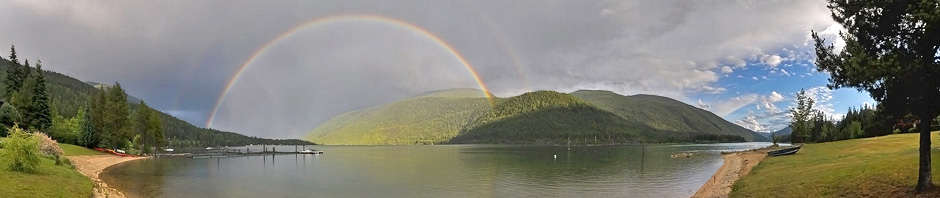
a time for rainbows, and a time for steam devils….
In the perceptive passage from Ecclesiastes, the teacher addresses episodic events in the lives of humans. Yet, the insight, that for everything there is a season, applies equally to the natural world. Normally, one does not look for rainbows in winter, nor for steam devils in summer. The study of quasiperiodicity in nature is phenology. While not as poetic as the teacher’s words, each speaks to nature’s seasonality.
What the devil?
Dust devils, snow devils, and steam devils are whirlwinds close to the surface. Why this name? Devil is from a Greek root meaning to throw. Satan earned it by throwing slander. Dust devils earned it by throwing dust.
With the arrival of cold, I knew the season was here for steam devils over the Lake. The devils playing on the water this year have not yet been quite as spectacular as ones I have seen during previous cold snaps, see steam devils, and devils’ playground. However, until it gets really cold again, these are the best I have.
To be able to see a steam devil, there has to be steam fog to serve as a tracer. With biting cold air flowing over the open waters of the Lake, convective sprites of steam fog abound. Occasionally, convection stretched a velocity gradient into a tall vortex and so created a steam devil. One appears in the foreground of this picture.

A very much taller but fainter steam devil appears in the distance. It probably would not have been noticed had it not been seen against the dark mountainside.

It is a mystery: Why are woodpeckers attacking the soffits of my home now that it is cold out?
About the only time I had previously seen woodpeckers attack my home was in the spring when male Northern Flickers hammer on the metal flange of the chimney. They have discovered that thin metal provides a more impressive sound than does a tree and so more effectively demonstrate prowess to a potential mate.
Yet, a couple of weeks ago, a Pileated Woodpecker made a racket as it probed under the chimney’s flange. As it was making a clatter at my chimney on Christmas morning, and as it wore a red cap, I succumbed to the temptation to suggest this was actually Santa Claus.
I thought nothing more of it. But then, a male Pileated Woodpecker returned and probed a soffit for comestibles. A few hours later a Northern Flicker did likewise. After years of not bothering to look for arthropods in my siding, why were woodpeckers suddenly taking an interest in the house?
Throughout this period, it has been cold. Woodpeckers have probed trees, pilings, and utility poles during other winters, but what is it about the wooden siding of a house that attracts them now? I don’t know.
A Pileated Woodpecker probes for grubs along the soffit of my home.
A few hours later, a Northern Flicker does likewise.
