Three weeks later, I revisited the nest of Bald Eagles. Earlier, no chicks were visible. Now, a couple of chicks occasionally peered out. This is a picture of one of them.
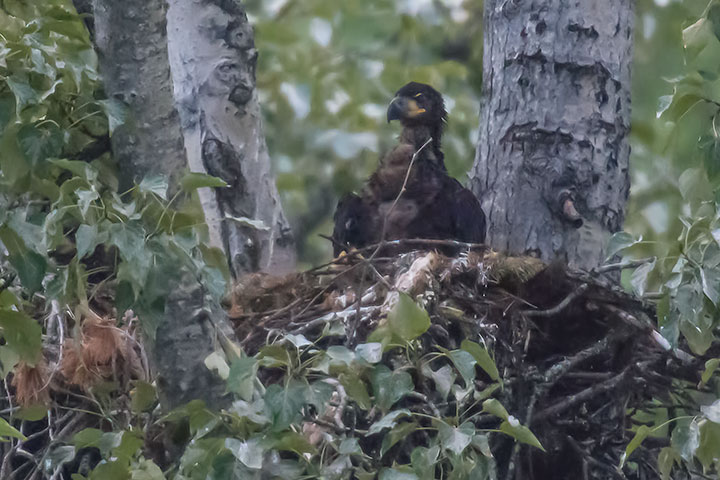
Three weeks later, I revisited the nest of Bald Eagles. Earlier, no chicks were visible. Now, a couple of chicks occasionally peered out. This is a picture of one of them.
If this issue has been settled, I don’t know about it. The issue concerns an osprey’s fidelity. Certainly, an osprey seems to mate for life, but is it being loyal to its mate or do both partners merely return to the same nest site each summer?
The question of osprey loyalty is one that might take many observations or experiments to answer. The answer is of interest around Kootenay Lake, which has an unusually high summer incidence of ospreys.
Today’s observations merely attests to osprey loyalty. It gives no insight into the reason for this loyalty, for an osprey had returned to the same nest as the previous year.
I took this picture beside one of my favourite osprey nests in May of last year (2015). This osprey bears a band on its left leg — something rarely seen on local ospreys.

Today, I visited the same nest and photographed an osprey with, presumably, the same banding on its left leg. There is a loyalty to something.

For many weeks, I have been watching a dipper nest as I wait for the chicks first to arrive and then be old enough to peek from the nest as they are being fed.
By displaying their yellow gapes, the chicks tell a parent: feed me.

We are all depressingly aware of recent vicious attacks made by individuals who believe they know the ultimate truth and that anyone who might think differently should be either cloistered or killed.
My recent experiences fall well short of this level of megalomania. Yet, they are a symptom of the same mindset: destroy rather than build.
In the last two days, my blog has been under continual attack by those who would subvert it to their own sleazy purposes. Not content to promote their ideas or products on their own merits, they prefer to co-opt the work of others.
I note that my blog is at most only of minor local interest. It discusses the wildlife, natural phenomena, and scenes around Kootenay Lake, Canada. Yet, in the last few years, it has been hacked twice and forced to (temporarily) promote irrelevant pharmaceuticals. At present, it is experiencing a third, ongoing, widespread, and coordinated attack, presumably with the objective of similarly turning it to the dark side.
The attack on blog.kootenay-lake.ca is impressive in its scope. In two days, there have been over three hundred attacks and that number is still climbing. Here is a list of the countries (internet jurisdictions) from which attacks have so far arisen:
Abu Dhabi, Albania, Algeria, Argentina, Armenia, Australia, Austria,
Bangladesh, Belgium, Bolivia, Bosnia and Herzegovina, Brazil, Bulgaria
Cambodia, Canada, Chile, Croatia, Cyprus, Czech Republic,
Denmark, Dominican Republic, Dubai,
Egypt,
France,
Georgia, Germany, Ghana,
Hong Kong, Hungary,
India, Indonesia, Ireland, Israel, Italy, Iraq, Ivory Coast,
Japan,
Kenya, Korea (Republic of),
Lebanon, Lithuania,
Macedonia, Malaysia, Mauritius, Moldavia (Republic of), Montenegro, Morocco,
Nepal, Netherlands, Nigeria,
Oman,
Pakistan, Philippines, Poland, Portugal,
Qatar,
Romania,
Serbia, Singapore, Slovakia, Slovenia, South Africa, Spain, Sri Lanka, Switzerland,
Taiwan, Thailand, Tunisia, Turkey,
United Arab Emirate, United Kingdom, United States, Ukraine, Uzbekistan,
Venezuela, Vietnam,
Zambia, Zimbabwe.
Three things are worth recognizing:
• Computers in many of these countries are responsible for not one, but multiple attacks
• It is likely that the attacks are coordinated from one location and that the owners of the compromised machines have no knowledge of what is going on
• The attacks are undoubtedly incidental to my blog’s specific content, arising only because the work of others is deemed exploitable.
Sigh.

I watched a moose swim along a shoreline in the rain. Previously, I have only ever seen a moose swim across a lake. However, moose are comfortable in water and have been known to swim for twenty kilometres. This male only swam about 500 metres before coming ashore.

By the time it climbed out, the rain had nearly stopped.

It then wandered off through the brush.

Before climbing out, it stopped briefly to stare at my camera. However, a moose’s poor vision probably prevents it from understanding digital photography.

Locally, we get two species of waxwings: Bohemian Waxwings in the winter; Cedar Waxwings in the summer. Bohemians course about in large flocks (see, waxing alliteratively, Bohemian Waxwings). Cedars are here to breed and so don’t move about in the same numbers.
The first Cedar Waxwing spotted yesterday was a fledgling. It lacked the silky feathers of an adult.

An adult flew in.

Cedar Waxwings are not seen locally in large flocks, but a few hang out together. Easily seen are the red waxy tips to the wing feathers after which waxwings are named.

Three days ago, I posted pictures of Chestnut-backed Chickadees parents bringing food to their chicks in a cavity nest. On this first non-rainy day since, I returned in the hope that the chicks would now be peeking out of the nest.
All was quiet.
There were neither chickadee parents nor chicks. Yet protruding from the cavity, was the hind end of a dead weasel-like mammal. Its fur was matted as if by the previous day’s rain.
I don’t know what this animal is. And while I can easily imagine it wanting to eat those delectable chicks, what could have killed it in flagrante delicto? I would have thought that the chickadee parents would have been defenceless against it. Any insights are welcome.
A small mammal died while raiding a chickadee nest. What is it? How was it killed?

This is the season of chicks. Three weeks ago, a male Wild Turkey treated us to its display. Now a female shows off her chicks. Ron Welwood sent me this picture taken in his yard.

Ron Welwood’s picture is used with permission.
A walk through the forest in Kokanee Creek Park revealed two oddities that do not quite fit normal ideas: pinedrops and slime mould.
Pinedrops are a mycotroph, a plant that lacks chlorophyll and so cannot synthesize its own carbohydrates. This might seem to put it at a disadvantage, but it has carved out an ecological niche on the forest floor where plants that must photosynthesize struggle from a paucity of sunlight. Mycotrophs obtain their carbohydrates indirectly from another plant (say, a tree), but through an intermediary, a mycorrhizal fungus. Locally, we have a number of mycotrophs: indian pipe, striped coralroot, spotted coralroot, pinesap, and today’s topic, pinedrops.
There were a half-dozen pinedrops growing adjacent to where another mycotroph, a spotted coralroot, was seen on a previous occasion.

As if mycotrophs aren’t odd enough, consider the slime mould that was seen elsewhere in the Park. Slime moulds are protists, a grab-bag classification for microscopic organisms that are not bacteria, not animals, not plants and not fungi. A slime mould starts life as individual free-ranging cells. Later they amalgamate to form a plasmodium, a blob of protoplasm with only a membrane to keep it together. The mould can move slowly as an entity and is often seen on rotting trees where it engulfs and digests bacteria. Known by various names, such as scrambled-egg slime and dog’s vomit, the slime mould has even inspired a horror movie, The Blob (1958, remake 1988).

Bird collisions
Do birds collide in flight?
Yes.
Unfortunately, this question is often begged (question’s answer assumed rather than sought), so it is often phrased as: Why don’t birds collide when flying close together? A responder then must struggle with the daunting task of explaining the truth of something that is false.
Now, birds are remarkably good at avoiding collisions and this fact does merit an explanation. However, they are not perfect at it. While avoidance is important, equally important seems to be the rapid recovery from inevitable collisions.
This shot into a flock of Snow Geese shows two collisions. In the upper centre right, two birds are colliding, while in the lower centre, three birds are.

Earlier this week, I was watching Cliff Swallows coming and going from the nests they had built on a human structure. While ascending to adjacent nests two of them collided.

Interestingly, a fifth of a second later each bird had recovered and continued on its way.

Of course, I have been discussing inadvertent collisions. During an attack, a raptor frequently collides with another bird. Indeed, falcons will purposely collide with prey so as to kill it. I lack a picture showing this, but do show one of an eagle about to collide with an osprey in its (successful) attempt to steal the osprey’s fish.
