Robin chicks


Both robin parents tend their chicks in the nest. The parent featured here is the mommy. 

A female robin pauses on a branch before delivering a mouthful of worms and insects to her chicks.

At the nest, four chicks beg: Feed me.

And one of them gets fed (this time).

Then, that chick turns its bottom up and poops out a faecal sac which mommy picks up to discard.

Posted in birds | 5 Comments

Kestrel nest


It has been five years since I last managed to photograph kestrels feeding chicks in a nest (kestrel bonanza). On that occasion the chicks feasted on both bugs and a decapitated bird. This time, it was bugs and a mouse. I will try to visit the latest nest again before the chick fledges.

The kestrel mother passes a green bug to her chick. 

Parents share in the feeding. I only spotted the kestrel father when he was about to leave the nest.

However, the chick happily displayed the tasty prize daddy brought: a mouse. 

Posted in birds, mammals | 3 Comments

Black-chinned


July has brought a hummingbird transition around my home. Earlier the Rufous dominated, now the Black-chinned does. 

The male Black-chinned Hummingbird has a distinctive black head, which depending upon the lighting might be edged with iridescent purple.

Unlike the aptly named Rufous, the Black-chinned has a greenish back and a black tail. 

However, the female Black-chinned Hummingbird is the real cutie as a result of its delightful penchant for spreading its tail feathers. 

Posted in birds | 2 Comments

Protect and serve


Protect and serve — not the police, parents — and not people, birds. 

While chicks are in the nest, bird parents have a seemingly endless task of ferrying food in and waste out. And then there is the job of keeping predators at bay.

A dipper parent brings an aquatic insect to its four demanding chicks.

These dipper parents have already done much to protect their chicks from land predators. The nest is under a bridge high over a raging stream. Further, the bridge deck prevents a raptor’s attack from above. Nevertheless, the nest must be kept clean. Chicks expel faeces in a white sac which parents then remove and discard. 

As with dippers, both Tree Swallow parents deliver insects to the nest. This is a male. The chicks are not yet big enough to be peeking out.

Having delivered food to the nest, the female swallow heads off on the endless round.

And both remove faecal sacs from the nest and drop them far away.

With all the coming and going, sometimes parents collide.

Tree Swallows must protect their nest. In this case, a female Common Goldeneye landed and twice peered into the cavity. It isn’t trying to eat the chicks, and it is late in the season for a goldeneye to start nesting. However, inexperienced female goldeneyes will begin looking for potential cavities the summer before breeding. Even though it is not an immediate threat, from the swallow’s point of view, the goldeneye had to be driven off.

Midst the activity, I managed perhaps my best shot of a swallow in flight.

Posted in birds | 3 Comments

Photobombing fish


Photobombing is a comparatively recent term used to describe a sudden and unexpected addition to a picture.

The object of my picture had been a duck in the centre of the frame, but far to one side a fish jumped. This is not an easy thing to capture purposely, so I happily accept a fish bombing my photo, and cropped out the duck. 

What I suspect is a Kokanee (landlocked Sockeye Salmon) jumped out of the water to bomb my photo.

Posted in fish | Comments Off on Photobombing fish

Deer serenity


The long weekend is a time to retreat from life’s exigencies. So it was that a young buck with velvet antlers arrived in its quest for wholesome serenity.

A White-tailed Deer looks for a good setting for its contemplative retreat.

It scans the neighbourhood with the objective of avoiding the boisterous crowd.

It starts its retreat with some fresh salad.

Sated, it begins yoga. This may be the cervid version of the Urdhva Prasarita Eka Padasana.

Yoga is followed by meditation in the grass. Life’s exigencies melt.

Posted in mammals | Comments Off on Deer serenity

June goulash


This is an end-of-the-month collection of images, none of which has had a posting of its own.

A cinnamon-coloured Black Bear eyes an intruder in its territory.

For a female Osprey to be lifting her tail this late in the season is a bit odd.

A female Redstart flits through the foliage.

A Columbia Spotted Frog prefers the quietude of its pond.

The Western Trumpet is one of the many wildflowers on the mountain slopes.

A Great Blue Heron flies by.

A Pileated Woodpecker searches for insects.

A male Tree Swallow brings a bill full of insects to its chicks.

Posted in birds, bugs, herptiles, mammals, wildflowers | 2 Comments

Spider and fly


“Will you walk into my parlour?” said the Spider to the Fly.

And set his her table ready, to dine upon the Fly.

The text adapts Mary Howitt’s 1829 parable, The Spider and the Fly.

Posted in bugs | 2 Comments

Harrop


Another sunny day, another panorama from high on a Forest Service road. Previously a panorama was centred on Queen’s Bay. This view was taken a little to west and only shows a bit of the Main Lake and the Purcell Mountains on the left. Besides Harrop, on the far side of the West Arm, one can see the peninsula with Kokanee Creek Park on the far right. The Harrop cable ferry is crossing the Arm.

Move the cursor to (mobile: tap image at) various places across the frame to see the whole picture.
[photonav url=’https://blog.kootenay-lake.ca/wp-content/uploads/2016/06/harroppano160626s.jpg’ container_height=720 container_width=720 mode=move position=center]

Posted in scenes | Comments Off on Harrop

Alulae or not


Alula: A structure on a bird’s wing occasionally deployed to limit stalling at high angles of attack.
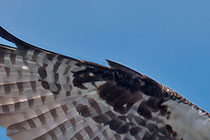
It is fun to discover something on one’s own — even if it is already in the literature. Such was the case this morning while I watched a hummingbird: I realized it lacks alulae.

Most birds have and make good use of alulae. However, alulae are unseen when a bird isn’t flying and only momentarily seen when it is. Consequently, the lack of visible alulae would normally merely be a sign that they aren’t deployed, rather than that they don’t exist. Well, that is my excuse for having taking so long to realize that hummingbirds lack alulae.

Hummingbirds have a different style of flying than other birds. Most birds only obtain lift when their wings are extended during a downstroke, not when wings are somewhat folded during an upstroke. Hummingbird wings are extended during both downstroke and upstroke. During downstroke, most of the lift is obtained, but during upstroke lift is increased by a further third when wings are twisted. 

Most birds must have a rapid flow of air against sloping wings to stay airborne. But, when such a bird lands, it must slow. This requires an increase in the slope of the wings (the angle of attack) for it to remain airborne at the lower speed. However, this increases the likelihood of a stall. A solution to this problem is to deploy the alulae which force the airflow back over the wing’s upper surface allowing continued lift and control.

As a hummingbird’s flying style enables it to hover, it does not need to constantly move through the air. It has no need of alulae to prevent stalling, and being extra baggage, evolution has removed them.

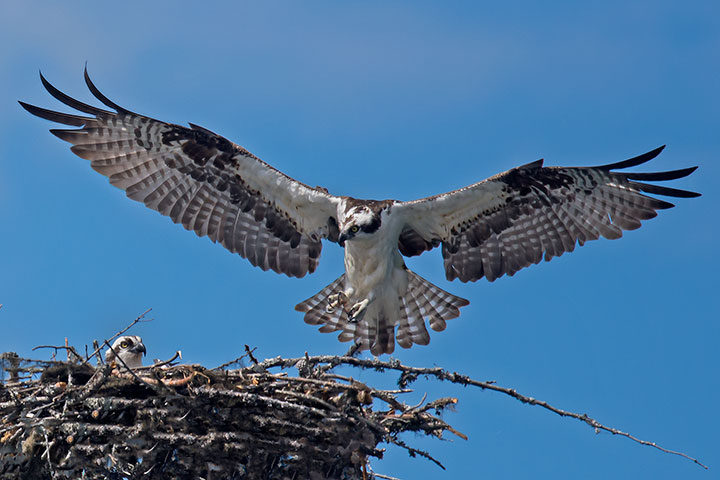
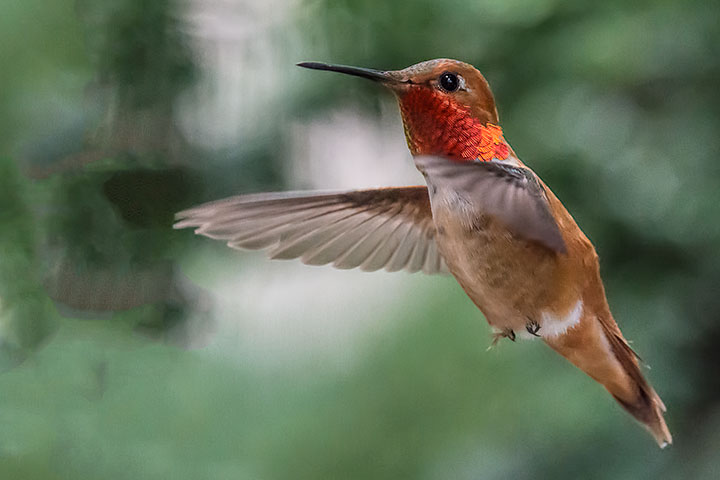
It was the juxtaposition of watching an osprey deploy its alulae and a hummingbird not do so that finally made me suspect that the latter actually lacks them. A literature search confirmed the insight.

An Osprey deploys its alulae (the small extra feathers at the bend of the wings) as it lands at its nest.
A hummingbird can hover and so is unconcerned with stalling. It lacks alulae.
Posted in birds | 4 Comments