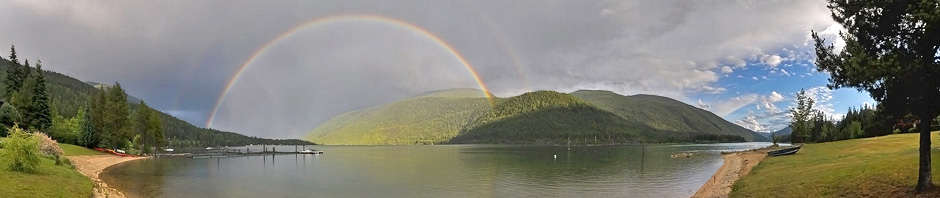
Blue: sky and birds arrived together.

Each year at about this time, a contest ensues. Norther Flickers, who build the nesting cavities and have been on site for some time, are challenged for ownership by freshly arrived Tree Swallows. It usually works out that flickers get to use some cavities and swallows others.
A female Norther Flicker examines a nesting cavity. The male was hanging around doing the same thing.

Tree Swallows (male on left, female on right) arrived on the last day of March to look for nesting sites. Inevitably they try to take over ones that flickers have built for themselves, and the swallows sometimes succeed. On this occasion, they were harassing the flickers in a failed attempt to drive them off.

“Combat is a real nuisance. Just because flickers build the cavities doesn’t mean they should own them all.”

Ducks in trees? Given the day, this might sound as if it is an April Fool’s gag. It isn’t.
About a half-dozen local ducks will nest in trees, among them, the beautiful Wood Duck. It is a bit early to see the nests, but these pictures show that nesting is on the ducks’ minds.
“This is a terrible time of year to be alone on the pond.”

“Hey, big boy I am calling to you down there on the pond — yes, you.”

“OK, I came up into the tree with you — now what?”

“Look, maybe I will have to explain this nesting business to you.”

This blog is about the region around Kootenay Lake, but it is sometimes useful to recognize what cannot be seen here. This posting shows two pictures of a Greater Yellowlegs. Although occasionally this sandpiper is seen around the Lake, the particular bird shown could not have been photographed here. I wonder why this might be?


The sub-adult Bald Eagle is often mistaken for a Golden Eagle for they both can have a mixture of brown and white plumage, but they differ in other ways. Yesterday’s Bald Eagle looks as if it were hatched last summer.
An overflight reveals the mottled plumage of a nearly year-old Bald Eagle.

“I am practicing for a dance competition doing Knees Up Mother Brown.”

The mule deer and the black-tailed deer are the same species, but different subspecies. They have been separated by the Coastal Range of mountains so long that they have evolved a somewhat different appearance and behaviour. While the region around Kootenay Lake has both the white-tailed deer and the mule deer, it lacks the black-tailed deer.
First a earlier picture of a mule deer near the Lake. Its rope-like tail is largely white, but has a black tip.

This black-tailed deer was seen yesterday just west of the crest of the Coastal Mountains. The black on its tail extends the full length, and the whole deer is somewhat darker.

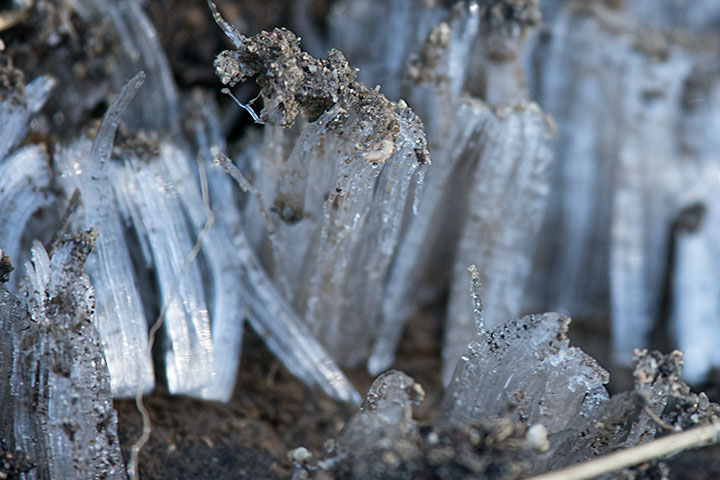
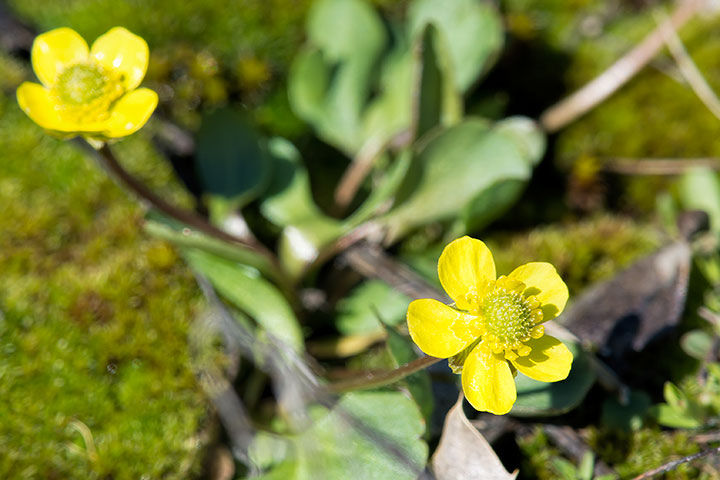
In a lovely example of a seasonal transition, I saw ice extrusions and subalpine buttercups within three metres of each other at an altitude of about 800 metres on a mountainside above Kootenay Lake.
Typically, ice extrusions are seen when the daytime temperature is above 0C and the nighttime temperature is below, so this is not a midwinter phenomenon. During daytime, water drains into the cavities within a porous soil; during nighttime, the freezing water expands forcing little columns of ice up through the ground (often capped with dirt). Those of us who remember the home delivery of milk to a cold doorstep in the winter are already familiar with the process whereby the cap of the milk bottle was lifted atop a column of frozen cream. When I wrote about these a year ago, a commentator noted that geologists refer to these as ice needles, a name that has a different meaning for meteorologists.
About three metres away was a crop of a dozen (what I suspect were) subalpine buttercups (Ranunculus eschscholtzii), an early sping flower — lovely.
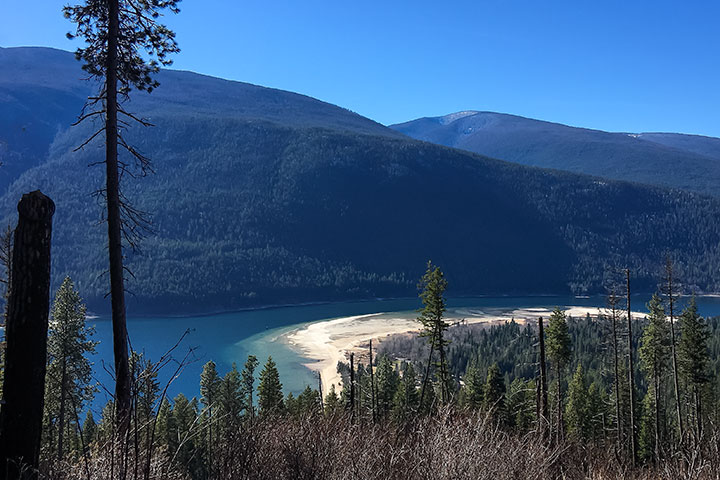
And for fun, I include a picture from the same spot, but looking down towards Kokanee Creek Peninsula.
The winter has passed without any of the Ruffed Grouse in my yard displaying their ruffs. Now that the mating season is approaching, a male grouse was seen to flash some of his ruff without ever opening it completely. What seemed half-hearted now should get serious soon when the grouse’s display is used to both intimidate other males and attract females.
A male Ruffed Grouse shows a bit of its black ruff as if practicing for the forthcoming mating season.

Two days ago in the Park, I watched one of the most frenetic of birds: a Golden-crowned Kinglet. By the time it was spotted and the camera pointed, usually the bird was gone.
Then yesterday, four Trumpeter Swans were spotted far along the shore. They remained in place as I walked the kilometre and a half. While not completely unconcerned by the passage of humans along the beach, they were certainly nonchalant.
The Golden-crowned Kinglet is caught in a rare moment between bursts of speed.

It is not that it even seemed aware that it was being watched, but that it had to hurry to the next delectable.

It is instantly off again.

Contrasting the frenetic kinglets are the languid swans, which hardly moved for an hour.

Psychedelic BOB
BOB is Nelson’s Big Orange Bridge.
Alas, its truss design is more functional than lovely. Even when built in 1957, I remember thinking that a more beautiful bridge would better suit its setting. Curiously, the bridge’s ugliness did not prevent it from becoming — indeed, may have encouraged it to become — a local icon.
Although the truss design suffers from industrial unsightliness, it does offer some interesting mapping projections of a full-sphere image. I might explore these from time to time.
The centre of this full-sphere image of BOB looks west towards the afternoon sun.