A feast of rowan berries (a.k.a mountain ash berries) has been prepared and the guests flew in to enjoy it.
A red-shafted Northern Flicker helped itself.
As did a Varied Thrush.
A Robin showed off its prize.
A feast of rowan berries (a.k.a mountain ash berries) has been prepared and the guests flew in to enjoy it.
A red-shafted Northern Flicker helped itself.
As did a Varied Thrush.
A Robin showed off its prize.
I suppose that we should be grateful that River Otters have a strange compulsion to use boat docks as potties. If it were not so, we would not see them nearly as often as we do.
The otter swam to the boat dock and climbed out. With its tail whipping water drops, it used the dock as a potty.
Although its visit was brief, it did allow a portrait. 
It is the best, most evocative, shot of a Grizzly Bear I have ever seen (and I have seen and taken many grizzly pictures). It was taken by Jim Lawrence, a wildlife photographer (Kootenay Reflections) and friend.
The story of Jim’s shot can be found at the CTV News site, where Jim comments that “the picture reflects the gentle, intelligent nature of the animals.”
Therein lies the impact of an image such as this: It counters the longstanding scaremongering by wildlife magazines and taxidermists, each of which has a vested interest in demonizing these creatures.
If Jim’s wonderful picture tips the balance against the hunting of Grizzly Bears, so much the better.

Jim Lawrence’s picture is used with permission.
The fall is a time of many transitions. Here are two.
A Black Meadowhawk was seen flying around today. November 2nd is late for any dragonfly to be about.
Meanwhile, Bufflehead Ducks fly in. They are rare in summer, but common in winter.
A birder spends time watching and listening; it seems that birds do likewise.
A Wild Turkey watches an intruder.
A Pileated Woodpecker listens for the possibility of insects in a utility pole.
Today on ten-minutes’ notice, I was interviewed for a BBC science programme.
Unexpectedly, I was asked to comment on an article in a British newspaper with the intriguing title:
Passenger’s amazing photo captures moment her plane flew directly over a ‘RAINBOW’
A good rule of thumb is that one should be on one’s guard whenever a copywriter uses the word, amazing. This was no exception. The picture was not of a rainbow but was the result of stress polarization in a birefringent aircraft widow—a phenomenon previously treated in this blog.
The explanation and picture from that earlier posting is:
The aircraft window, itself, can show some interesting features. The stressed plastic of the window is birefringent and so produces colours when seen with polarized light. The light from most scenes is not strongly polarized, but a reflection from a body of water is, so the colours seen here are a consequence of both the reflection (from, in this case, Georgia Strait) and the aircraft window.
To me, what was particularly interesting is that the person who took the picture in the article, Melissa Rensen from London, Ontario, had come close to guessing what caused the colour in her picture: She speculated that it was the result of “the polarized window on the plane.” (The window isn’t polarized, light is polarized, but the window is birefringent). However, another photographer then misled her by suggesting that it couldn’t be in the window by pointing “out that the rainbow was beneath the clouds.” That other photographer was wrong.
The colours seen require three things: polarized light (this comes from sunlight reflected off the water); a birefringent medium (the stressed plastic of the aircraft window); an analyzer (probably the second aircraft window—they are double). The colours do not appear against the clouds in her picture because the light from the clouds is not polarized.
It all goes to show that copywriters should do better research, and should bite their tongues when tempted to use the word, amazing.
Here are four (species of) of birds seen yesterday.
Most Osprey have migrated, yet this juvenile was feeding in a tree along the lakeshore.
The only striking thing about these Wild Turkeys is that while walking across a field, one chose to lift off. 
These are a few of many Pine Siskins feeding on (birch?) catkins.
Derek Kite found this Great Horned Owl near his home.
Derek Kite’s image is used with permission.
In the cool early morning, steam fog rose from a stream and drifted over the countryside.
Wild turkeys are silhouetted in the morning mist as they feed in a field.
As the fog drifts by, its droplets are intercepted by the threads of funnel webs of (what is probably) the hobo spider.
Drops on these webs are captured from the fog; they are not dewdrops.
‘Tis the season of fall colours and my favourite is the larch, a deciduous conifer.
When this posting was made, I believed the trees shown here were alpine larches. Doug Thorburn, a man who knows his trees, assures me that, no, they are western larches. The title and text has been corrected to show this.
The colours of the western larch spill down the mountain side.
When trees are viewed across the valley, contrast and colour is muted.
The western larch is brilliant when seen close by.
Official local site
bing.com (the Microsoft and Yahoo search engine) tries to add helpful information alongside its listings. So, if one searches for Vancouver Canada, out of the many million listings bing produces, it labels the one from the city, itself, as being the official one:
Vancouver — Official Site
vancouver.ca
Similarly, among the many results from a search for Selkirk College, bing obligingly says the same about this institution’s site:
Selkirk College — Official Site
selkirk.ca
Fair enough, that sounds as if it is a useful distinction for a listing.
If you now use bing to search for Kootenay Lake, you discover over a million results, but topping them all is the regions’s official site of (ta-dah):
Kootenay Lake — Official Site
www.kootenay-lake.ca
Yikes, how did they come to that conclusion? What bizarre bit of algorithmic processing has prompted Microsoft to decide that a retiree’s hobby site can possibly be the official spokesman for the region?
Now, I suspect that various provincial ministries would justifiably protest my authority to speak officially on behalf of, say, trees, bears, bumble bees, lake levels, soils, or water purity. Yet, I have a face-saving solution for Microsoft: in the absence of staunch opposition, I will allow my site to speak officially on behalf of local rainbows—and just maybe steam devils (below).
Alistair
Microsoft-certified official local spokesman
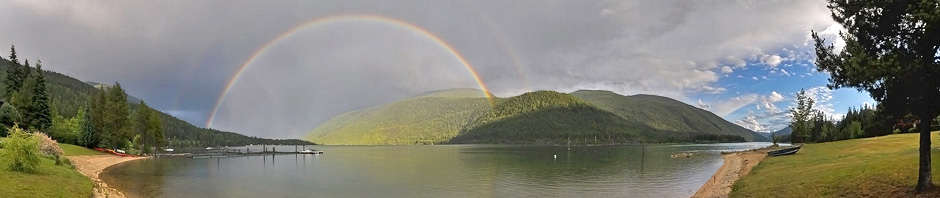
With all of this in mind, I proclaim my favourite rainbow from this summer to be an officially approved bow.

And I might just push my luck and speak officially on behalf of steam devils also.