There is nothing that says spring like the first guttation—not the arrival of swans, swallows, or robins, but guttation. It tells me that local plant metabolism is underway.
Guttation is often confused with dew. Although superficially similar in appearance, dew and guttation come about in different ways and are easily distinguishable. There are examples of each below.
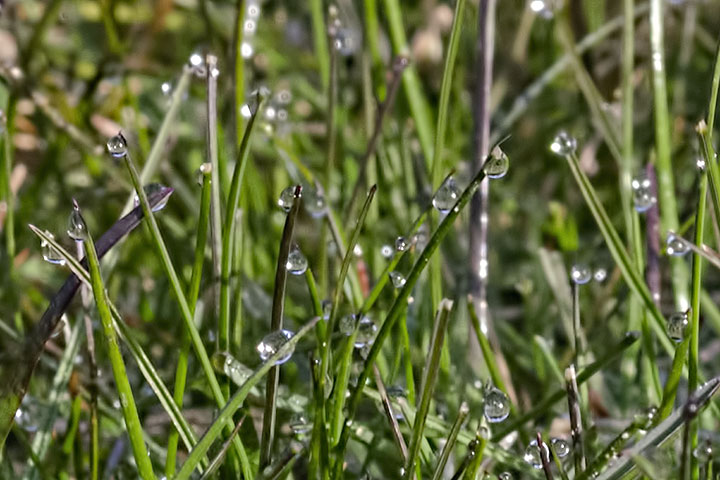
Guttation on grass appears as rather large drops of water hanging from the tip of the blade (although sometimes a drop may slide downwards). It is formed from soil moisture that the roots have pumped upwards. During the day, this moisture would have passed out through the stomates, but with the lower nighttime temperatures, the stomates have closed. Frankly, grass is not very smart and so the roots keep pumping despite the blade having closed down for the night. The water is thus extruded from the tip of the blade to produce the guttation (from Latin, gutta meaning drop + ation).
The source of the moisture for dew is not the ground, but the atmosphere. Water vapour condenses on the cold blade. The grass (or any plant) need not be metabolizing for dew to form. Indeed, dew will form on all manner of cold surfaces. Guttation, on the other hand requires the plant to be metabolizing, making it a good sign that spring is here.
(Incidentally, one sometimes sees a picture of a spider’s web covered with droplets which the photographer has labeled as dew. Alas, those drops are formed neither as dew nor guttation, but something else.)
Nearly spherical guttation drops are hanging from the tips of the metabolizing grass.
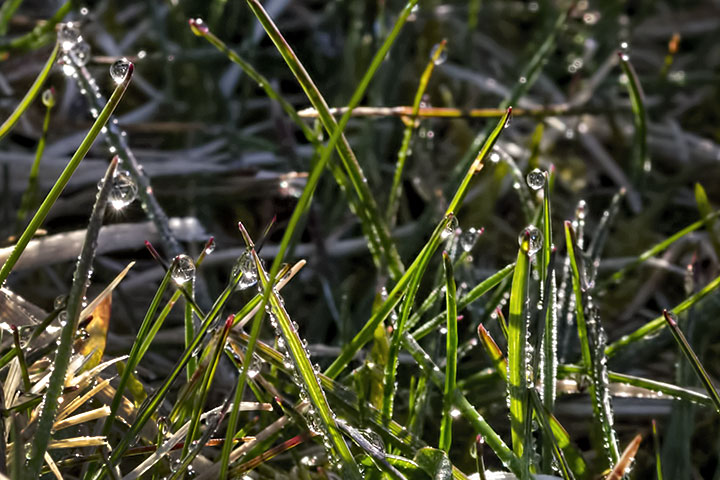
Guttation and dew can form separately or together. The large pendulous drops near the tips of these blades are guttation; the smaller ones along the blades are dew.
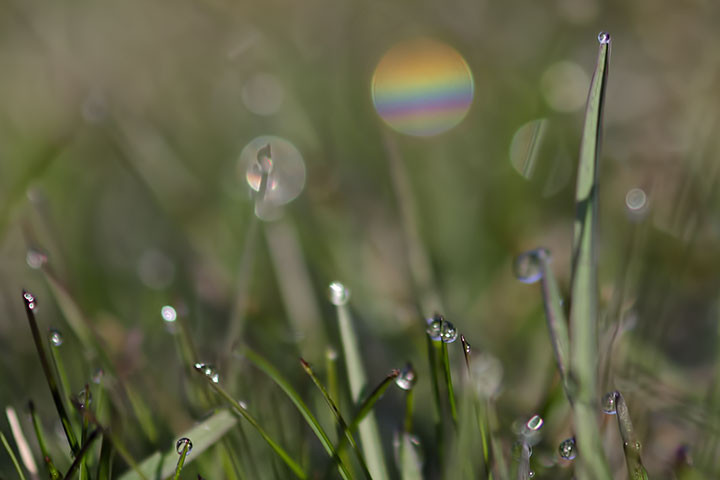
The previous pictures were taken in the general direction of the Sun to attain a high contrast. There are delights to be seen in the other direction: rainbows. Typically only formed by the more nearly spherical guttation drops, the tiny portions of a rainbow are easiest to see when the drop is out of focus.


 It was only later that my pictures showed that the woodpecker had had two Merlins to contend with—not good.


An idiot
This morning, I was repeatedly told I was an idiot.
The backstory is familiar to the handful of people who read this blog. I am a nature photographer. To take pictures of birds, bears, or bugs, I use a telephoto lens stabilized with a monopod. It is my standard equipment on walks along woods, meadows, or beach. I am not alone in applying this rather successful recipe to wildlife images—it is the practice of most wildlife photographers (although some carry an even more bulky tripod).
The majority of the pictures that have appeared in this blog over the years have been taken in this way. Indeed, readers have ofttimes commented upon the sharpness or clarity of the resulting images.
Dogs find the bulk of my camera and its monopod to be a threat. Or at least that is the reason this morning’s dog walker gave when justifying the behaviour of his three off-leash dogs which had barked, bared their teeth, and charged me: “you are an idiot for carrying a big stick [the monopod].” This insult was repeated a number of times, just in case I initially had not grasped his own blamelessness for his dogs’ behaviours.
I responded that I am allowed to carry my “stick” but that he is not allowed to walk his dogs here. For curiously, the standoff took place past, but within sight of, one of the many signs BC Parks has posted around the Park. That sign (below) says:
This is the second time this week that off-leash dogs have accosted me in this no-dog area. It seems that while I am allowed to carry a camera and others are not allowed to walk dogs, it is I who am the idiot. At least I am sufficiently literate to read signs.