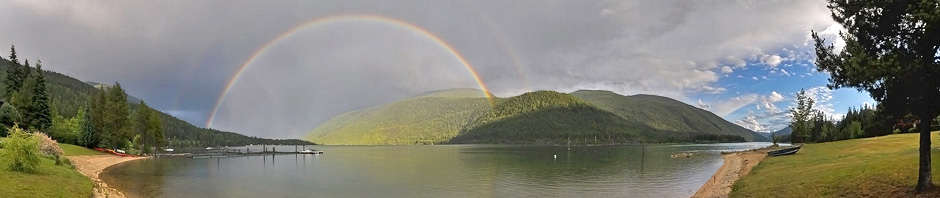
It’s Monday, so it is lundi. And lo, there it was, floating in the calm of the early morning light.

It’s Monday, so it is lundi. And lo, there it was, floating in the calm of the early morning light.
Many birds feast on insects. Some of these insects can fight back, some cannot. If you are one of those tasty, but defenceless insects, what better tactic could you develop than to make the bird think you were actually a well armed something else?
This tactic is called Batesian mimicry: a defenceless species evolves to imitate the warning signals of a well armed one. Batesian mimicry is easy to see among flies who frequently do a remarkably good job of mimicking the better armed bees (and wasps).
Here is an example just seen in my garden: a bee and its lookalike fly. Now, I don’t actually know the species of either of these. (Possibly the bee is a Bombus bifarius queen, and the fly is a Criorhina sp.) Whatever the species, the fly is mimicking the bee, and doing a rather good job of it.
This is the bumble bee (note its long antenna). This insect can sting.

This is the lookalike fly (note its stubby antennae). If you were a bird flying by, would you be able to tell that this one was safe to eat?

The title is not a typo: this is about sky lines, not skylines.
White lines across the sky are easy to interpret: contrails (trails of condensation from aircraft).
What about dark lines across the sky, such as seen in these pictures? These lines also result from contrails, but indirectly. Here, the contrails are above the clouds and not visible. But the shadows they cast on the lower clouds trace dark lines across the sky.


The bombylius looks like something that might be created by a child’s toy maker: fuzzy, large eyes, spindly legs.
Yet, it is real and is visiting everyone’s yard right now—albeit a rather small object to descry. Bombylius is a genus of flies that mimics bees, presumably as a defence against being eaten by birds. Whatever the reason, it is a striking little creature, that can be seen around here in the months of April and May, and then it is gone.
There are a quite a few different species of bombylius in British Columbia and I don’t know which one appears in these pictures. Indeed, I don’t even know if the three pictures show the same species. Alas, there are not very many local fly experts to consult on this matter.
A bombylius rests on some of last year’s dried grass. This momentary inactivity enables one to see the black and transparent wings, things that are usually in rapid motion. Its long proboscis, used for collecting nectar from flowers, is apparent here. This one could very well be the species, Bombylius major.

On this occasion, the rapidly moving wings hold the fly in position as its proboscis penetrates the flower.

The bombylius: a ball of fur hanging from flowers—what a delight.

For days now I have been watching blossoms open on a flowering bush in the hope of seeing flies and bees feasting at them. Unfortunately, the wind during the day has been sufficiently strong that insects found it difficult to land on these flowers—some flew by, but couldn’t land.
The solution to this problem was at my feet, for the wind at the level of the grass is more gentle. This fact wasn’t very useful to the insects when the grass lacked flowers, but now, the appearance of dandelions opens possibilities.
This afternoon, a few species of flies and a lone mining bee were flying low over the grass and taking advantage of the dandelions. Higher up, the flowering bushes remained unattended.
A tachinid fly digs into a dandelion.

Covered in dandelion pollen, a mining bee avoids the wind by crawling through the grass to the next flower.
The Osprey is the iconic bird of the Kootenay Lake summer. Indeed, the Main Lake ferry is named for it. There are often 20 to 30 Osprey nests along the West Arm alone.
This morning, I saw my first Osprey of the year on the West Arm. One was seen on the North Arm earlier in the week. Over the next half year, ospreys will mate (soon), lay eggs (late April), hatch chicks (June), fledge chicks (July, August), and throughout this time, will fascinate the public with their spectacular dives into the Lake to catch fish. In September they head back to Central and South America for the winter.
This morning’s Osprey. It’s good to be back.

The Dark-eyed Junco is a sparrow. While it might be seen around the Lake at any time of the year, it is most common in the spring when juncos that wintered to the south of us pass through this region to breed farther north. The spring brings us a jamboree of juncos.
Our local Dark-eyed Juncos are more to be noted for their black hangman’s hood than their eyes, although the hood is darker in the male than the female.
A male Dark-eyed Junco stares at the camera.

Another male sits in the trees.

The hood of the female is more grey than black.

Ok, the first picture was not actually taken while riding bareback on a bull elk—but, it certainly looks as if it might have been. This, and the two following shots were taken by Doug Thorburn. Doug has allowed me to present a number of his local wildlife shots over the years, but these shots of the elk are the first in some time.


Doug Thorburn’s pictures are used with permission.
Nelson City Council now requires the head of every household to own a gun and ammo to “provide for the emergency management of the city” and “provide for and protect the safety, security and general welfare of the city and its inhabitants.” The new law does have exemptions for felons and the mentally ill.
Bizarre? Jarring? Yes, but that is the story out of Nelson, Georgia, a community of 1300 in the southern U.S.
This is truly a Nelson in an alternative reality.
Nelson in our reality: gun ownership is not required.

I am indebted to my daughter, Cynthia, for pointing out this odd story.
Trompe-l’oeil
Kate Bridger is a local artist and author. Her recent article in the Nelson Star discussed trompe-l’oeil—the ancient art of painting a building with such realism that the eye is tricked into believing the structure has three-dimensional features that it does not. She gave a nice overview of the technique and offered examples, her local one being Reo’s Video at 607 Front Street.
Now, I am a fan of trompe-l’oeil and have long admired what I had considered Nelson’s only representative: a building at 110 Baker Street housing a dentist’s office. It’s not that I was unfamiliar with Reo’s, but had always assumed that its decor was chosen more to amuse the eye than to trick it.
Reo’s Video certainly has a delightfully evocative paint job, but the design is purposely cartoonesque. It is unlikely to trick anyone into imagining that its painted features are real. Yet, it does amuse.

There is a local building with faux structures that is much more likely to fly under the radar. The Dental Building at 110 Baker not only has fake windows mixed in with its real ones, but even real windows with fake features such as lintels. Indeed, this building also tricks the eye with its painted anchor plates, pillars, and arcades.

Now, if there there is a nicer example of trompe-l’oeil in Nelson, I don’t know of it. Of course, some building may have been so cleverly disguised that I have yet to spot it for what it is. Does anyone know of other regonal examples?