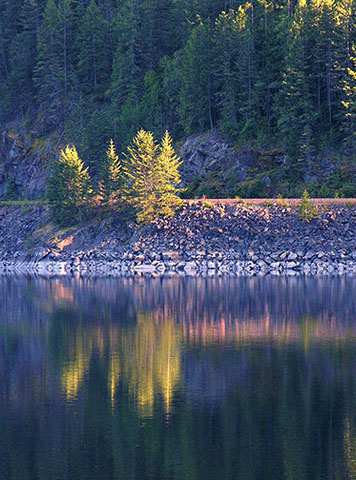
A double white line (and reflection) photographed in 2005
The white line that is often seen on rocky portions of the shoreline has long presented a mystery to me. What is it made of? As the waterlevel changes, what turns its formation off and on? Why does it appear some places and not others? That such matters have intrigued me for some time is evidenced by the picture on the right taken seven years ago.
For the longest time, I thought that the line was biological in origin and sought answers from that community. It wasn’t until I encountered Rick Nordin, a retired limnologist from the University of Victoria, that I learned the basic answer: CaCO3.
Calcium carbonate (CaCO3) is a common substance found in rocks in all parts of the world, and is the main component of shells of marine organisms, snails, coal balls, pearls, and eggshells. Calcium carbonate is the active ingredient in agricultural lime, and is usually the principal cause of hard water. It is commonly used medicinally as a calcium supplement or as an antacid (Wikipedia).
CaCO3 in a lake is brought in by streams, by groundwater seepage, and by the leaching of the lakeside soil during high water. In some lakes (called marl lakes), the concentration of CaCO3 can become so great that it will crystallize as a whitish precipitate in the deep water. A provincial marl example is Kalamalka Lake. The formation of that precipitate depends upon the solubility of CaCO3 which, in turn, depends upon things such as the temperature and pH of the water, and the amount of CO2 in the atmosphere. In Kootenay Lake, where concentrations are lower, these things may influence how CaCO3 dissolves in the water, but they seem to have little influence over the formation of the white line, itself.
The white line around Kootenay Lake seems to be caused during high water when the concentration of CaCO3 is greatest. Yet, it does not form below the Lake’s surface, but above it. The deposit seems to come about as waves wash up and repeatedly wet the lakeshore. Some of this water evaporates and, as it does so, the concentration of CaCO3 increases until all that is left is a deposite coating the surface. Each wave adds to the deposit. While the white line is readily seen on rock bluffs, the calcium carbonate is also found on any of the wave-wetted surfaces, such as pilings and willow bushes.
The rock bluff across from Nelson is one of the many places which displays the white line. There is a well defined top set approximately by the height of the high water. The reason for the cutoff at the bottom is less obvious, but it may be that the concentration of CaCO3 in the Lake decreases quickly following the inflow and leaching of the freshet. Another striking feature of this picture is the horizontal variation: about a third of the way from the right-hand side of the picture, the white almost vanishes. This seems to be a consequence of the directionality of the waves which will wash up on rocks facing one way but not another.
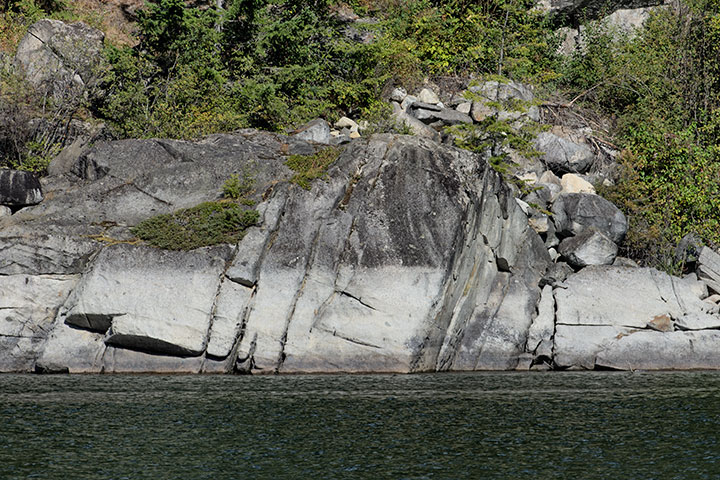
On the right of the picture, there are two lines, with a distinct gap between them. This probably is a result of the intermittent nature of waves. As the lake level is dropping there will be days when waves splash a good deal of water onto the rocks, and other days when the lake is calm.
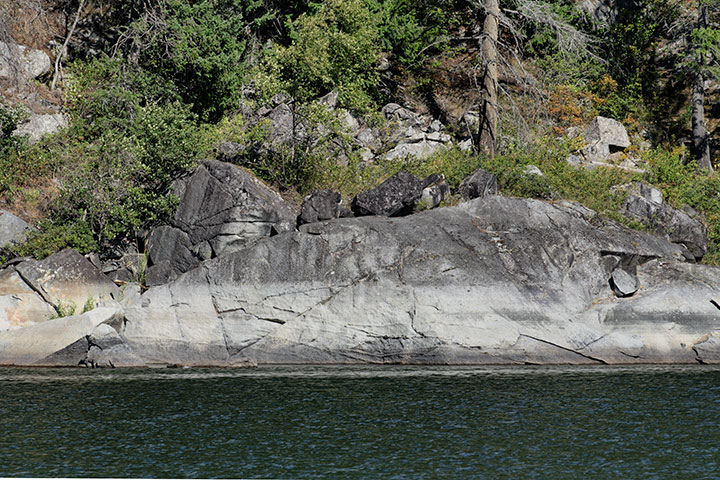 While the white line is clearly visible here, on closer examination it is not uniform across the rubble. Rock surfaces facing one way are coated; those facing another way are not. Again, this appears to result from the directionality of waves and suggests that the repeated wetting of the rocks by waves (and that water’s subsequent evaporation) is the primary mechanism leaving a residue of CaCO3 on the surface.

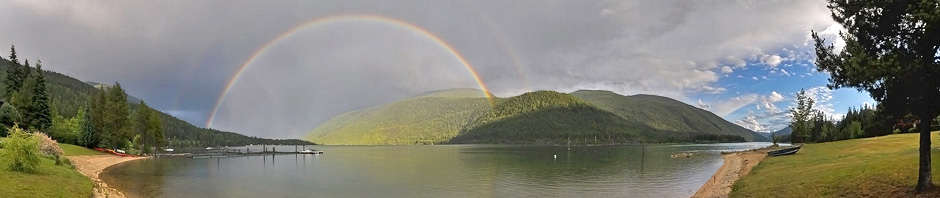


White line
A double white line (and reflection) photographed in 2005
The white line that is often seen on rocky portions of the shoreline has long presented a mystery to me. What is it made of? As the waterlevel changes, what turns its formation off and on? Why does it appear some places and not others? That such matters have intrigued me for some time is evidenced by the picture on the right taken seven years ago.
For the longest time, I thought that the line was biological in origin and sought answers from that community. It wasn’t until I encountered Rick Nordin, a retired limnologist from the University of Victoria, that I learned the basic answer: CaCO3.
Calcium carbonate (CaCO3) is a common substance found in rocks in all parts of the world, and is the main component of shells of marine organisms, snails, coal balls, pearls, and eggshells. Calcium carbonate is the active ingredient in agricultural lime, and is usually the principal cause of hard water. It is commonly used medicinally as a calcium supplement or as an antacid (Wikipedia).
CaCO3 in a lake is brought in by streams, by groundwater seepage, and by the leaching of the lakeside soil during high water. In some lakes (called marl lakes), the concentration of CaCO3 can become so great that it will crystallize as a whitish precipitate in the deep water. A provincial marl example is Kalamalka Lake. The formation of that precipitate depends upon the solubility of CaCO3 which, in turn, depends upon things such as the temperature and pH of the water, and the amount of CO2 in the atmosphere. In Kootenay Lake, where concentrations are lower, these things may influence how CaCO3 dissolves in the water, but they seem to have little influence over the formation of the white line, itself.
The white line around Kootenay Lake seems to be caused during high water when the concentration of CaCO3 is greatest. Yet, it does not form below the Lake’s surface, but above it. The deposit seems to come about as waves wash up and repeatedly wet the lakeshore. Some of this water evaporates and, as it does so, the concentration of CaCO3 increases until all that is left is a deposite coating the surface. Each wave adds to the deposit. While the white line is readily seen on rock bluffs, the calcium carbonate is also found on any of the wave-wetted surfaces, such as pilings and willow bushes.
The rock bluff across from Nelson is one of the many places which displays the white line. There is a well defined top set approximately by the height of the high water. The reason for the cutoff at the bottom is less obvious, but it may be that the concentration of CaCO3 in the Lake decreases quickly following the inflow and leaching of the freshet. Another striking feature of this picture is the horizontal variation: about a third of the way from the right-hand side of the picture, the white almost vanishes. This seems to be a consequence of the directionality of the waves which will wash up on rocks facing one way but not another.

On the right of the picture, there are two lines, with a distinct gap between them. This probably is a result of the intermittent nature of waves. As the lake level is dropping there will be days when waves splash a good deal of water onto the rocks, and other days when the lake is calm.
 While the white line is clearly visible here, on closer examination it is not uniform across the rubble. Rock surfaces facing one way are coated; those facing another way are not. Again, this appears to result from the directionality of waves and suggests that the repeated wetting of the rocks by waves (and that water’s subsequent evaporation) is the primary mechanism leaving a residue of CaCO3 on the surface.
