Marmot & legs


After posting Cynthia’s pictures yesterday of the hoary marmot taking an interest in hikers in Kokanee Glacier Park (marmot & shoes), there was a discussion of marmots licking hiker’s legs. This morning, Bethany Arndt (she of Bethany’s marmot) sent me her picture taken this July along the same trail. Bethany noted that the marmot preferred the legs of some hikers over those of others.

Bethany Arndt’s picture used with permission.

Posted in mammals | 2 Comments

Marmot & shoes


We have two local species of marmot: yellow-bellied and hoary. The yellow-bellied marmot lives in the valleys and has been featured two times this year: mommy marmot, March marmot. The hoary marmot lives in alpine country and has appeared only once and that was last year: Bethany’s marmot.

While on a recent hike between Gibson Lake and Kaslo Lake, my daughter, Cynthia, was surprised by how boldly a marmot approached and examined her sneakers.

A hoary marmot stands in a field of western anenome.

The marmots take an interest in hikers. This one licked and chewed Cynthia’s tattered trail runners.

The marmot’s black, brown and grey blends well with its home terrain. 

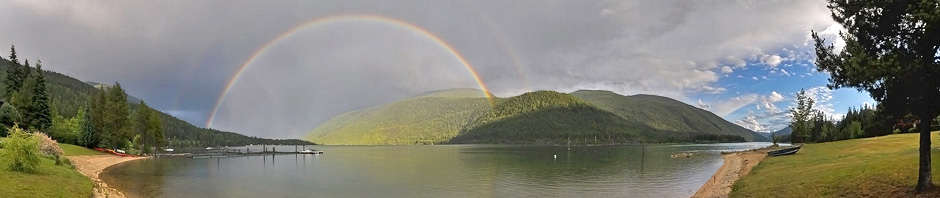
This is Cynthia’s panorama of Kokanee Lake from the trail alongside it. Marmots prefer the alpine meadows to the rocky slopes of this lake.

Cynthia Fraser’s pictures are used with permission.

Posted in mammals, scenes | 8 Comments

Buck in velvet


Within meters of where I saw the white-tailed deer with antler buds early in May, I saw possibly-the-same buck this morning. It is now summer, so its antlers have grown but they are still covered with the hairy skin known as velvet. The velvet will be shed early in the fall.

Posing for a portrait


Posted in mammals | 3 Comments

Kokanee spawning


They are at it again: the Kokanee are spawning. Depending on the creek, from mid-August until late September the water becomes either spotted or awash with red as these land-locked sockeye salmon move upstream. I hope to get more views as the season progresses.

This is a view looking downstream towards the approaching Kokanee salmon. Their red bodies are reflected on the underside of the suface of the water.

Posted in fish | 3 Comments

Boy bear


Bears continue to hang out where I previously saw the valley bears—sometimes in trees, sometimes on the ground.

This male is displaying his impressive paw, but it wasn’t a threat—he is merely turning to leave.

Posted in mammals | Comments Off on Boy bear

Valley bears


This is the season in which bears come down from the mountains and rummage around in the valleys for fruit. There are a great many fruit trees around the Lake—they are a legacy of bygone orchards. It is likely that now only the animals know the location of many of those trees.

While on a walk yesterday afternoon, I noticed two trees that were shaking even though there was no wind. Each held a Black Bear high in its branches. I watched for a while as the bears first ate cherries and then moved on to serviceberries. We exchanged pleasantries; they graciously posed for pictures; I wandered on my way.

Posted in mammals | 2 Comments

Two kings feasting


Two kings were feasting in a park: a kingfisher and a kingbird.

The high water has left the grassy area on the southwest side of Kokanee Creek Park closer to being a marsh than a meadow. The water has attracted mosquitoes, gnats, dragonflies and fish (we watched a heron catch one). The kingfisher was probably after fish, but the kingbird was feasting on dragonflies.

A female Belted Kingfisher sits in a tree from which it would regularly fly off and catch something.
An Eastern Kingbird (it’s found here in the West, too) also hunts from a tree.
It spots something and heads out.

The kingbird returns with a golden-looking dragonfly in its bill. It was soon eaten.

There were meadowhawks (a type of dragonfly) all over the marsh. This one looks to be a female cherry-faced meadowhawk. Possibly this is what the kingbird caught.

Posted in birds, bugs | 1 Comment

Osprey, fish, crow


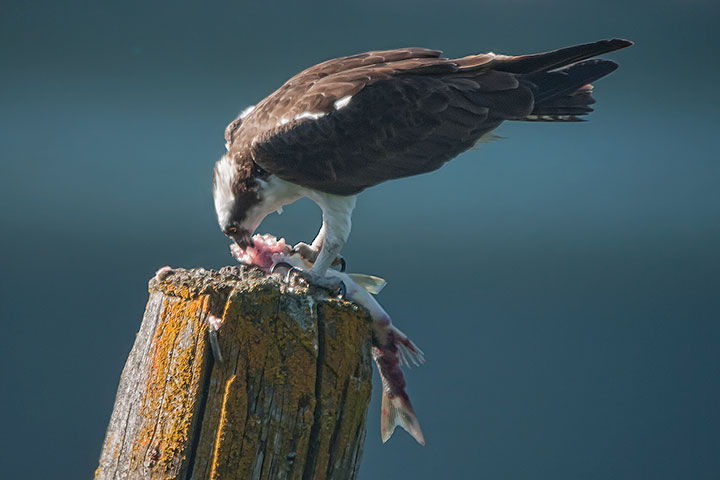
An osprey cannot eat a fish when it is flying; the bird must first land. Even if it is taking the fish back to its chicks in a nest, the osprey will often stop off for a snack first. That seems to be what this morning’s osprey was doing when it brought a fish to an ancient piling.

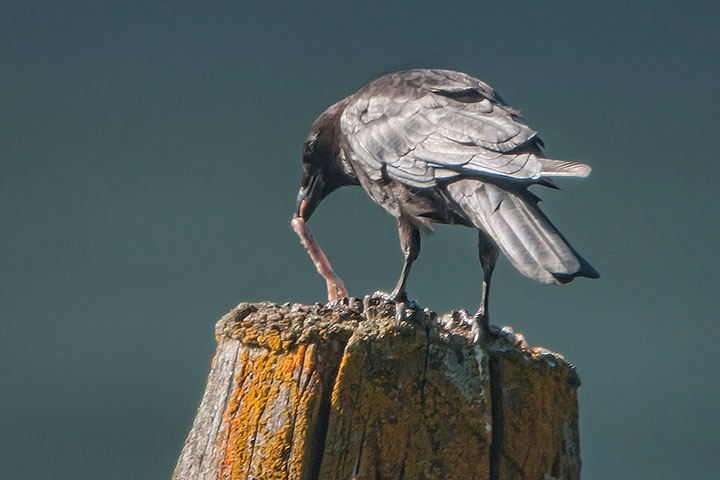
When the osprey departed with the remaining half of its fish, there was sufficient offal left on the piling that a crow immediately took the opportunity to clean it up.

First, the osprey with fish, and then the crow cleaning up.

Posted in birds, fish | 2 Comments

Finn’s spider & fly

Finn’s second guest posting Finn is my seven-year-old grandson. I played consultant, but Finn took and edited his own pictures using his own equipment and did the writing. I helped post them.
Alistair


Crab spiders can change colour from white to yellow. Granddad and I looked for a white crab spider on a daisy, but we found a yellow one instead.

This is a crab spider waiting on a yellow cinquefoil for its lunch.

This crab spider finally got its lunch!

As I left the crab spider, I spotted a bee-mimic beetle on a daisy.

Posted in bugs | 6 Comments

Bow on drumly water


The waters were drumly. Ok, you won’t find the word, drumly, in most dictionaries. It is an old Scots word meaning turbid or murky. Drumly is not how one would normally describe Kootenay Lake—a remarkably transparent, indeed potable, body of water. Yet, biological debris does settle on the Lake, and now and then it becomes locally concentrated.

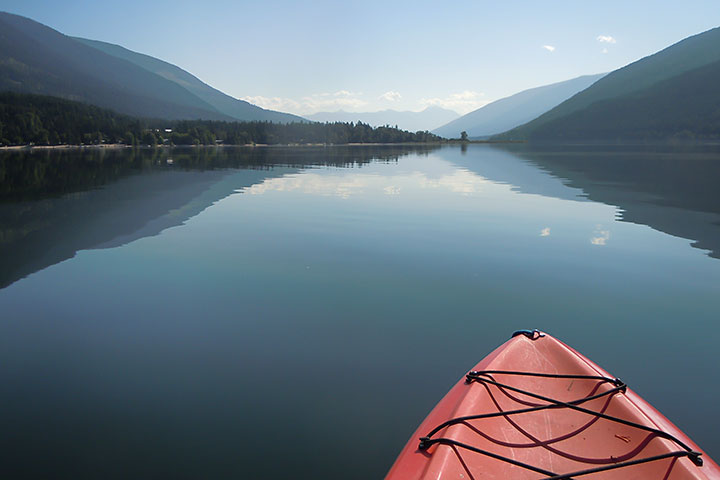
I encountered such a concentration when kayaking yesterday morning. This enabled one uncommon sighting (well, uncommon around here), and one distinctly rare sighting (apparently, for anywhere).

First, a bit of background on why debris will sometimes collect in a small area.

The West Arm of Kootenay Lake is composed of a series of lakelets—wide regions separated by narrows constricted by the deltas of creeks. These lakelets are rather like pearls on a necklace; when you are in one, you have your own little lake, but a passage connects you to another pearl.

The main flow of the water through any lakelet generally follows a fairly narrow channel. Elsewhere on the lakelet there may be a backflow. Certainly, that is the case on my lakelet where the channel and the backflow forms a large gyre. Now, a gyre is an area of convergence: water drifts towards the centre and sinks. In the absence of wind and waves, all manner of debris—pollen, leaves, bugs, driftwood, lost water skis, escaped boats—collects in the centre of the gyre.

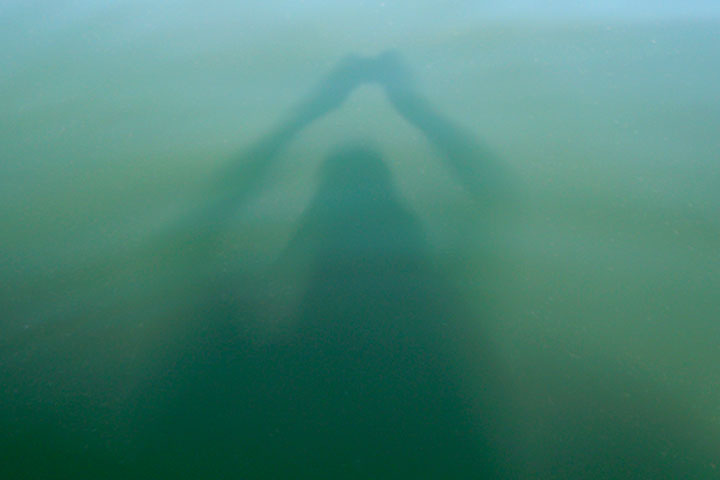
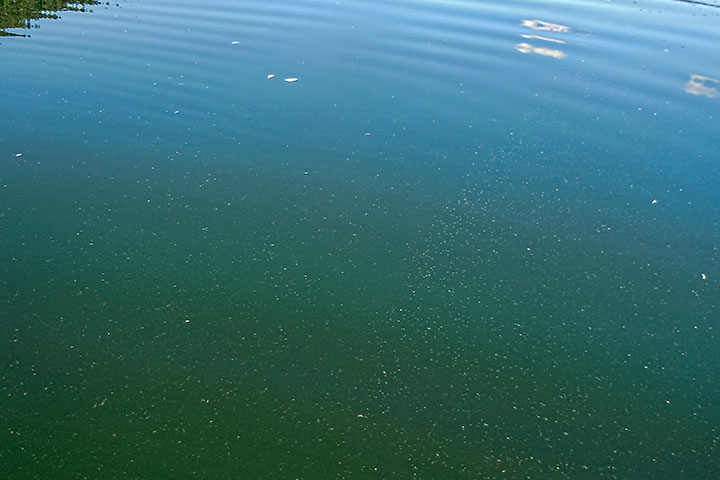
Yesterday morning, I noticed a region of my lakelet where biota seemed to be collecting, so I kayaked away from the pristine waters and into its midst. Normally when one’s shadow is cast onto clear water, it is barely visible. But, in drumly water, the shadow becomes obvious. Further, the shadow is three dimensional and looks as if it sweeps down into the depths. For this picture, I held a camera over my head. This is an uncommon view for the Lake as the waters are normally clear. Such a view is, alas, normal for people of many other places.
Now for the truly unusual: a rainbow formed by the bodies of tiny insects floating on the surface of the water. A likely insect, Peter Wood tells me, is the clear larva of a midge. Truth be told, a rainbow formed by a millimeter’s depth of this biota does not produce as striking a pattern as does a kilometre’s worth of raindrops. Nevertheless, a rainbow it is.

I had heard about the phenomenon of multitudinous transparent insect bodies producing a rainbow. I had even seen a picture of it taken elsewhere. Before this morning, I had not seen such a thing myself.

Alas, my picture is not nearly as good as the one of my memory, yet, the bow across the water is evident. It is the bright band sloping diagonally from the centre bottom to the upper right. To its left is a darker region; in the argot of rainbows, this is Alexander’s dark band. To the left of the Alexander’s band is another bright region: the secondary bow. Is this bow formed by midge larvae? At this stage, we just don’t know. I went out again this morning. I could still find the drumly water, but whatever had caused the bow had come and gone.
Posted in bugs, weather | 1 Comment