A Snow–White lunch

In Walt Disney’s 1937 telling of the story, Snow White’s adventures are accompanied by various creatures of the forest. I thought of that wonderful movie while having lunch amidst the gamboling of forest creatures: Red Squirrel, Red-brested Nuthatch, Black-capped Chickadee, and Song Sparrow.

Pictures taken Tuesday (Aug. 23, 2011) around noon.

Posted in birds, mammals | Comments Off on A Snow–White lunch

Wave clouds

The (main) Kootenay Lake website has a page devoted to local wave clouds.

In the summertime, cumulus clouds are the norm; in the wintertime, wave clouds (lenticular clouds) are more common. Alas, for those of us who are valley dwellers, the wave clouds of winter are often obscured by stratus. So, we take pleasure in the occasional summertime appearance.

(Aside: This is my first posting for a week. As yet, my broken computer is neither fixed nor replaced. I am limping along on a borrowed machine. I will now try to catch up on a week’s backlog of images.)

Wave clouds over the south Selkirks a week ago (Aug. 17, 2011)

Posted in weather | Comments Off on Wave clouds

Blocked clam

Imagine the plight of the clam in the picture, below. It was moving slowly across the lake bottom and—clunk—it encountered a rock.

That is how I felt yesterday, when… (continued below)

my computer went down—disastrously. I will be limping along on a borrowed machine for a few weeks, but as I lack my normal image processing capabilities, this may be the only posting for a while. However, this already prepared springtime image of a frustrated clam well expresses my feelings. The clam eventually worked its way around the blockage. So, will I.

Posted in commentary | 4 Comments

BC Parks party

On Saturday, August 13, 2011, BC Parks and the Friends of West Kootenay Parks threw a spectacularly successful party at Kokanee Glacier Provincial Park to celebrate the centennial of BC Parks.

Under cerulean skies, they offered helicopter rides to the alpine meadows, interpretive walks, classical music, story telling, historical images, birthday cakes, and an alpenhorn. The public response to this bonanza in the park was impressive—many came and everyone loved it.

I leave it to others to show images of people and events. I went so I could be immersed in the spectacular setting. Indeed, I have already made three postings about delights seen that day: a bird, a mammal, and a wildflower. In this final posting, I offer ten scenes.

The helicopter climbs above Gibson Lake to head up the steep valley.

It flies past Kokanee Lake as it continues climbing.

It reaches Kaslo Lake where one can see the blue roof of Kokanee Glacier Cabin, the site of some of the festivities.

The path from the Kokanee Glacier Cabin to the Slocan Chief Cabin takes one through alpine meadows. This 360–degree panorama was taken along that path.

And another view along the path.

The Slocan Chief Cabin was build in 1896 and was recently restored.

The cabin is now an interpretive centre.

A view on the walk back to the Kokanee Glacier Cabin.

The Kokanee Glacier Cabin (with a trio of musicians performing on a balcony).

The trip back down the valley: Kokanee Lake on lower left; Gibson Lake on centre right.

It was a memorable day.

Posted in history, scenes | 1 Comment

Alpine mops

The Western Anemone has gone to seed.

Indeed, this plant of the alpine meadow is usually seen after it has gone to seed for there are fewer hikers in the early spring when the flower blooms. The plant has many names, a familiar one is the Pasqueflower.

Below are two pictures of the anemone: the flowers (obviously taken earlier in the year), the seed heads or fruit (taken last Saturday).

The flower of the Wester Anemone is curious: what looks like white petals are actually sepals and they are variable in number.

Later, the flower is replaced by a clump of plumed seeds (the fruit) that have inspired various descriptive names, one being mops.

Posted in wildflowers | 3 Comments

Chipmunk

I recall that as a child, I would see chipmunks around Kootenay Lake, that is, right down to the valley bottom. Now, I only see them much higher in the mountains. David Nagorsen’s book, Rodents & Lagomorphs of British Columbia (2005), suggests that such a variation in altitude range is largely a result of competition with related species (p. 186).

The three pictures of the Yellow–pine Chipmunk below were taken at an elevation of about 1570 metres on the same jaunt into Kokanee Glacier Park that produced the pictures of the Solitary Sandpiper.


Posted in mammals | Comments Off on Chipmunk

Solitary Sandpiper

The most frequently seen shorebird here is probably the Spotted Sandpiper, yet, the Killdeer is also common. Only occasionally have I seen a Wilson’s Snipe.

However, yesterday was the first time I had seen a Solitary Sandpiper. To be sure, it wasn’t actually along the shore of Kootenay Lake, but over 1400 metres above it on an alpine pond in Kokanee Glacier Park. This area is at the southern limit of the Solitary Sandpiper’s breeding range, so one would not expect them often. There are three pictures of it below.

A Solitary Sandpiper flies toward the grassy edge of an alpine pond.

It alights.

And starts hunting along the shore.

Posted in birds | 2 Comments

Three arms

A satellite view of Kootenay Lake

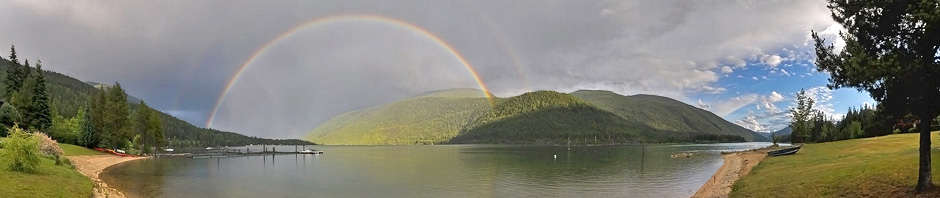
I am a sucker for an interesting panorama. For example: the header for this blog and the rainbow posted earlier, are panoramas which each span about 270 degrees.

Kootenay Lake has three arms: North, South, and West. The Lake is shaped somewhat like a bow and arrow, with North and South Arms forming the bow and the West Arm being a bent arrow.

Some time ago, I wondered if there were a spot on the Lake near the junction of the arms where one could look along all three arms. The best spot seems to be in the vicinity of the (now decommissioned) Pilot Bay Lighthouse (which, of course is why it is where it is).

Last Sunday, I went to a spot just offshore from the lighthouse and took multiple images which were then stitched together to form a 360–degree view. The resulting panorama is below.

The picture is split at roughly the position of the lighthouse and so the greenery on either edge of the picture is the Pilot Bay Peninsula. There are three gaps in the mountains: The one on the left is the South Arm; The one in the middle is the West Arm; The one on the right is the North Arm. In no case can one see the full length of an arm, but it is interesting to see them laid out in this way.

A 360–degree view showing the three arms of Kootenay Lake


Posted in scenes | Comments Off on Three arms

Cabbage White

There is nothing rare about this butterfly. The Cabbage White is common across the southern half of the Province and, although it is an introduced species, it has been here for about two centuries.

A female shows two spots on the upper forewing.

Last week, I watched a dozen or more Cabbage Whites sipping nutrients from the moist soil along the shore of Duck Bay at Nelson’s waterfront. During their phrenetic activities I could not distinguish the sexes. Later, using pictures, I could only identify males.

Both sexes have a black tip on the upper forewing, behind which there is one black spot on the male, and two black spots on the female. The underwings are virtually the same, each with two black spots on the forewing.

So, one must see the two spots on the upper wing to identify the female. To the right, I include a small picture of a female taken a previous year.


The extended proboscis of each Cabbage White is being used to sip nutrients from the moist soil.

The butterfly lifting off seems to have a faint second spot on its upper forewing, but we are merely seeing through the wing to the lower side where there are two spots. This too is a male.

The back underwing is a pale mustard colour. The proboscis is coiled as it flies away.

Posted in bugs | Comments Off on Cabbage White

Bluet protectionism

The first thing to realize when watching the Tule Bluet is that you can normally tell the boys from the girls. The males are blue and black while the females are brown and black.

Tule Bluets mating in the wheel position (taken a previous year)

It is of interest to tell the sexes apart as these damselflies seem to spend most of their adult lives either trying to mate, mating, protecting their investment, or laying eggs.

Damselflies are one of August’s lakeshore delights. More often in the past, I have seen them mate, something they do in what is known as the wheel position where the male clasps the female by the back of the head. After mating, he maintains this hold on her neck and accompanies her until she has laid the eggs he fertilized.

Sunday, I watched the later stages of this interaction: the flying away, fending off competitors, and guarding her until eggs are laid on a plant just below the surface of the water. Three pictures, below.


This is my freshly mated girlfriend; I drag her around with me because…

so many others would like to transform my investment into their own investment.

I stay locked on her until she has laid all (my) eggs (and hope that those minnows don’t eat them).

Posted in bugs | Comments Off on Bluet protectionism