May brings hummingbirds. Below are three images taken on Friday of some visitors: the first two are of a female Rufous Hummingbird, and the last is of male Calliope Hummingbird.


May brings hummingbirds. Below are three images taken on Friday of some visitors: the first two are of a female Rufous Hummingbird, and the last is of male Calliope Hummingbird.
Until yesterday, pollinia were vaguely remembered structures encountered only in obscure books. Then I saw some.
One often sees a solitary bee covered in pollen (first picture). Also, one often sees a female bumble bee carrying a pollen ball on its hind legs (second picture). The bumble bee collects pollen and packs it into a ball on (what is called) its corbicula for transportation back to the nest. In each of these cases, the pollen is collected from the flower as individual grains.
Pollinium (pl: pollinia): a mass of pollen grains fused by means of their wavy texture or fine threads, It originates from a single anther. This mass sticks together and during pollination is transported as a single unit.
It came as a surprise to me yesterday to see quite a few bumble bees transporting pollen a different way (final pictures). In truth, I first thought those yellow pellets between the wings were mites attacking the bees. But no, they are pollinia. Lincoln Best set me straight.
Some flowers don’t spread individual pollen grains to a pollinator such as a bee. Rather the flower packs many grains into a bundle, a pollinium, which it then glues onto the back of the bee. When the pollinia–packing bee visits another flower, some of the individual pollen grains brush off, but the rest of the pollinium stays in place to travel to other flowers on the bee’s back.
Wild orchids, periwinkle, and dogbane package their pollen in this way. But, what flower supplied the pollinia seen in these pictures remains unclear. Could there be some fairy slippers blooming this early? Does anyone know?
A small solitary bee (Andrena sp.) is covered in pollen.

A Bombus morissoni has packed pollen into a ball on its hind legs.

This Bombus mixtus is carrying some pollinia between her wings.

Here is a rear view of the mixtus more clearly showing two yellow pollinia.

Another bumble bee (a Bombus vagans?) is carrying pollinia on its back as it flies to a dandelion.

Bugs and birds abound now that we have had a day or three of sunshine. Here is a collection of a few of them from yesterday and today.
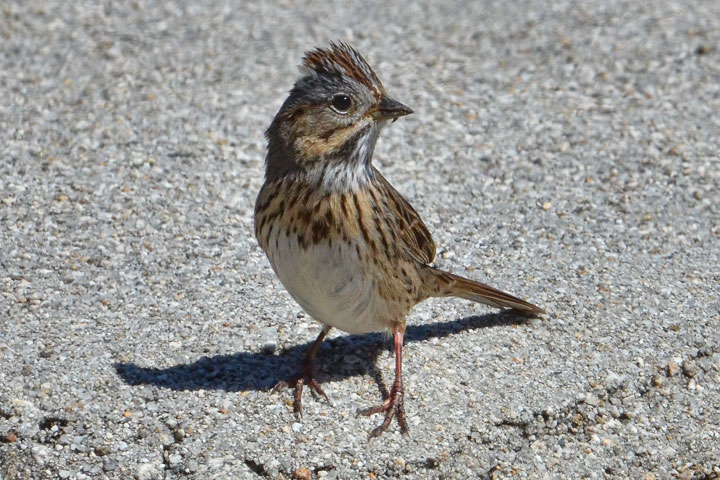
Lincoln’s Sparrow is frequent around the Lake in the spring and summer, but I had never noticed one before.
A tachinid fly stands astride two blossoms.

A hoary comma butterfly alights on a juniper.
A sub–adult Bald Eagle seems to be mimicking a vulture.

This long-horned bee is covered in pollen. 
The jumping spider mentioned earlier, seems a bit better fed this time.

And, of course, some forget–me–nots.

It is nearly half–past May and we are all looking for some evidence that there will be a spring this year. Today was sunny and warm, so I headed out to see how nature might have responded.
Some of the evidence is presented below. It is not everything seen today, but is enough to suggest that maybe we have turned the corner on the seasons. The range of blossoms for insects to visit is still not large, so many visit dandelions that proliferated in the last day.
Goslings accompany their parents out onto the Lake.

A stream violet grows in the woods.

The colour of the Western Spring Azure (butterfly) is only apparent when its wings are spread in flight.

A comma butterfly (a Hoary Comma?) lands on a Douglas–fir.

A female flesh fly visits a dandelion.

A bald-faced hornet visits a dandelion.

The bombilius is a bee–mimic fly seen mainly in the early spring.

The first bumble bee (a Bombus bifarius) I have seen this season.
• Muriel’s partner found her a far better nest.
• If you had arrived earlier we wouldn’t have such a dump.
• Where are we ever going to put the chicks.
• You left me alone this morning to chase away the geese by myself.
• The sticks you brought are covered with lichen.
• Go and get me a fish. I’m hungry.

The name of the game seems to be nest usurpation.
Swallows: A few days ago, a Mountain Bluebird attempted to take over the nest established earlier by Tree Swallows. Today, as the first picture below shows, the swallows are back firmly in control.
Ospreys: There has also been an ongoing saga of the rather sorry nest being built by two ospreys. It has been told with topics such as: trial nest, mating, sticks, biting, and rising water. Today, while the osprey couple were briefly absent, a pair of Canada Geese took over the osprey nest. They scrounged around setting up house. The tranquility did not last. From perhaps 40 metres overhead an osprey started calling. It then started a dive toward the nest. When the osprey was perhaps only about four meters above its nest and closing rapidly, the second picture was taken. It shows the beginning of the abrupt departure of the geese. A moment later, the osprey was back on the nest and the geese were complaining about their lot in life from the surface of the lake.
Tree swallows are back firmly in control of their nest.

Canada Geese in the process of losing control of the osprey nest.

The osprey couple firmly in control of the nest the next morning.


Lake level at Queens Bay (courtesy Wateroffice)
Do birds react to a freshet?
On April 24, this year’s freshet began on Kootenay Lake. The lake level had been declining during the winter as precipitation became locked in the mountains as snow. Now, driven by the melting of that snow, the Lake has begun to rise. It will not peak until late June after which it will settle back to summer levels.
How does the changing water level affect wildlife?
One consequence is that we probably have no loons nesting along the shore. Loons need to nest within, say, a meter of the water’s edge and the variable shoreline during the freshet does not allow this.
I would not have thought the freshet would have any consequences for an osprey, but then I had not previously watched an osprey build its nest. It seems that rising water changes the source of the osprey’s building supplies. When the water level was falling, my resident osprey couple quickly depleted the sticks on adjacent beaches. Now that the rising water dislodges and floats debris from along the extensive shoreline, the osprey need merely pick up sticks as they drift by its nest.
Handy building material just floats by and is easily picked up…
and delivered to the nest.

You must search till you find the bluebird.
You will find peace and contentment forever.
Bluebird of Happiness (song), Edward Heyman, 1934
The myth of the bluebird of happiness is ancient and spans many cultures; the bluebird supposedly brings happiness, prosperity, good health, new births, springtime—the list goes on.
It is unlikely that Tree Swallows accept such human silliness. The two pictures below show a female Mountain Bluebird attacking the Tree Swallow couple mentioned earlier. The bluebird was presumably trying to take over the nest. The male Tree Swallow drove it off—or so it seemed at the time. Yet a day later, the swallows seemed to have vanished and a couple of bluebirds were hanging around. Who knows how this is going to play out?
Update: the next step is presented at That’s my nest.


An osprey takes a bite.
Move cursor over image; wait; move cursor off image; repeat.

