Comstock’s Sallow

Comstock’s Sallow (Feralia comstocki) is a moth. I am used to thinking about moths as being nocturnal, but this one was flying around during the day. It alighted on my driveway and started sucking nutrients (salts?) in a manner similar to that of butterflies.

From the Entomology Collection at the University of Alberta, I learn that the emergence of adults is tied to the arrival of new needle buds on conifer trees. Adults lay eggs on these buds which then serve as food for the larvae. Although common in May across southern Canada and northern US, this moth vanishes in early June.

The tongue of this Comstock’s Sallow is extended to the ground.

Identification courtesy of Butterflies and Moths of North America.

Posted in bugs | Comments Off on Comstock’s Sallow

Gorget flashing

See my gorget!

Move cursor over image; wait; move cursor off image; repeat.

Posted in birds | Comments Off on Gorget flashing

See males now

I am told that the only hummingbirds one is likely to see in the West Kootenay are the Rufous, Calliope, and Black–chinned, and they appear in that order of likelihood.

I am also told that while female hummingbirds can be seen throughout the summer, by late June the males have finished breeding and have headed higher in the mountains.

So, if one wants to see the distinctive adult male hummingbirds, the time is now—wait awhile and they are gone. A week ago, this blog showed a picture of the male Calliope Hummingbird. Today, I managed to photographed the male Rufous and the male Black-chinned.

A male Black–chinned Hummingbird

A male Rufous Hummingbird


Posted in birds | Comments Off on See males now

Two bears

I confess that in the winter I miss the bears.

So, when spring comes, I welcome them back. Thus it was fun last Saturday to watch a black bear grazing in a field. About the same time, my friend, Doug Thorburn, watched a grizzly in the woods just south of Nelson.

Now it must be noted that Nelson has had a bit of a flap over grizzlies of late. For example, see this story in the Nelson Star. Further, Doug noted that the bear he saw grazing on clover beside the Selous creek road, “had a collar on, as well as two yellow tags in its ears.” So, he was, as the police sometimes say: known.

My black bear south of Nelson, just doing his grazing thing.

Doug’s grizzly, clearly wondering if it is safe to reenter the City.

Picture used with permission.

Posted in mammals | 2 Comments

Ground squirrel

This Columbian Ground Squirrel has its burrow well out on the edge of the colony. This suggests that in the colony’s hierarchy, this squirrel ranks low. However, its suburban location did make it easier to watch.

Posted in mammals | 2 Comments

Long tongue

A hummingbird has a long tongue.

Move cursor over image; wait; move cursor off image; repeat.

Posted in birds | Comments Off on Long tongue

Big birds in a marsh

Cranes, herons, and vultures were all seen when Peter McIver lead the West Kootenay Naturalists to the marshes around Leach Lake. In this final posting about the jaunt, the Great Blue Heron will be ignored—I see and photograph it regularly along the West Arm.

However, the Turkey Vulture is only rarely seen on the portion of Kootenay Lake where I live, and (so far) the Sandhill Crane, never.

Turkey Vultures favour the fields and marshes at both ends of the Main Lake where they can more easily spot carrion. Sandhill Cranes, although common at the Coast, had been rare here until recently. Indeed, the first local breeding record was made only three years ago. Many cranes were seen at a great distance; shown are a couple nearby.

A Turkey Vulture soars over the open country south of Kootenay Lake.

Sandhill Cranes wander through the marshland…

and take flight.


Posted in birds | 2 Comments

Blackbirds in a marsh

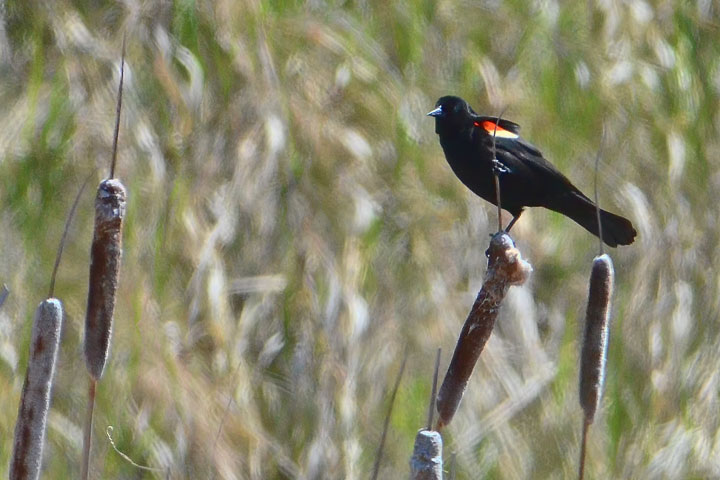
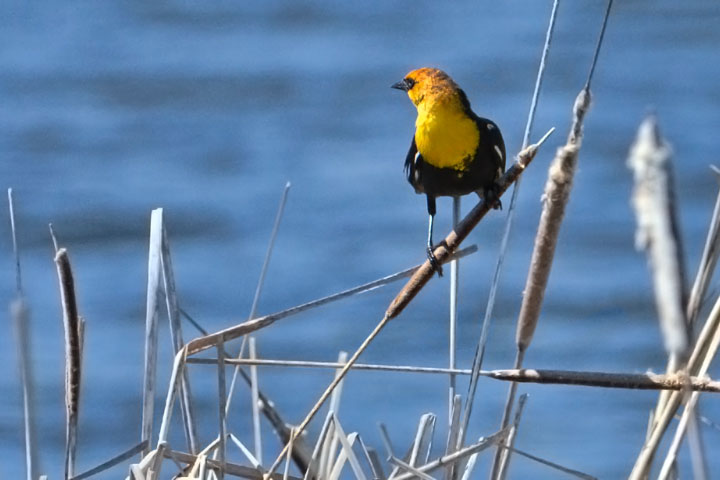
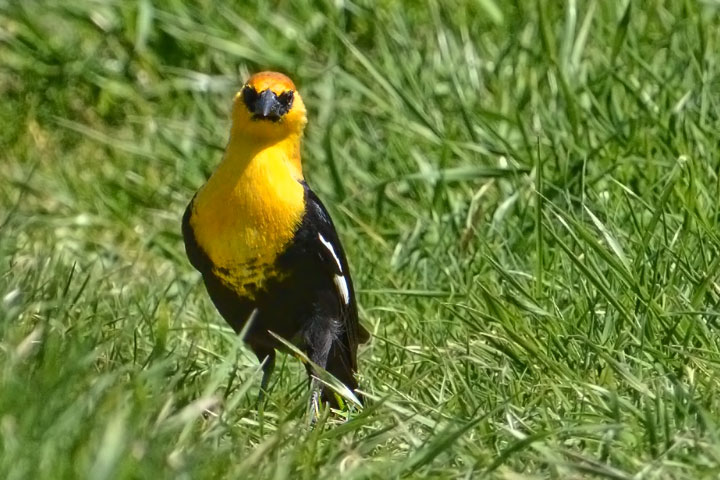
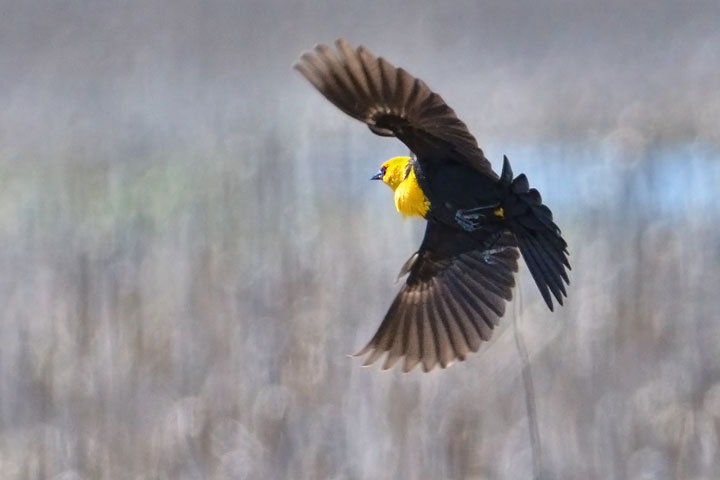
A visit to a marsh reveals birds that don’t frequent the well–drained portions of the region. So it was, that during last Saturday’s field trip of the West Kootenay Naturalists to the fresh–water marshes south of Kootenay Lake, I managed to get close enough to take pictures of both a Red–winged Blackbird and some Yellow–headed Blackbirds. Both birds favour marshes where they are often seen perched on cattails.

The red shoulder markings on the wing of the male are usually hidden but may be displayed when the bird is perched and singing.

This Yellow–headed Blackbird is probably watching for insects to eat.

The dominant foraging technique is to look for bugs while walking.

This Yellow–headed Blackbird has deployed alulae to maintain lift during a bank.

Posted in birds | 2 Comments

Four–spotted spotting

Along a path through the wetlands just south of Kootenay Lake were hundreds of Four-spotted Skimmers. These dragonflies are both stunning and new to me. Peter McIver had led the West Kootenay Naturalists to this area around Leach Lake following the visit to the Harlequin Ducks.

The Kootenay Lake website offers other pictures of local dragonflies.

The dragonflies I am used to seeing are darners (Aeshna) and snaketails (Ophiogomphus), but only rarely have I seen a skimmer (Libellula), and it has always had been a Common whitetail.

The Four-spotted Skimmer (Libellula quadrimaculata) is named for the black spots on the front middle of each of its four wings. This early–season dragonfly favours marshy areas, so the timing of this visit to the wetlands was ideal.

Below are three pictures showing four of these delightful creatures.

Posted in bugs | Comments Off on Four–spotted spotting

Harlequin ducks

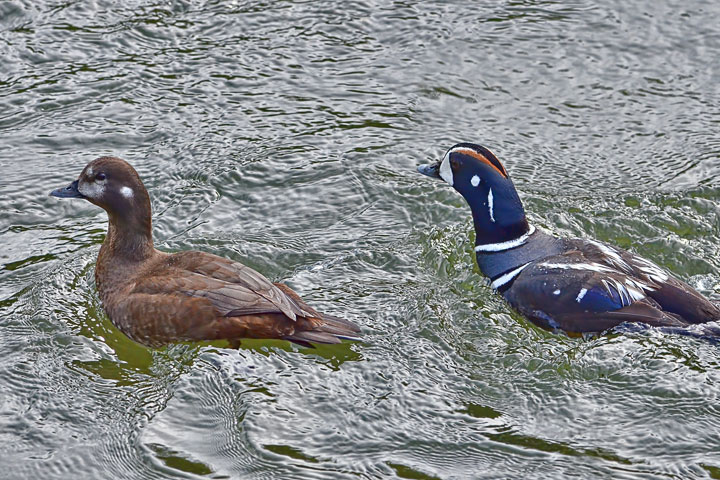
On Saturday, May 14, 2011, the West Kootenay Naturalists held a field trip lead by Peter McIver. The first stop was the Salmo River for a peek at the Harlequin Ducks that delight in this cold fast–moving stream.

Below are three pictures of them. As usual with ducks, the plumage of the male is fancier (on the right in the first two pictures) than that of the female. The third picture might be entitled: pay no attention to us, we’re just a couple of river rocks.

Posted in birds | 2 Comments