Pygmy Owl


This is a first for me: the first owl I have managed to find on my own. In the past someone else had to point one out to me. Well, truth be known, I had a bit of help on this occasion from some irate birds, but I am willing to take full credit.

The Northern Pygmy Owl is unusual in that it is our smallest owl, it is substantially confined to the western cordillera, and it is active during the day. It will merely sit in a tree and wait for lunch to come along.

In addition to the portrait on the right, I include three more pictures of this morning’s visitor: two are shots of it in the tree where chickadees had tried unsuccessfully to chase it off; finally, there is a detail from the image on the right.

The Kootenay-Lake Website offers more pictures and discussion of local owls.

Posted in birds | 4 Comments

Varied Thrush

In a contest for the most beautiful local bird, the Varied Thrush would certainly be among the finalists.

The Varied Thrush, a bird of the western cordillera, is more common around the Lake in spring and summer than in fall and winter. More information and pictures of local thrushes are found on the Kootenay Lake website.

Yet it is also one of our most difficult birds to approach or photograph. Unlike its cousin the robin, it is skittish. If it knows you are in the vicinity, it flies deep into a thicket and presents its backside. The trick, then, is to not let it know you are anywhere around.

My best pictures so far of this bird were taken this morning. They are of a male. I have seen the female, but she has defied all my attempts to capture her image. Ah well, in time….

Addendum: Since posting the two pictures of the male, I managed a somewhat lower quality picture of a female in the trees. It appears and is discussed below the male.

The colour of the female Varied Thrush, as seen below, is quite similar to that of the male, but black has been replaced by greyish brown. In particular, the breast band has become a mottled brown. A juvenile is similar to the female. This female has, as is often the case for all Varied Thrushes, secreted itself in a thicket.

Posted in birds | 2 Comments

Circumzenithal arc

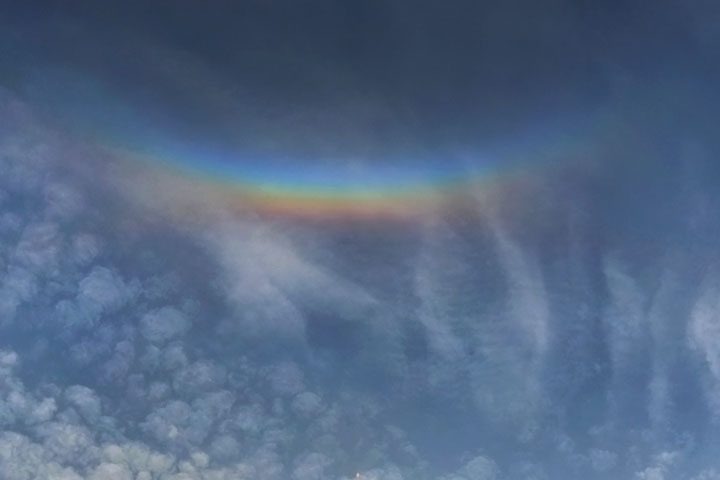
Who can fail to love the circumzenithal arc?

It is uncommon and it displays one of the purest colour spectra to be found in nature.

More information about when and how the circumzenithal and circumhorizontal arcs form is found on the Kootenay Lake website page about haloes.

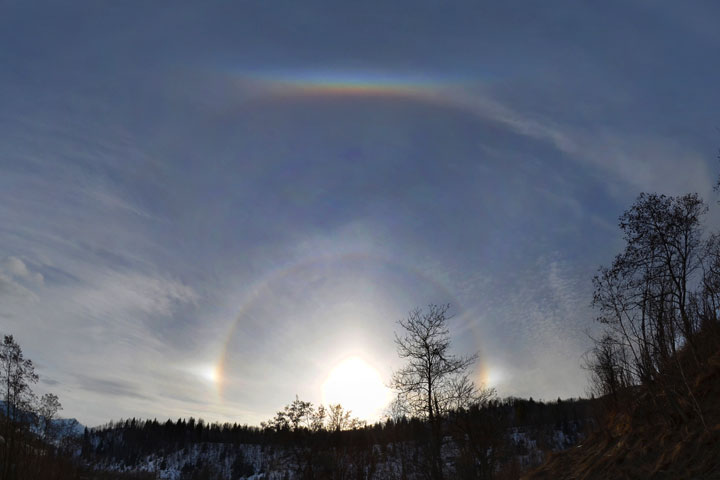
Indeed, at its best the circumzenithal arc shows an even purer spectrum than does the rainbow. Its only serious competitor in the sky is the circumhorizontal arc. Never seen together, these two arcs are brothers, both being formed by sunlight passing through the same types of ice crystals. The circumzenithal arc is seen high in the sky when the Sun is low in the sky; the circumhorizontal arc is seen low in the sky when the Sun is high.

I used to see the circumzenithal arc every two or three months when I lived at the Coast. Around here, I only see it every two or three years (a spectacular display appeared over Kaslo in March 2009). Yet, the one I saw yesterday while on the road to Trail was close to the best I have seen anywhere.

The first picture shows only the arc; the second, wide–angle picture shows it in relation to the Sun, the 22° halo, and the two sundogs (parhelia).

Posted in weather | 3 Comments

Emboldened birds?

Steller’s Jays held virtually an exclusive reign over my feeder until the temperature plummeted (see, Strictly Steller’s). The Jays are still around, but with this morning’s temperature of -15°C, two other species visited: a Varied Thrush and a Red-breasted Nuthatch (below).

So, the question is: could it have been the chilly conditions that embolden them to seek food from the feeder?

Posted in birds | Comments Off on Emboldened birds?

Fog fun

Recipe: take one cup of boiling water and throw it out in the cold.

Steam fog is a favourite topic of the Kootenay Lake website. There is a page dealing with Steam fog over the Lake, one about Steam fog over land, and a discussion of vapour mixing as one of the two  condensation mechanisms leading to clouds and fog. Steam fog has also been treated twice before in this blog: Sprites, dogs & devils; and Delights of steam fog.

Despite presenting numerous pictures and discussions of steam fog around the Lake, I had never before seen the little demonstration offered here: produce a steam fog by tossing boiling water outside on a really cold day. I learned of it from a friend in Pennsylvania, who learned of it from a correspondent in Brazil, who learned of it from a video doing the rounds in Brazil: Agua a ferver com uma temperatura a 30º NEGATIVOS (roughly: throw boiling water at a temperature of -30°C). I found the video on Youtube. When I tried the experiment this morning, the temperature was only -5°C, and the result is not as spectacular as shown on the video, but it was easier to see what is going on.

In the first picture, freshly boiled water is tossed from a (Pyrex) cup.  The water breaks into falling drops, each of which leaves a trail of steam fog. The second picture is merely a detail of the first. In it one can more clearly see the fog trailing the individual drops.


Posted in weather | Comments Off on Fog fun

Fort Shepherd cairn

I may be one of only two people alive today to have attended the dedication of the cairn at Fort Shepherd some sixty years ago.

I was reminded of the event by a feature Greg Nesteroff wrote for the Nelson Star (Feb. 18, 2011 pp 14,15) entitled Six Unusual Monuments, one being the cairn at Fort Shepherd. Erected in 1951 on the site of the sometime Hudson’s Bay Fort (used on again, off again from 1859 to 1870) the monument has now lost its plaque, but that may soon be restored.

As I remember the day, there were very few people who ventured along a rough road down the Columbia River from Trail. I believe that my brother and I were the only children present. I was armed with my Brownie box camera and took the pictures, below. The first picture was taken before the dedication and shows the cairn draped with the Canadian Red Ensign. I believe that the man on the left is Trail’s mayor. The second picture was taken after the dedication and shows the plaque, a Union Jack fastened to a tree, a member of the R.C.M.P., and again the mayor (this time with a cane).

Posted in history | 8 Comments

Tweet, click

Tweet, click; tweet, click. So went my duet with a Song Sparrow from one perch to the next in this morning’s early light. The bird finally flew away, apparently finding my endless clicking an inadequate counterpoint for its own beautiful voice.

Posted in birds | Comments Off on Tweet, click

Restless waxwings

I am sure that when a Bohemian Waxing encounters a genuine birder, it alights nearby and allows a closeup photograph. With me, waxwings always arrive in great numbers at the top of a distant tree, flutter about for a while, decide that I am clearly unworthy and leave.

The Bohemian Waxwing is a winter bird around here. Others have been reporting it for some time, but I didn’t see any until this morning near Sitkum Creek where I played cat and mouse: I arrive, they leave; I move, they move. Well, that is just how waxwings behave: arrive in great numbers, start flying from branch to branch and if enough neighbours join in, take off for somewhere else and start all over again.

The Kootenay Lake website offers more pictures and a discussion of waxwings.

Some of their frenetic activity is evident in the three pictures below where at any given moment, a fair fraction of them are in the air merely flying to adjacent branches.

Posted in birds | 3 Comments

Swooping Scaups

I am always impressed with the number and variety of species of waterfowl to be found at the Nelson’s waterfront. Why are the numbers and diversity so much greater there than elsewhere along the West Arm of the Lake?

Of late the big population at Nelson’s Duck Bay is Greater Scaups. Certainly there are other species around—Buffleheads, Canada Geese, Ring-necked Ducks, Mallards—but, numbers are dominated by scaups.

The scaup is a diving duck, indeed it gets its name from the Scots name for a bed of mussels, a favourite feeding ground for it there.

The Kootenay Lake website offers other pictures and a discussion of diving ducks.

Often one sees waterfowl just hanging out: floating along, each with its bill tucked under a wing. But, watching them today was great fun for they were on the move, if only from one part to the bay to another.

A male (lower right) and two female Greater Scaups. The female shows more brown and has white on its face.

Two female scaups about to land on the lake and one male (right) already down.

A female scaup landing on water.

A male scaup planes across the water surface.

Posted in birds | 2 Comments

Strictly Steller’s

Birders around the area are beginning to report a variety of birds at their feeders: nuthatches, chickadees, goldfinches, robins, flickers, finches, siskins, waxwings—the list goes on.

Not me. My feeder has been taken over by local mobsters: Steller’s Jays. I have heard Black–capped Chickadees and seen Varied Thrushes and Robins in the area, but the intimidating presence at the feeder belongs to the Jays, which arrive in numbers each morning.

The Kootenay-Lake Website offers more pictures and discussions of local Steller’s Jays.

So, what does one do in the face of this clear display of avian muscle? Why, take pictures, of course.

Posted in birds | 1 Comment