A muskrat is primarily a vegetarian, but occasionally it will eat other small mammals: snails, mussels, crustaceans, and small birds. But, would it tackle a large bird? The literature is unclear.
There is a pond where a few of us have watched interesting wildlife: turtles, various species of water birds, and, of course, muskrats. A few days ago, Shirley Smith sent me comments and pictures about a muskrat doing something rather odd there: It was harassing a mallard.
Two days later, I stopped by the pond and watched. Both animals were still at it. The muskrat would swim after the mallard. As the muskrat could swim slightly faster, it would close in on the mallard. When within a metre, the muskrat dived towards the mallard. Simultaneously, the mallard took to the air, flew perhaps a half-dozen metres and then alighted on the pond again. At this point the muskrat would start after the mallard again. Over and over the sequence repeated, and did so for as long as I was willing to watch.
Why was the muskrat doing this? Time and time again, it proved unable to catch the mallard. And why did the mallard always alight nearby and so invite another bothersome attack?
There is silliness to these behaviours.
Typically, a muskrat tries for a mouthful of salad (25 October 1916). But not this week.

A muskrat swam towards a male mallard. When close, the muskrat dived towards it and the mallard flew, but the mallard alighted nearby. At this point, the muskrat started after it again.

This time the muskrat is chasing the mallard towards the shore.

When within a metre, the muskrat again dived (the splash on the left) towards the mallard. Once more, the mallard took to the air. At first, I was confused by why the muskrat would dive upon approaching the mallard. Then it struck me. The speed of travelling over a water surface is effectively limited by what is known as the hull speed, a consequence of the waves the swimmer creates. However, the constraints of the hull speed do not apply underwater where an animal can travel much faster. So, by diving, the muskrat is doing the equivalent of a land-based predator that lunges towards its prey. The dive is thus evidence of the muskrat’s intent to attack. The mallard, knowing that the dive was the attacking lunge, took to the air to escape.

Strangely, the mallard would never fly far, but would alight nearby, thus inviting a repeat of the chasing game. Both animals seem remarkably slow learners. Advice to the obsessive-compulsive muskrat: Give it up and have some salad. Advice to slow-witted mallard: Just fly to the next pond; Do you think you can walk on water?



Perching imbalance
I have long heard the question: Why don’t birds in a flock collide? It is an odd question in that it does not ask if they collide, but why they don’t collide. The short answer is: They do collide, and fairly often. However, they have the ability to make a quick recovery.
A similar question is: Why don’t perching birds lose their balance? The short answer is: They do lose their balance, and fairly often. However, they have the ability to make a quick recovery. To verify this watch perching birds.
More important than the complete avoidance of small errors is the ability to recover from them. Here are two avian examples from this last weekend.
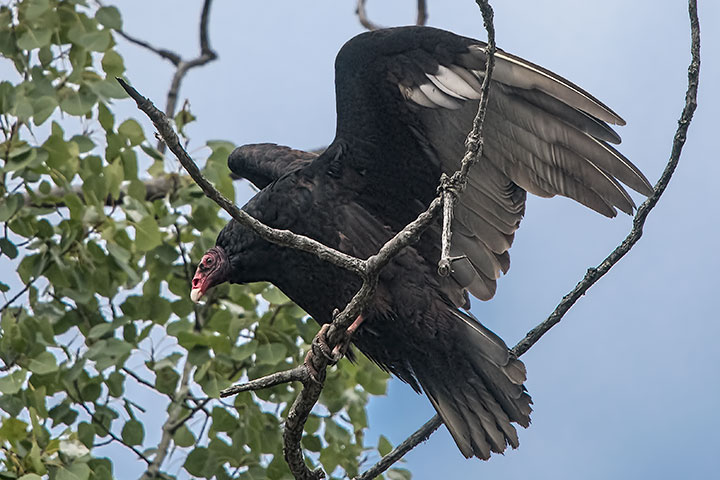
A Turkey Vulture perched in a tree, but before long it lost its balance and had to use its wings and tail to regain its position.
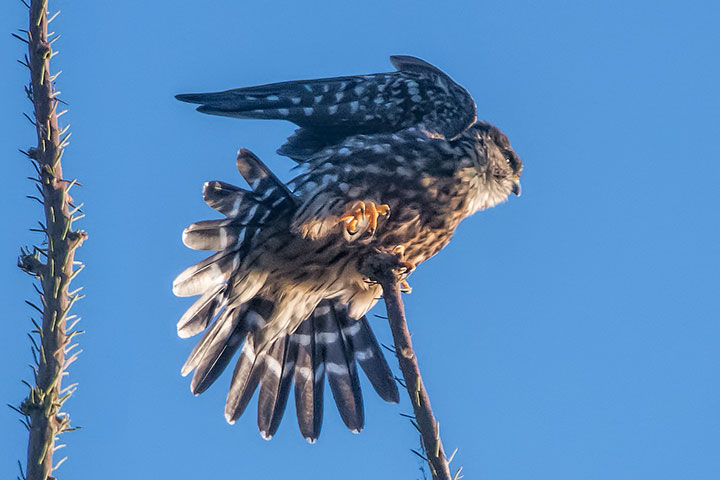
A merlin was perched atop the leader of a tree when it lost its balance. It too had to use its wings and tail to regain balance so it could continue scanning for prey.