Raven attack


Only days after a marmot accosted a local hiker, I was attacked by a raven. Had our local wildlife started to run amuck? It was easy to be reminded of Alfred Hitchcock’s 1963 horror-thriller, The Birds.

There was no need to conjure up a wildlife conspiracy. The raven was a freshly hatched chick that had taken to begging from humans whom it mistook for its parents.

The raven chick begged incessantly, pulled at my trousers, and tried to eat my shoe laces. I had no food to give it, so it soon transferred its attentions to someone else.

There were a few clues that this was a chick, but the striking one was its flesh-coloured gape.

Posted in birds | 4 Comments

Murray, the marmot


Murray, the Hoary Marmot, is a mugger. It hangs out near a popular sub-alpine trail and accosts passing hikers. Murray prefers those with bare arms and legs for it likes to lick salty limbs.

Murray’s activity has a long tradition behind it for it seems that marmots along this trail have been doing this for decades.

Permission for me to post this picture of Murray mugging a hiker was given by Finn, the photographer, and Julia, the hiker. That the permission of Murray, the marmot, was not sought is probably a violation of animal rights.

Posted in commentary, mammals | 3 Comments

Bear’s blaze


A visiting Black Bear bears a blaze (a white V) on its chest. Fans of redundancy are wont to call this feature a white blaze.

Some websites that discuss the blaze claim that it is a common characteristic of Black Bears; others say that it is rare. Possibly the occurrence of a blaze varies from one region to another; possibly some websites are just poorly researched and edited (imagine that!).

What I can say is that around here, a blaze is rare. Indeed, the last time I photographed a bear’s blaze was a decade ago. 

It is a rare bear that bears a blaze.

Posted in mammals | 4 Comments

Airborne creatures


Here are some recent shots of things in the air.

A juvenile Red-tailed Hawk

An osprey packing a headless fish (which is also airborne)

A juvenile Bald Eagle in (perhaps) its second year

A female Belted Kingfisher

A Merlin coming in for a landing

Imagine posting all those birds just to be able to pun that, like them, this creature is hareborne.

Posted in birds, mammals | 1 Comment

Limb darkening


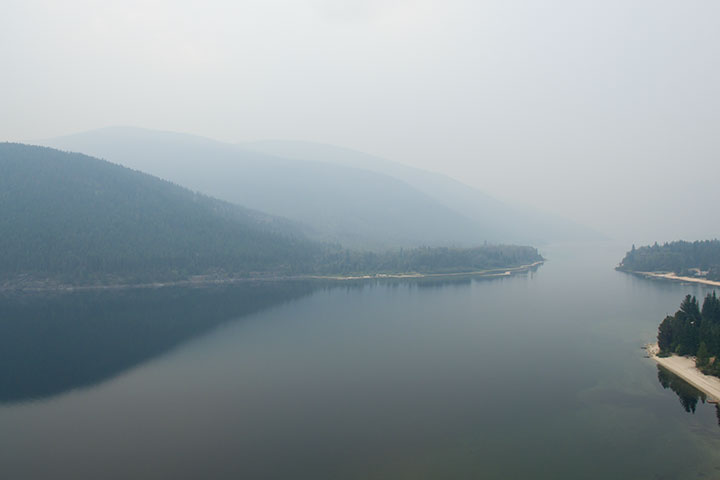
My enthusiasm for the natural world wanes when it comes to things such as earthquakes, floods, tornadoes, wildfires, and mosquitoes. Nevertheless, while our present smoke-filled valleys are distinctly unpleasant, they offer some interesting features. Consider a view of the Sun.

Colour:
Molecules in the atmosphere preferentially scatter bluish light and this produces the blue of skylight. The smoke particles do likewise and, as they add to the scattering, direct sunlight gets distinctly orangish.

Brightness:
As the smoke removes light from the direct beam, the Sun becomes dimmer making it easier to view and even see…

Sunspots:
A sunspot can be seen at seven 0’clock. 

Solar prominences:
It may be that some of the fuzziness around the edge results from solar prominences.

Limb darkening:
The picture shows a distinct variation in brightness and colour across the solar disc. This is a consequence of a real variation from the Sun, itself, and is known as limb darkening. Sunlight is emitted by (what is known as) the photosphere, but it must then pass up through the Sun’s atmosphere which absorbs some of that light. More sunlight is absorbed on the longer path through the solar atmosphere near the Sun’s limb than on the shorter path near the centre making the sunlight dimmer towards the edge. (The Moon, which lacks an atmosphere, does not show limb darkening.)

Elevation darkening:
Finally, the limb darkening is asymmetric, with more darkness near the bottom of the image than the top. This is a result of the variation in the path with elevation through the smoke in our own atmosphere. 

A view of the Sun through our smoke-filled sky reveals interesting features.

Posted in scenes, weather | 7 Comments

Wildlife presentation


When an organization invites me to give a presentation, I normally don’t bother with promotion.

I make an exception for Science in the Park at Kokanee Creek — thus, this posting. This will be the fourth year I have presented in this series.

Topic: Portraits of local Wildlife
Presenter: Alistair Fraser
Time: 7:00 p.m., Tuesday, August 15, 2017
Donation: $5 (to the West Kootenay EcoSociety, not to me)
Location: Nature Centre, Kokanee Creek Provincial Park

An image that characterizes this year’s presentation.

Posted in birds, commentary, mammals, scenes | 3 Comments

Bear is back


Last year, I noticed that Black Bears arrived in my yard on August 1st. This year it was virtually the same: August 2nd.

I live at the valley bottom, so whether the bears arrive at this time of year or not at all, depends upon the availability of berries in the subalpine. I do not know about this year’s huckleberry crop, but something has driven the bears into the valley.

A Black Bear clings to the trunk of a wild cherry tree. 

Posted in mammals | 2 Comments

Osprey family


During summer, the Friends of Kootenay Lake survey local Ospreys. The objective is not just a monitoring of these magnificent birds, but an indirect monitoring of the Lake, for the bird’s success depends upon clear and bountiful waters.

I like to join an expedition when one might see chicks. Yesterday morning, many of the occupied nests on the South Arm of Kootenay Lake were too distant for good pictures, but finally… 

A family of Ospreys sits on a nest. The parents are the ones standing taller on the left and right. They have yellowish eyes and brownish wings. The three chicks have orangish eyes and blackish wing feathers that look as if they have been dipped in cream.

Posted in birds | 1 Comment

View from high up


Here are two views from high on a North Shore Forest Service Road.

The Harrop wildfire as seen on Sunday morning, July 30, 2017.

This view of the dolphin at Kokanee Creek Park easily shows why this channel marker is placed where it is. We also see a group of people on stand-up paddle boards in the shallows.

Posted in scenes | 5 Comments

Pipe pollination


The Indian Pipe (Monotropa uniflora) is an interesting plant — it lacks chlorophyll. Yet, it thrives in rare locations on the forest floor where it has carved out a niche which does not require it to have access to sunlight.

The story starts with a common mutually beneficial relationship between a soil fungus and a tree. The fungus passes minerals to the tree and the tree passes sugars and other complex molecules to the fungus. This is a relationship that the Indian Pipe exploits: It persuades the fungus to give up some of the sugars obtained from the tree, but it offers nothing in return. By taking the chlorophyll-produced sugars from the tree, albeit via the fungus, the Indian Pipe can survive on the dark forest floor where other plants often struggle for light.

From the point of view of a pollinator, a flower is a flower, and the Indian Pipe produces both nectar and pollen. Consequently, bees appreciate it just as they would any other flower.

A Half-black Bumblebee forages among the white flowers of an Indian Pipe. The pollen sacks on its back legs are packed with the yellow pollen of its flowers.

Posted in bugs, wildflowers | 2 Comments