Our local community of Stellar’s Jays are energetic fliers and omnivorous eaters. Social, smart, and family-oriented homebodies, they spend considerable time feeding and hiding food caches across their territory. Because they easily mimic other sounds, their daily vocalizations are delightfully varied. However, their gentle chittering and melodious songs can be quickly replaced by loud bossy squawking.
When a predator appears, their community coordination can be swift and spectacular.
An interior Stellar’s Jay with white eye streaks and blue crest streaks. Photo by Cynthia.

While observing our jays, a marten emerged from some bushes and crossed the snow!
Now, I had never seen a marten before! It reminded me of a weasel or domestic cat on the prowl. Nose to the ground, it had thick chestnut brown fur, short legs, long claws and cute curvy ears. It was really quite light weight (1-2 kg) with a long slender body (35–43 cm), and bushy long tail (18-23 cm).
A marten patrols the snow and sniffs for prey. Photo by Cynthia.
Martens spend most of their life alone and are skilled climbers.
After foraging on the ground, this marten lithely began to climb the trunk of one its favourite habitats, a tree. Photo by Cynthia.

As soon as it began to climb, a Stellar’s Jay raised the alarm. At least 10 jays swiftly flew over to the tree and began mobbing the marten — calling loudly, diving and swooping at the intruder, in an attempt to dissuade it. The jays sat on branches above, below and all around the Marten.
A Steller’s Jay vociferously squawks at a marten while staying out of reach. Photo by Cynthia.
Martens eat fruit, animals and carrion but this marten ignored the tree’s juicy rowen berries and seemed mostly interested in the birds.
The marten climbs a rowen berry tree and tries to get a jay. Photo by Cynthia.
From this angle, you can clearly see its pale whitish throat patches.
This acrobatic marten balanced and jumped easily between tree branches for about a half hour while the jays protested and dove at it. At one point, the marten stopped to nonchalantly lounge along branch, looking down while having a rest.Photo by Cynthia.

This posting will be followed by another which will show more pictures of the marten.
Ducks in water
It is cold out — about -10 °C as the sun gets up on Thursday.
Now, that is the temperature of the air, and probably 0f the snow, but it is not the temperature of the lake. The liquid water has a temperature of about 0 or 1 °C, so it is much the warmer of the other two regions due to convection from below.
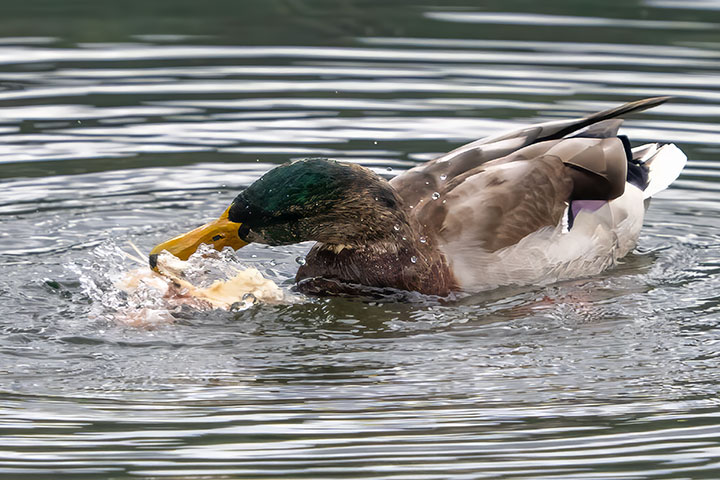
It is not surprising then, that mallards spend their time in the warmer shallows of the lake. Or is it? After all, humans (and deer) would not think about lounging in the water at these temperatures.
What is going on? Ducks prefer the lake, but mammals avoid it.
The first thing to realize is that both waterfowl and mammals have an internal heat supply. The question is, how are we each affected by conduction with the surrounding medium, whether air or water? This then is a question about thermal conductivity or how the body transfers its heat to the surroundings. What then differs in the thermal conductivity between waterfowl and (most) mammals?
Thermal conductivity is a question about the time it takes to adapt. A high conductivity means that adaptation to external temperature happens quickly; low conductivity means that adaption happens slowly. In particular, water has about 30 times the thermal conductivity of air.
Let us treat the ducks first, because they are slightly easier. Although cold, the water is a good deal warmer than the land. In addition, the ducks are very well insulated by thick fat layers and puffy feathers. This is enough to keep them adequately warm as they lose only a little of their heat to the water.
But without clothes, humans are rather poorly insulated and even the thermal conductivity of the air (although lower than that of water) causes them to lose heat quickly and get cold. A wrapping of clothes and mittens can balance this. But, wander into the water where regular clothes can make little progress against the much higher thermal conductivity found there.
The ducks are in the water, because it is much warmer there than out, but humans are out of the water because their clothes only just balance even the lower thermal conductivity found there.
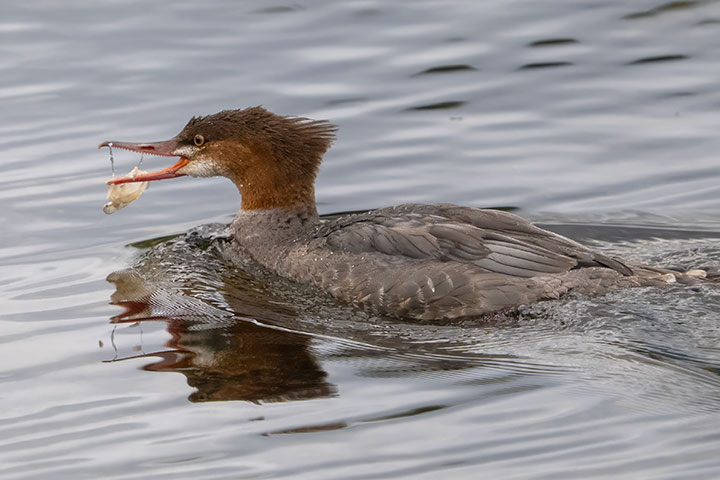
In cold weather, ducks stay in the water.