Steller’s Jays vs marten

Our local community of Stellar’s Jays are energetic fliers and omnivorous eaters. Social, smart, and family-oriented homebodies, they spend considerable time feeding and hiding food caches across their territory. Because they easily mimic other sounds, their daily vocalizations are delightfully varied. However, their gentle chittering and melodious songs can be quickly replaced by loud bossy squawking.

When a predator appears, their community coordination can be swift and spectacular.

An interior Stellar’s Jay with white eye streaks and blue crest streaks. Photo by Cynthia.

While observing our jays, a marten emerged from some bushes and crossed the snow!

Now, I had never seen a marten before! It reminded me of a weasel or domestic cat on the prowl. Nose to the ground, it had thick chestnut brown fur, short legs, long claws and cute curvy ears.  It was really quite light weight (1-2 kg) with a long slender body (35–43 cm), and bushy long tail (18-23 cm).

A marten patrols the snow and sniffs for prey. Photo by Cynthia.
Martens spend most of their life alone and are skilled climbers.

After foraging on the ground, this marten lithely began to climb the trunk of one its favourite habitats, a tree. Photo by Cynthia.

As soon as it began to climb, a Stellar’s Jay raised the alarm. At least 10 jays swiftly flew over to the tree and began mobbing the marten — calling loudly, diving and swooping at the intruder, in an attempt to dissuade it. The jays sat on branches above, below and all around the Marten. 

A Steller’s Jay vociferously squawks at a marten while staying out of reach. Photo by Cynthia.
Martens eat fruit, animals and carrion but this marten ignored the tree’s juicy rowen berries and seemed mostly interested in the birds. 

The marten climbs a rowen berry tree and tries to get a jay. Photo by Cynthia.
From this angle, you can clearly see its pale whitish throat patches.

This acrobatic marten balanced and jumped easily between tree branches for about a half hour while the jays protested and dove at it. At one point, the marten stopped to nonchalantly lounge along branch, looking down while having a rest.Photo by Cynthia.

This posting will be followed by another which will show more pictures of the marten.


Posted in birds, mammals | 6 Comments

Ducks in water


It is cold out — about -10 °C as the sun gets up on Thursday.

Now, that is the temperature of the air, and probably 0f the snow, but it is not the temperature of the lake. The liquid water has a temperature of about 0 or 1 °C, so it is much the warmer of the other two regions due to convection from below.

It is not surprising then, that mallards spend their time in the warmer shallows of the lake. Or is it? After all, humans (and deer) would not think about lounging in the water at these temperatures.

What is going on? Ducks prefer the lake, but mammals avoid it.

The first thing to realize is that both waterfowl and mammals have an internal heat supply. The question is, how are we each affected by conduction with the surrounding medium, whether air or water? This then is a question about thermal conductivity or how the body transfers its heat to the surroundings. What then differs in the thermal conductivity between waterfowl and (most) mammals?

Thermal conductivity is a question about the time it takes to adapt. A high conductivity means that adaptation to external temperature happens quickly; low conductivity means that adaption happens slowly. In particular, water has about 30 times the thermal conductivity of air.

Let us treat the ducks first, because they are slightly easier. Although cold, the water is a good deal warmer than the land. In addition, the ducks are very well insulated by thick fat layers and puffy feathers. This is enough to keep them adequately warm as they lose only a little of their heat to the water.

But without clothes, humans are rather poorly insulated and even the thermal conductivity of the air (although lower than that of water) causes them to lose heat quickly and get cold. A wrapping of clothes and mittens can balance this. But, wander into the water where  regular clothes can make little progress against the much higher thermal conductivity found there. 

The ducks are in the water, because it is much warmer there than out, but humans are out of the water because their clothes only just balance even the lower thermal conductivity found there.

In cold weather, ducks stay in the water.


Posted in birds, commentary | Comments Off on Ducks in water

Steam devils


When it is cold out, the lake often delivers steam fog; and, very occasionally, a steam devil.

Steam fog is not formed by the same mechanism as, say, cumulous clouds or even radiation fog. The latter form when the water vapour in the air is cooled below its saturation point. But, steam fog, and aircraft contrails, form by a non-linear mixing process when warm vapour is mixed with cold vapour. In this case, the warm vapour is in the bottom centimetres above the non-frozen water surface and the cold water vapour is in the overlying much colder air flowing over it. They mix and form a fog, although neither had a cloud in it to begin with.

The main time this happens around here is at night when cold vapour flows down from the mountain side over the warmer lake. One sees the fog over the water with the first light of daytime. And it becomes spectacularly visible when the sun gets up. But, the sun quickly turns off the process by warming the draining vapour from the mountain side and so stops it from flowing out over the lake. Thus, there is perhaps a quarter or a half hour of good observing before it all stops.

Now, steam fog is nice, but sometimes a strong wind shear turns a convective plume of steam fog into a steam devil. The word, devil, comes from a Greek word, diabolos, meaning to throw, which probably is the origin of devil in names such as dust devil and steam devil for they throw things. And a steam devil is a marvellous vertical structure: a whirlwind with a hollow core. 

Today’s brief view did provide a couple of steam devils, but none were quite as grand as one I saw sixteen years ago (which is shown last).

The sun gets up and temporarily shows steam fog on the lake, before it warms the mountain side and turns off the drainage.

A steam devil extends up from the lake. There is a hint of a hollow centre.

And another steam devil.

The steam devil from 2009, showing a well developed one.


Posted in weather | 3 Comments

Stellar’s Jays vs hawk


The birds were clearly agitated! A wild persistent cawing drew me towards some tall conifers, alerting me to the possible presence of a predator. Our local Stellar’s Jays were causing a loud commotion, hopping and darting between branches trying to harass something. And there, deep amongst the shaded trees was what we initially thought might be a Merlin. Upon closer examination, this small yellow-eyed accipiter was most likely a juvenile Sharp-shinned Hawk busily eating a catch. Mind you, the raptor only remained there for a moment or two, and then flew off — there was barely time enough for a picture.

A small sharpie (?) looks up from its meal and decides that it is time to move on. Photo by Cynthia.


Posted in birds | 3 Comments

January goulash


This is a selection of pictures from January 2025 that didn’t have a posting of their own.

We went looking for Bald Eagles and found three different pairs sitting close beside their nests. This is perhaps the female and her partner was on an adjacent tree.

These two eagles were nearby their nest.

As were these two. All show pairing in anticipation of raising a family. Photo by Cynthia.

A mountain whitefish swam by in the shallows. Photo by Cynthia.

Much less common than the Downy, this Hairy Woodpecker spent its morning pecking its way to the top of several dead lakeshore trees. Photo by Cynthia. 

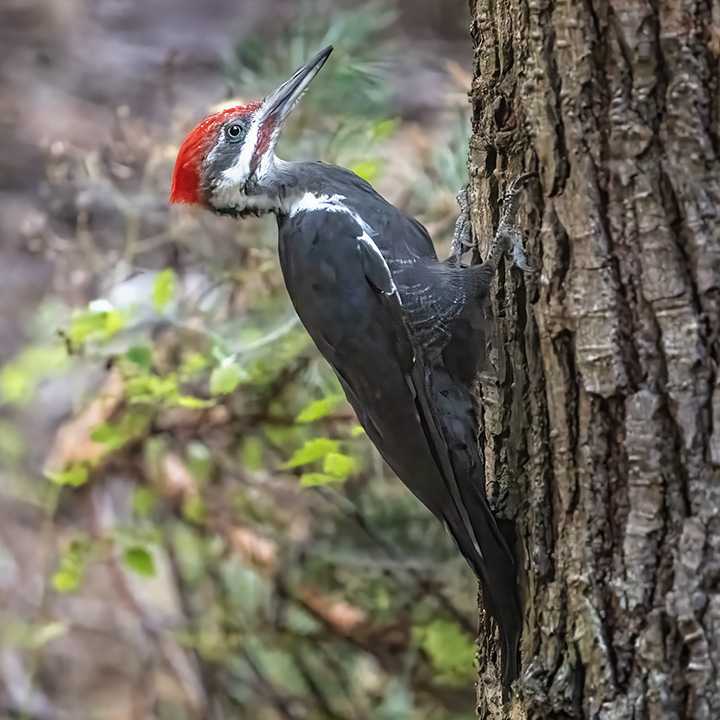
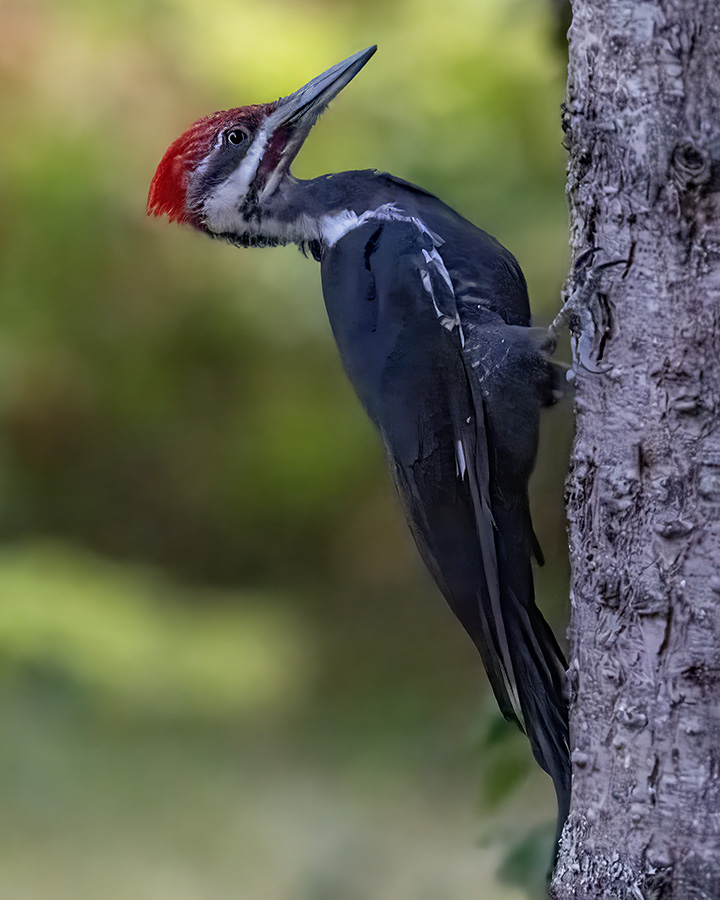
This was one of two Pileated Woodpeckers feasting on Rowen berries. Photo by Cynthia.


Posted in birds | 3 Comments

Clark’s Nutcracker again?


A few days ago, we saw several Clark’s Nutcrackers flitting around by a sunny west arm beach in below freezing temperatures. Intermixed with a flock of feeding robins, the nutcrackers were gleefully hunting pine cones and snacking on fatty seeds. 

Normally, this alpine bird lives at higher altitudes. Yet, as recently as October 2024, a flock of Clark’s Nutcrackers visited Kokanee Creek Park for a dozen days down here in the valley. (blog.kootenay-lake.ca/?p=33914 and blog.kootenay-lake.ca/?p=33951).

During that unusual Fall visit, some nutcrackers may have collected and buried pine seeds in secret underground caches, which would allow them to return later and eat the seeds during leaner months. So, could this be a returning bird? Or another altitudinal anomaly?

A Clark’s Nutcracker fetches a cone from a Douglas Fir. Photo by Cynthia.


Posted in birds | 1 Comment

Great Grey Owl leaving


Great Grey Owl: This is the last posting on a planned sequence of five postings on this largest owl.

The Great Grey Owl has scanned the field for a vole, has flown to catch it, has consumed it, and is now flying back to a perch to look for more.


Posted in birds | 2 Comments

Great Grey Owl eating


Great Grey Owl: This is the fourth of five postings on this largest owl.

The Great Grey Owl flies over the meadow to catch and eat voles.

It was noted earlier that the Great Grey Owl flies very quietly. The question is: does the owl fly quietly so that the vole will not hear it coming, or, so that the owl can hear the vole’s low-frequency scratching above the noise of its own wings? Research has revealed that it is the latter <https://www.allaboutbirds.org/news/to-catch-voles-under-the-snow-great-gray-owls-must-overcome-an-acoustic-mirage/>. The vole cannot hear the owl anyway, but the owl must fly quietly to be able to accurately find the sound the vole makes.

But, what enables it to fly so quietly? A number of things contribute starting with its particularly large wings which reduces the need for rapid, noisy wing flapping that is characteristic of many other birds. And the leading edges of its wing feathers have serrations that reduce the size of the fluctuations that would otherwise create a swooshing sound. These fluctuations are further reduced by a velvety texture on the wings and body, plus a soft fringe on a wing’s trailing edge. Together, they greatly dampen its sound.

The Great Grey can hear the vole’s scratching at a distance and this prompts it to leave its perch. At first, it finds it hard to determine the vole’s exact location, but as it flies closer, detection positioning improves. In the end, the owl often hovers over the spot to accurately pinpoint the sound. It then strikes from directly above.

The owl not only hunts for voles from a perch, it also hunts by making long flights over the meadow. Here it has identified a vole’s position and is beginning its dive straight down.

Upon catching a vole, it seems that the first thing it does is t0 dispatch it. Here, the owl is bending down to the left and the captured vole is dangling from its beak.

Strangely, while grasping the vole in its talons, it often looks up. It is too big to be concerned about predators, but it may be watching for anything that could steal its prize.

The final three pictures show the owl with a vole in its mouth in a couple of stages of eating it. This view was taken by Cynthia.

Here is another view of the freshly dead vole, but the owl is still looking around for thieves.

Now, always head first, it eats the vole.


Posted in birds | 4 Comments

Great Grey Owl flying


Great Grey Owl: This is the third of five planned sequential postings on this largest owl.

Having spotted a vole either by sight or hearing, the Great Grey Owl flies to catch it.

The Great Grey takes off from its perch.

And begins to extend its wings. Photo by Cynthia.

The Great Grey Owl is now flying noiselessly to catch a vole.

A back view of it flying after something in the field. Photo by Cynthia.

And a shot of the Great Grey Owl flying back to its perch. Photo by Cynthia.


Posted in birds | 6 Comments

Great Grey Owl perching


Great Grey Owl: This is the second posting on a planned sequence of five postings on this largest owl.

The Great Grey Owl visits briefly beside the North Arm of the Lake during many a winter. It comes to hunt voles in a field.

It spends a fair bit of time perching somewhere, just looking around and listening for those voles. While perched for a large amount of time, one just sees the back of its head as it looks the other way. However, these pictures are biased towards seeing the eyes. It also looks and listens as it hunts on the wing. Presumably, after running low on voles in that field, it just moves on.

This owl owes a great deal of its success to its enormous facial disc, the largest disc of any owl. Its considerable size separates the ears and significantly helps it position things it hears in the horizontal. But, it doesn’t stop there. It has one ear higher than the other, which enables it to pinpoint sound in the vertical as well. This is added to super sensitive hearing which may even enable it to hear the heart beat of a vole beneath a foot of snow. But, while the owl can hear the vole, its own flight is virtually silent, so a vole does not hear it coming until it is too late.

A power line runs down one side of the field. Much time was spent searching from it.

The owl looks in all directions, but most of the pictures taken show its face, not its back.

As it moves about, pilings also served as a searching position. Photo by Cynthia.

Only once did it perch and search from a tree.

But while there, it fluffed its feathers. Photo by Cynthia


Posted in birds | 5 Comments