Seeing the unfamiliar


While rummaging through a bookstore nearly a half century ago, I discovered an interesting paperback. It was an English edition of the 1937 Dutch book by Marcel Minnaert: Light and Colour in the Open Air. I read it, reread it, and gleaned many insights to interpreting nature.

A striking point he made in the preface was that:

However remarkable it may seem, it remains a fact that we do not observe much more than the things we are already familiar with; it is very difficult to see something new, even if it stares us in the face. In ancient times and in the Middle Ages, innumerable eclipses of the sun were observed, and yet the corona was hardly noticed until 1842, although nowadays it is regarded as the most striking phenomenon of an eclipse and may be seen by anyone with the naked eye. In this book, I have tried to collect and draw to your attention all those things that in the course of time have become known through the activities of many outstanding and able naturalists.

Minnaert’s book did not talk about birds (he was an astronomer), but his remarks are certainly applicable to my recent observations of four unfamiliar birds. Although none is uncommon, each was new to me and I had to seek help to identify two of them.

It is just rather difficult to see something new.

Nashville Warbler

Female Yellow-rumped Warbler

American Pipit

Savannah Sparrow

Posted in birds, commentary | 4 Comments

Twilight visitors


When the Sun is below the horizon, photographing animals becomes more difficult. Consequently, most of my pictures are taken during daylight. Yet, because humans are so active during the day, other mammals often prowl in the dark. Racoon, skunk, coyote, deer, and bear, all seem to prefer either twilight or nighttime hours.

Below are two recent visitors to the ground below a tree I occasionally watch. The bear, about to scarf an apple, came by late one evening; the deer, with an apple already in its mouth, came by early one morning.

Posted in mammals | 3 Comments

White line

A double white line (and reflection) photographed in 2005


The white line that is often seen on rocky portions of the shoreline has long presented a mystery to me. What is it made of? As the waterlevel changes, what turns its formation off and on? Why does it appear some places and not others? That such matters have intrigued me for some time is evidenced by the picture on the right taken seven years ago.

For the longest time, I thought that the line was biological in origin and sought answers from that community. It wasn’t until I encountered Rick Nordin, a retired limnologist from the University of Victoria, that I learned the basic answer: CaCO3.

Calcium carbonate (CaCO3) is a common substance found in rocks in all parts of the world, and is the main component of shells of marine organisms, snails, coal balls, pearls, and eggshells. Calcium carbonate is the active ingredient in agricultural lime, and is usually the principal cause of hard water. It is commonly used medicinally as a calcium supplement or as an antacid (Wikipedia).

CaCO3 in a lake is brought in by streams, by groundwater seepage, and by the leaching of the lakeside soil during high water. In some lakes (called marl lakes), the concentration of CaCO3 can become so great that it will crystallize as a whitish precipitate in the deep water. A provincial marl example is Kalamalka Lake. The formation of that precipitate depends upon the solubility of CaCO3 which, in turn, depends upon things such as the temperature and pH of the water, and the amount of CO2 in the atmosphere. In Kootenay Lake, where concentrations are lower, these things may influence how CaCO3 dissolves in the water, but they seem to have little influence over the formation of the white line, itself.

The white line around Kootenay Lake seems to be caused during high water when the concentration of CaCO3 is greatest. Yet, it does not form below the Lake’s surface, but above it. The deposit seems to come about as waves wash up and repeatedly wet the lakeshore. Some of this water evaporates and, as it does so, the concentration of CaCO3 increases until all that is left is a deposite coating the surface. Each wave adds to the deposit. While the white line is readily seen on rock bluffs, the calcium carbonate is also found on any of the wave-wetted surfaces, such as pilings and willow bushes.

The rock bluff across from Nelson is one of the many places which displays the white line. There is a well defined top set approximately by the height of the high water. The reason for the cutoff at the bottom is less obvious, but it may be that the concentration of CaCOin the Lake decreases quickly following the inflow and leaching of the freshet. Another striking feature of this picture is the horizontal variation: about a third of the way from the right-hand side of the picture, the white almost vanishes. This seems to be a consequence of the directionality of the waves which will wash up on rocks facing one way but not another.
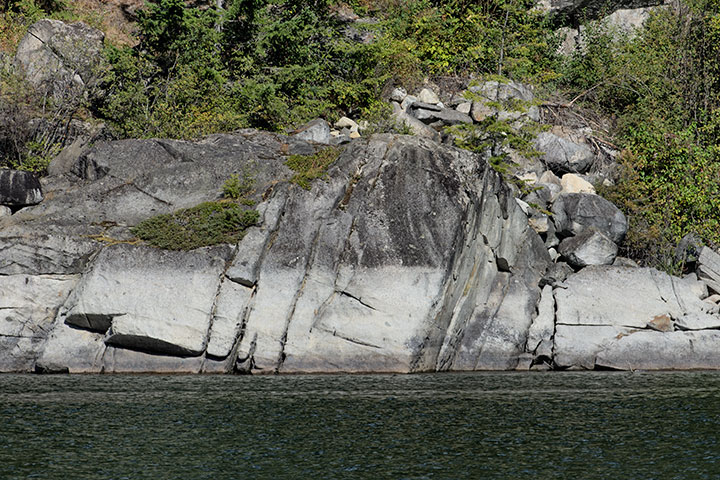
On the right of the picture, there are two lines, with a distinct gap between them. This probably is a result of the intermittent nature of waves. As the lake level is dropping there will be days when waves splash a good deal of water onto the rocks, and other days when the lake is calm.
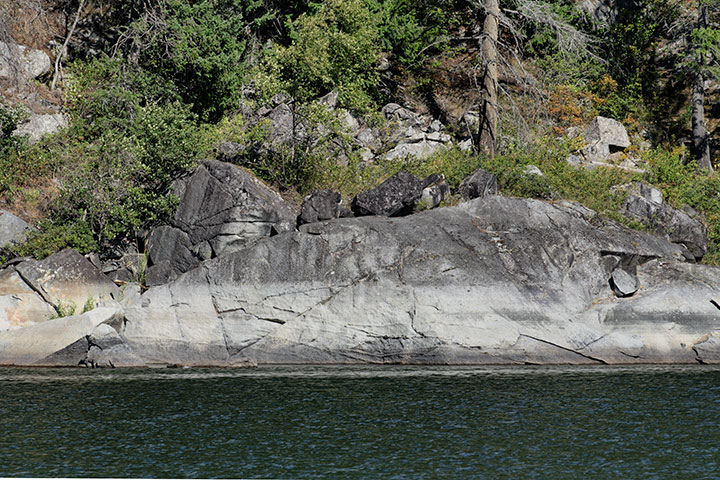
While the white line is clearly visible here, on closer examination it is not uniform across the rubble. Rock surfaces facing one way are coated; those facing another way are not. Again, this appears to result from the directionality of waves and suggests that the repeated wetting of the rocks by waves (and that water’s subsequent evaporation) is the primary mechanism leaving a residue of CaCO3 on the surface.

Posted in commentary, scenes | 8 Comments

Steam fog


The coming of steam fog signals the coming of fall. Steam fog forms when the lake water is much warmer than the air over it. This often happens when the surface water is still warm from the summertime, but a clear autumnal night causes katabatic winds to spread somewhat colder air over the Lake.

The formation of the steam fog is, itself, interesting. Many other clouds form when water vapour is cooled. However, when steam fog forms it is the result of the mixing of packets of warm and cold vapour, the average temperature of which is the same after as before the mixing. Oddly, this can produce condensation: the fog.

Steam fog is seen here both in the foreground and in the background, where it is strikingly visible against the shaded mountain. The locally variable nature of katabatic winds produces a patchy and rapidly shifting fog. As the sun warms the mountainsides, the katabatic winds die and the steam fog vanishes.

Posted in weather | 1 Comment

Riveting orange


This is the time of year to see juvenile ospreys around the Lake. They have left the nest, but migration is still a few weeks off. These birds will not return for two or three years when, as adults, they come to breed.

The juvenile is subtly different (and more picturesque) than the adult: its wing and back feathers look as if dipped in cream; its eyes are a riveting orange (an adult’s are yellow). It also has a buff-coloured necklace, but this feature is often shared with a female adult.

Really satisfying osprey pictures are infrequent; this is one.

Posted in birds | 2 Comments

Paddle-tailed Darner


Darner dragonflies fly rapidly and tirelessly over local lakes, ponds and woodlands as they hunt for other insects to eat. Seemingly always in the air, they are most likely to be photographed in flight. Yet, they do land long enough to mate. These pictures are of one of the darner species: the Paddle-tailed Darner.

Two pictures show a Paddle-tailed Darner in flight: head on and in profile.

These Paddle-tailed Darners are mating in the grass.

A moment after this picture was taken the two of them flew off to lay the eggs with the male still holding the female by the back of the head. He stayed with her to protect his investment from other males.


Posted in bugs | 1 Comment

Kokanee keep coming


The Kootenay Lake naturalist’s year is marked by many events: irruptive finches in the winter, migrating swans in the spring, the return of humming birds and ospreys, the freshet, pollinating insects, the arrival of black bears in the valleys in the late summer, the first steam fog of the fall, the arrival of snow.

One event stands out: in late summer, the Kokanee salmon spawn. Locals and tourists flock to marvel at waters that flow red with fish.

A bit over a week ago, I posted a single picture of the early stages of the Kokanee salmon spawning run. Today, I post a few more.

A happy osprey holds a large partially eaten Kokanee.

A male Kokanee bares its teeth as it jostles for postion among the many.

Underwater pictures show a perspective rarely seen by people.

Sometimes the play of light and colour produces an almost incomprehensible jumble.

At other times, the world seems awash in red.

Here’s looking at you.

The two above water pictures were taken by Cynthia Fraser and are used with permission.


Posted in birds, fish | 6 Comments

Stump stabber


I clearly don’t spend enough time in the woods. Otherwise, my first encounter with a stump stabber would not have taken place inside my home. This western giant ichneumon wasp (Megarhyssa nortoni) was looking for some grubs deep inside decaying wood so it could parasitize them. Unfortunately for it, my home offered slim pickings.

The female stump stabber has an amazingly long ovipositor which is used to insert eggs into wood-boring grubs deep inside a tree. The hatched egg will then devour the living grub, leaving the vital organs for dessert.

The stump stabber searches for grubs deep in the wood by drumming its antenna on the surface. This windowsill proved a disappointment—no grubs here.

Posted in bugs | 6 Comments

Etty versus Doug


Etty would not have approved of Doug or his lawn.

Etty was the daughter of Charles Darwin and she helped her father with his editing, alas, often with an eye to bowdlerizing biology to conform with her Victorian sensibilities.

Etty’s oddest campaign was her attempt to cleanse the world of, what she viewed as, an obscene fungus. As Etty’s niece reports:

Armed with a basket and a pointed stick, and wearing special hunting cloak and gloves, she would sniff her way round the wood, pausing here and there, her nostrils twitching . . . then at last, with a deadly pounce, she would fall upon her victim, and poke his putrid carcass into her basket. At the end of the day’s sport, the catch was brought back and burnt in the deepest secrecy on the drawing-room fire, with the door locked; because of the morals of the maids.

Douglas Sly is a lakeside resident who has harboured in his lawn the object of Etty’s moral outrage: a common stinkhorn. This fungus’ scientific name tells all: Phallus impudicus—the shameless phallus. Here is Doug’s picture of it.

Douglas Sly’s picture is used with permission.

Posted in commentary, wildflowers | 6 Comments

Pond bubbles


Photosynthesis takes place in plants and cyanobacteria even when they are underwater. Photosynthesis involves the exchange of gases with the surroundings. Occasionally such a gas release underwater becomes obvious.

On a hike into Kokanee Glacier Park, my daughter, Cynthia, took this sequence of increasingly close pictures at a alpine pond. The view presented a mystery to us all until an aquatic biologist wrote and said: “Yep – very pretty pic of gas bubbles from submerged photosynthesis, hard to tell if that’s a crust of cyanobacteria or early stage of moss development that’s making the bubbles.”

Cynthia Fraser’s pictures are used with permission.


Posted in scenes | Comments Off on Pond bubbles