Canadian life


Today — July 1st, 2017 — marks the sesquicentenary of the creation of Canada as a nation.

My two-dozen mute portraits offer peeks into the charm and beauty of life in Canada.

Posted in birds, commentary, fish, mammals | 15 Comments

Feeding flicker chick


Each year, I try to watch flicker parents flying in to feed their chicks. This year, a Merlin has intimidated our local flickers, so I had to go along the shore to find some other pilings in which flickers were in cavity nests. Finally, on the third visit, there was some action.

A Norther Flicker female flies towards a cavity nest bearing food for its chick. Flicker parents swallow the insects they find, then regurgitate them for the chick. This explains why there does not appear to be anything in the parent’s bill.

Feeding is not impressive; the parent sticks its bill down the throat of the chick and regurgitates.

Posted in birds | 2 Comments

Galls


I had no idea what I was looking at.

The plant was the wild rose (Rosa woodsii), but what were those spiky red balls on its leaves? Adjacent clues — spider’s threads, spittlebug’s froth — turned out to be irrelevant.

Rather, these are galls provoked by the rose-leaf gall wasp (Diplolepis polita). The wasp lays eggs on the leaf and the leaf responds by encasing them in a gall, inside of which grow one or more wasp larvae. The gall provides the larvae with both protection and food. What chemical stimulus would prompt the wild rose to respond in this way seems to be a mystery.

These spiky red galls are the plant’s response to the eggs of the rose-leaf gall wasp.

Posted in bugs, wildflowers | 2 Comments

Hunting styles


Predators have various hunting styles: some wait in ambush, others search. I watched each style yesterday. In these cases, the prey were insects. One predator was a bird; the other, a spider.

The Western Tanager (this is a female) flies from branch to branch in a canopy. At each stop, it scours leaves for insects and larvae and then eats them.

Restlessly, the Western Tanager never stays long on any branch and is soon off to another one.

The hunting style of the crab spider is different. It waits on a flower until a pollinator comes by, grabs it, and eats it. The pollen spread around it on the daisy petal testifies to a recent conquest.

Posted in birds, bugs | 1 Comment

Creek mouth will move


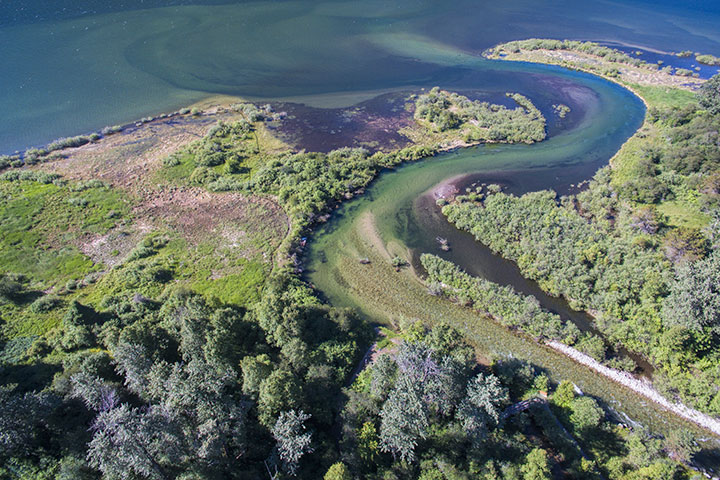
It has happened before, and it will happen again: The mouth of Kokanee Creek will (abruptly) shift to the east.

The portion of the delta immediately to the west of the creek mouth is strewn with gullies and ponds. These are the older channels of the creek. Two years ago (February 2015) I wrote about this and showed pictures of this terrain under the title, wandering creek. I also showed pictures of the bank slump along the berm where, I believe, the creek will, in a few years, break through and flow into the grasslands to the east. 

Since that time, this berm of soil and brush between the creek and the grasslands has become thinner and thinner as the creek has continued to erode it. 

Such erosion is a natural process when a creek or river flows through gentle terrain: Material on the outside of a bend is transferred to the inside causing the channel to shift. When flowing down a steep mountain valley, the stream is constrained. But, on a delta, the creek bed wanders. Of course, around Kootenay Lake, there are settlements on most creek deltas, with the result that humans use concrete or riprap to prevent such wandering.

To a good extent, the stewardship of Kokanee Creek Park has been left to the devices of nature. One result is that near its mouth, the creek occasionally shifts course. When the next big course change takes place, I suspect it will happen fairly quickly. It will be fun to be able to watch geology in action as the creek breaks through into the grasslands on the east side (left) of the picture and leaves behind more ponds on the west side (right).

This is a view of the mouth of Kokanee Creek as it flows into Kootenay Lake. The region of interest is the outside of the bend that appears in the centre of the picture. It is here that the berm of dirt and brush protecting the grasslands is eroding rapidly and will soon break.

Posted in commentary, scenes | 1 Comment

Thicket trail


This is an experiment: I want to be able to display a navigable full-sphere image.

For the meaning of full sphere, imagine that you are at the centre of a sphere, but can look in any direction whatsoever. You can scan 360° around the horizon (and so come back to where you started); you can also lift your eyes to the zenith or look down at the nadir. In short, you can examine everything within the sphere centred upon your eyes.

By navigable, I mean that, by clicking and dragging, you control where you look. By clicking on the icon on the lower right, the navigable image becomes full screen.

The picture for this experiment was taken alongside the Thicket Trail in Kokanee Creek Park.
[vrview img=”https://blog.kootenay-lake.ca/wp-content/uploads/2017/06/thickettrail_equi170619bs2.jpg” width=”695″ height=”480″]

Yikes, the experiment worked during the preview, yet failed in Safari, but worked in Chrome and Firefox. Sorry for the inconsistency.

Posted in scenes | 11 Comments

Owl, toad, rainbow


Seen yesterday: a Great Horned Owl chick, a Western Toad, a double rainbow.

A recent posting showed a Great Horned Owl parent and one of its chicks. Here is the other.

Lest one be called a speciesist, we must recognize this Western Toad as one handsome fellow.

Things to notice in last evening’s double rainbow:
  • the darkest region of the sky is between the two bows;
  • red is on the outside of the primary bow, but the inside of the secondary bow;
  • the colours are best near the horizon;
  • the supernumerary bows (faint bows inside primary) are best near the top of the primary.

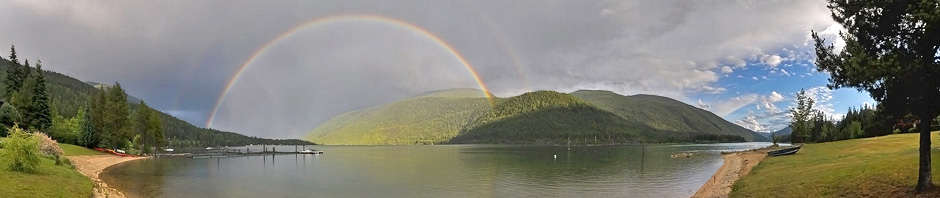
To view the full width of the picture, the cursor must be moved to various places across the frame. (A mobile device uses a tap.)
[photonav url=’https://blog.kootenay-lake.ca/wp-content/uploads/2017/06/rainbow170616s3.jpg’ container_height=480 container_width=695 mode=move position=right]

Posted in birds, herptiles, weather | 5 Comments

Worm for lunch


One does not have to spend much time in the company of robins to realize that earthworms have an uneasy friendship with them. Each time a robin invited one to lunch, the worm demurred.

This worm clung to its home so strongly that it took multiple invitations and much effort before the robin persuaded it accept a luncheon invitation.

However, in the end, the worm was persuaded to come for lunch.

Posted in birds | Comments Off on Worm for lunch

Chicks’ water behaviour


Who can resist the sight of mommy duck parading her ducklings across the water? It is especially cute when the chicks hitch a ride on mommy’s back, as merganser chicks do.

However, this is not the only neat behaviour that these merganser chicks exhibit. In addition to hitching a ride, chicks both draft and plane.

Merganser chicks ride on mommy’s back as a way to keep pace with her swimming. 

While some of the chicks are hitching a ride on mommy, many of them are following behind in the water. Keeping pace with mommy in free swimming is a problem for, due to their lesser length, the chicks have a lower hull speed. The solution is to draft mommy. By travelling in a group behind her, water resistance is lowered and they can keep up. 

There is another way the chicks can keep up with mommy: They can plane. This is another method of getting around the problem of the speed limit imposed by their hull speed.

At a speed somewhat below the swimmer’s hull speed, the swimmer is in displacement mode, where support is (primarily) a result of buoyancy. When planing, support is (primarily) provided by the rush of the water against the tipped-up hull. However, to attain this new state requires considerable energy (as any pleasure boater will confirm).

It is true that owing to a lower threshold speed, planing is easier the smaller you are (chicks are better at it than adults), but it is also the case that a particular hull configuration is needed. In displacement mode, a rounded stern (for a boat) or butt (for a bird) is desirable: In planing mode a sharp underwater transition between the hull and transom is necessary. A bird normally has a rounded butt, so how does it make the sharp underwater transition it needs to be able to plane? Answer: It forces its tail feathers down into the water.

This picture shows two merganser chicks in planing mode (left) and one in displacement mode (right). The chick on the right has its tail feathers lying along (slightly above) the water surface. The two chicks on the left have forced their tail feathers as deeply as they can into the lake. Also the wakes look different whether the swimmer is in displacement or planing mode.

This image shows all three behaviours. There are chicks that solve the problem of the speed mismatch by riding on mommy’s back. There are also chicks that are keeping pace by drafting mommy. Finally, three chicks (upper left, centre, lower centre) are planing.

Posted in birds | 3 Comments

Great horned chick


A birding guidebook says that the Great Horned Owl is a common resident of almost all habitats in our region. Fair enough, but just try to find one.

So, it was a delight to encounter one, and its chick, in the last few days. (OK, I didn’t find it on my own; Joanne Siderius, the senior naturalist at Kokanee Creek Park, showed me where to look.)

A Great Horned Owl perches high in the forest and watches trail walkers far below.

Nearby is one of its two chicks on its first day out of the nest.

Posted in birds | 7 Comments