In which, something normally hidden is disclosed: a thin layer of snow reveals internal structure. The same is true of frost and dew.
I first became aware of these things as a student when I discovered a book (Geiger, 1957, The Climate Near the Ground) that discussed how an otherwise-hidden structure had been revealed by frost. Geiger showed an aerial view of a frost-covered farmer’s field in the U.K. in which a previously unknown sub-surface Roman foundation was suddenly outlined. The greater thermal conductivity of the stone foundation prevented the formation of frost over it and so offered a map of underground structures.
Wow! That prompted a long-term fascination with patterns revealed by the distribution of snow, frost and dew on all manner of surfaces (a recent discussion of it being beach frost). The patterns do not all arise from differences in thermal conductivity, but today’s do—and they depend upon house construction.
Internal structure: the patterns shown here result from sub-surface (hidden) structures, not surface structures such as the ribs on a metal roof.
My knowledge of house construction is scanty. I think that all of today’s pictures illustrate snow on what is referred to as a hot roof. This often happens when the attic is occupied. One way of protecting attic space is to place insulation between the rafters. Although, rafters and insulation are normally hidden below roofing, the construction becomes visible after a light snow. The wood of rafters is more thermally conductive than typical insulating material and so the snow is ablated preferentially above rafters with the result that a pattern emerges.
The term, ablation applied to snow or ice, says that the loss might be a result of either melting or evaporation. In the present case, the temperature might stay below 0C, so the snow does not melt, but evaporation does increase as the temperature rises, with the resulting loss of snow.
See the windows: this house clearly has an occupied attic. The insulation between the rafters results in a greater snow ablation above the wood.

This house shows much the same structure as did the last, but, in addition, there is the striking band of snow above the roof’s overhang. Here the roof is not being heated from below and so the snow is thicker.

This house shows the variable ablation between the location of rafters and insulation. It also shows the greater depth above the roof’s overhang. In addition, it shows almost no snow ablation above the unheated deck.

This house shows many of the same features, but also the effect of the warmer air rising to the top of the attic.

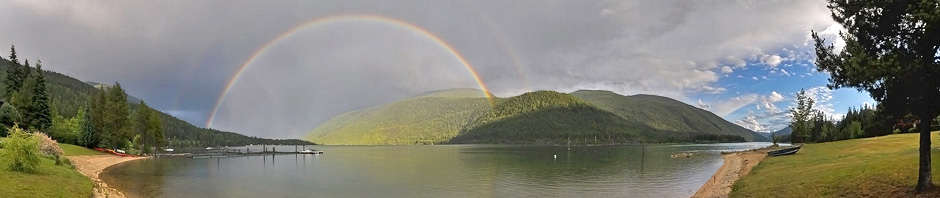


Otter haven
I see river otters a few times a year, but only when they are wandering. This week, I saw them at home.
Tracks across the ice, local piles of snow, and openings in the ice, all hinted at a haven for otters. Soon there was confirmation as heads poked through the ice; some otters lounged on top, others hunted in the open water.
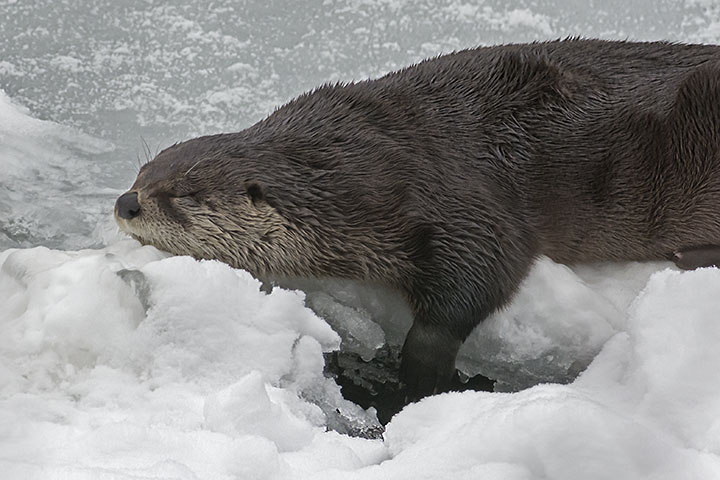
The first otter spotted was sitting beside an opening in the ice and lazily looking around.

Although it eventually vanished down the hole, first there was time for a snooze with a forepaw in the ice water.
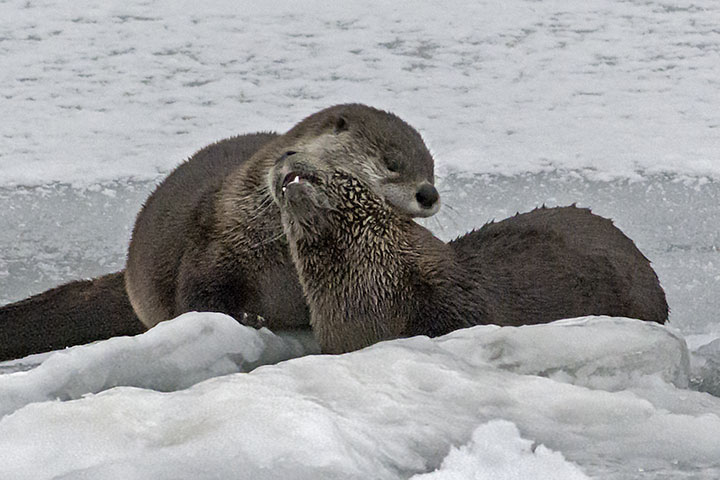
Elsewhere, a mother groomed her kit.
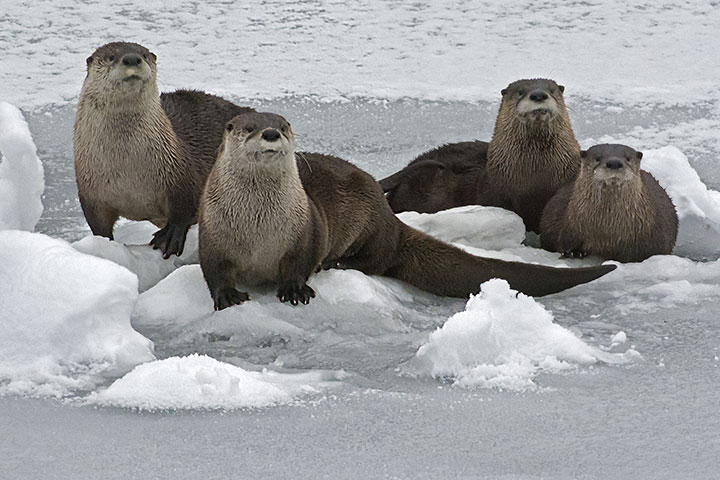
Best of all was a small group posing for what appears to be a family portrait. One kit has only half emerged.
Ten meters from this otter, a sign reads: This area contains historic [sic] mine wastes with elevated levels of arsenic, lead, and other metals; and may be a health hazard. The otter might ask, “Why?”