Flying under water


I have long sought a clear view of a dipper hunting under water. Alas, repeated attempts proved unsuccessful. There was no reason to think that today would be any different. 

Certainly, the temperature had risen; the anchor ice was gone; and the dippers were back patrolling the turbulent portions of the creek which only a week earlier had been beyond reach. Now, the dipper’s restored access, some propitious perspectives, and good lighting allowed a previously eluded view.

The successful shot shows a dipper flying under water as it hunts in a manner almost identical to that used by other birds that hunt in the air: wings out and head down as it scours the surface below.

Posted in birds | 7 Comments

Solstice arthropods


One does not normally think of arthropods as appearing around the winter solstice. Yet, a few hang out in the house. Here are three seen this week.

This is a Cellar Spider, a female Pholcus phalangioides identified by arachnologist, Robb Bennett. This striking creature landed on my breakfast table. With its gangly legs it looked rather like a harvestman, but it clearly had to be a spider for it had descended on a silken thread. As the ancestors of this spider came from the subtropics, it cannot handle cold and so lives in homes where it ignores seasons and is active year round. This young lady was ushered into the laundry room, where she continues to hang out. 

Not active year round is this Western Yellow Jacket (Vespula pensylvanica). Most members of this species die with the first frost—but not the queen. She hides and overwinters, only to start a new colony in the spring. This one, apparently, mistook the warmth of my home for the arrival of spring and, rather drowsily, came out to look around.

And then there is everyone’s unfavourite: the Western Conifer Seed Bug (Leptoglossus occidentalis). Some locals call this a stink bug, but if they had ever encountered a real stink bug, they would realize that the miasma of this mild insect just does not measure up. It neither bites, stings nor eats through the winter; it just hangs out with you and hopes earnestly that you will not throw it out in the cold—lots of luck on that one, buddy.


Posted in bugs | 1 Comment

Coyote


A few valleys to the west, there have been coyote culls; a few valleys to the east, there have been deer culls. We seem to live at the balance point; around here, we happily coexist with both species (see a local sign at the right).

Whether the coyotes and the deer coexist is another matter. 

Wednesday, just before seeing the Trumpeter Swan, I watched a coyote hunting in a field.

The coyote spotted me and kept me in its gaze for only a few moments.

Soon it decided that I wasn’t a threat and it went back to the task at hand: looking for voles under the snow.

I really wanted to wait until it made a kill. Alas, I inadvertently spooked it, and it was off, with only a glance back.

Posted in mammals | 1 Comment

Swan again


Yesterday I posted a single picture without comment: Shades of white. I had just photographed a swan by the water’s edge and was so entranced by the beauty of its spread wings that I quickly picked one shot and posted it.

Rewrite When posted yesterday, I came to the conclusion that the swan was a Tundra. Rick Howie has persuaded me that it is a Trumpeter Swan. Consequently, this posting has been rewritten.

However, this lovely creature deserves more: Which species is it? It is usually seen swimming and feeding, so why was it now standing? Was yesterday’s image choice the best?

My initial impression was that this was a Trumpeter Swan—despite a subsequent day spent suspecting it to be a Tundra. Some signs of it being a Trumpeter are: The bill is massive, long, and flat (not concave); The eye is partially enclosed by the black of the beak and not perched out on the end of the black as in Tundra; Also telling is the way it is holding its neck in this picture. This is a classic trumpeter pose with the head almost appearing to arise out of the back as opposed to rising from the front of the breast. Tundras have a shorter neck and do not do this.
trumpeterswan131211fs

One of the pictures included a mallard and this enabled me to measure the ratio of swan/mallard body lengths. The value, about 2.6 corresponds to the trumpeter/mallard ratio and is much much larger than the tundra/mallard ratio of 2.2. The swan is preening, which appears to be the reason it is out of the water.

The U shaped boundary between the forehead and bill (which I thought was definitive) turns out to be found in Trumpeters also, so was not a good guide.

However, my comments on the final picture still stand. I suggested that I might have acted too quickly in choosing the previous day’s image as my favourite. I think that this was the shot of the day.


Posted in birds | 4 Comments

Shades of white


Posted in birds | 1 Comment

Dipper vs anchor ice


The anchor ice photographed yesterday covered significant portions of the creek bed. This ice forms in the same swiftly flowing streams that provide homes to dippers—birds that scour the stream bed for aquatic insects and fish eggs. Yet, anchor ice denies the dipper access to its food. A dipper seems to easily deal with the cold, but how does it handle the food problem?

Despite the fact that both dippers and anchor ice favour the same creeks, I could discover nothing that discussed how dippers might handle the situation. Consequently, these are my own speculations based upon anecdotal observations.

The dipper seems to have three tactics. It might:

• Seek a calmer portion of the steam where anchor ice hasn’t formed;
• Switch from hunting things on the creek bed to hunting things that swim;
• Abandon the creek and hunt along the lakeshore, where there is no anchor ice.

What the dipper actually does probably depends up the extensiveness of the anchor ice. Each tactic is illustrated.

Bird books assure one that a dipper lives and hunts in fast-flowing streams. Yet, in the depth of winter, I have often seen it hunting along the lakeshore. I suspect that it does this in response to anchor ice in its favoured stream. This picture of a dipper hunting along the lakeshore was taken in January a couple of years ago.

It would probably take a particularly long cold spell for anchor ice to obliterate the bottom of local streams, or for surface ice to prevent all access to the water. At the same time as photographing the anchor ice yesterday, I was able to find gentler portions of the stream without anchor ice; the dipper found them also.

The final tactic is to hunt things that swim, even when they are somewhat more ungainly than the dipper’s normal pickings. I watched this dipper reach down from the ice-covered shore and grab the fry of a rainbow trout. The interesting thing is that it was one day short of a year since the last time I saw a dipper capture a fry at the same spot. This suggests that this may indeed be a seasonal tactic.

Dippers seem to have difficulty eating such a large object. The bird made short hops as it tried to manipulate the fry, during which time, the fish froze.

Finally the dipper kicked up water as it flew off with its freshly frozen fish stick. While I assume the bird managed to consume it, I did not see it happen.

Posted in birds, weather | 6 Comments

Anchor ice


Anchor ice (also called bottom-fast ice) is ice attached (anchored) to the bottom of a stream.

At first blush, it seems rather odd that any ice should form on the bottom of a water body. After all, for ice to form, the water temperature must be 0C (or slightly less). But, water with such a freezing temperature is not as dense as the somewhat warmer water with a temperature of 4C. Consequently, the warmer water sinks to the bottom and the freezing water rises to the top. So, it is at the surface of ponds, lakes, and oceans where ice forms. (If the water is shallow enough, freezing that starts at the top might progress right to the bottom, but that is a different matter than ice that builds up on the bottom).  

The game changes slightly in a rapidly flowing river or creek. Turbulence mixes the water so thoroughly that density stratification does not take place. During particularly cold weather (such as at present) the stream cools, but being well stirred, it does so fairly uniformly. The temperature of the whole stream drops to 0C and now ice begins to form as tiny crystals or platelets throughout the depth of water. As these ice fragments are carried along in the turbulent waters, some brush against the stream bottom and stick, adhering first to rocks and subsequently to other ice. This ice that collects on the stream bottom is the anchor ice; it is quite porous as it is a composite of shards. 

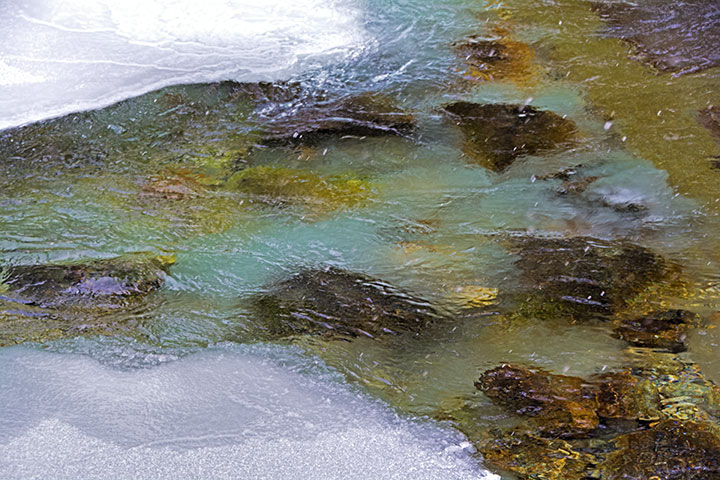
The ice at the upper and lower left of this picture is on the surface of the creek. It has formed on the creek edges where the water is shallower and the flow gentler. In the main channel, between these edges, a creek bottom of sand and rocks is visible. Locally, adhering to some rocks is the distinctly greenish anchor ice.

Anchor ice is occupying most, but not all, of the channel between the surface ice.

Very little of the creek bottom is seen in this picture. Surface ice occupies the shallow edges of the creek and anchor ice covers most of the stream bottom in the channel.

Posted in weather | 7 Comments

Devils’ playground


This morning, Kootenay Lake was a devils’ playground. It was spellbinding to watch, but also tooth chattering and bone chilling. Within easy sight, dozens upon dozens of devils frolicked.

The experience was bone chilling as the temperature was about -12C and the wind was brisk. What with open water on the Lake, it was an ideal time to watch for steam devils; when they came, they did not disappoint. Alas, after a time, the raw conditions drove me indoors.

Steam devils are fairly easy to distinguish from normal steam fog. Convective wisps of steam fog are chaotic and will usually evaporate by the time they have risen a metre or so. Sometimes though, a wisp will concentrate the wind shear in the atmosphere’s surface layer and begin to spin. This protects the droplets inside from evaporating in the surrounding air. The spinning column can retain its shape to heights of tens of meters. This is the steam devil.

While steam devils appeared all over the Lake, they only stood out dramatically in a narrow region on the edge of a mountain’s shadow. Here, steam devils were in the sunlight, but nicely contrasted with the dark backdrop.

As with dust devils and tornadoes, the hollow structure that results from spinning was sometimes evident.

Now and then one devil would wrap around another. Now that is playful.

All in all, a grand—if chilling—experience.


Posted in weather | 2 Comments

What tweeters tweet


Recent bird’s words: things real tweeters tweet.

Song Sparrow: “I’m not fat. It’s all these feathers. They make me look… poofy.”

Chestnut-backed Chickadee: “Ignore Martin Campbell, I’m the one on the edge of darkness.”

Great Blue Heron: “This is how I look when I am being watched by people.”

Great Blue Heron: “This is how I look when I am practicing my dance moves.”

Bohemian Waxwing: “Please explain, which one of us is me?”

Common Merganser: “Don’t bother me now; I am about to take a selfie.”

Bald Eagle: “Don’t you dare turn your back on me when I am talking to you.”

Posted in birds | 6 Comments

White on trees


Snow is white—which is really just to say, it is the same colour as the light source.

But, white on a tree does not require snow—frost is white; so is rime. We have had extensive rime on mountain slopes of late.

First some snow: ice crystals that form in clouds far above the surface and then fall only to pile up on the ground and trees. This picture was taken Sunday morning after a heavy wet snow began bringing down the odd tree.

This shows rime on the trees (well, maybe also a bit of frost). The cloud contains supercooled water drops which collide with trees, freeze on contact, and coat the trees with ice—the rime.

A characteristic of rime is that it only coats those things that are imbedded in the cloud, or fog. The rime coating the trees in a band was caused by a thin cloud against the mountain. Snow can be seen through the clearings.

Being white, snow has the colour of the light source: lit primarily by the setting Sun, it appears pinkish; lit only by the darkening sky, it appears blueish.

Posted in weather | 1 Comment