Chickadees two


Who can fail to like chickadees? They are cute, curious, and melodious.

Of the five species found in Canada, four can be seen in this region: Black-capped, Chestnut-backed, Mountain, and Boreal. The first two are the most frequently seen, and both appear here.

The Black-capped Chickadee influenced the name of all the species with its call: chick-a-dee-dee-dee. Its black cap and bib, along with buff sides, make it easy to spot as it scours for seeds and insects.

A close relative, the Chestnut-backed Chickadee, is identified by the rich chestnut brown on its back and sides.

Chickadees are acrobatic little birds and will sometimes hang upside down as they forage for insects and seeds. This Black-capped Chickadee is not only upside down, but has twisted its head around to look downward.

Posted in birds | Comments Off on Chickadees two

Pack train


Occasionally I post pictures from my family’s archives that might be of local historical interest. For many years, I had misplaced shots of my great-uncle Sidney’s pack train through the Crowsnest Pass, but I found two of the three yesterday. So, it seemed like a good time to post them.

Through much of the nineteenth century, the easiest access to this region was from the south—a consequence of the area’s system of north-south valleys and mountain ranges. This changed with the C.P.R.’s construction of the the Crowsnest Line from Lethbridge to Kootenay Landing (south end of Kootenay Lake). It was built during the years of 1897 and 1898, and it opened up an east-west route into the area. This significantly altered the development of the region.

During the construction, mail and many supplies had to be carried by pack train. Sidney S. Fraser ran one of these. Of course, the job only lasted for a short time. So, Sidney married a lass from Pincher Creek and settled on the West Arm of the the Lake at what came to be known as Fraser’s Landing. It served as the western terminus of the Main Lake ferry from 1931 to 1947.

As far as I know, Sidney Fraser never owned a camera, so the photographer is unknown. It shows him on one of the horses of his pack train. He is on flat land, possibly in the Rocky Mountain Trench.

The second picture is labeled as Pack Train, Canadian Rockies and was taken by Byron Harmon. Harmon later operated a photo studio in Banff (1904-1942).


Posted in history | 1 Comment

Lovely larch


This is the time of year when people admire the colours of deciduous trees. Most of those trees are broad-leaved, but my favourite is actually a conifer: the larch.

We have two local species: the Western Larch grows at low altitudes; the Alpine Larch grows at high. The larger of the two is the Western and it is the tree that mixes gold among the green where the valley walls rise out of the Lake.

Posted in scenes | 4 Comments

I will get you


Just know this: I will get you.

Juvie Bald Eagle

Posted in birds | 7 Comments

Why a white tail?


Two White-tailed Deer, a doe and fawn, were browsing behind my home in the pre-dawn light.  As I watched, I pondered: Why the white tail? What evolutionary advantage did it give these deer to be able to hide and show such a striking signal?

I have encountered two conjectures:

• The first relies on the realization that an individual has a better chance of survival when it stays with the group. When fleeing a predator, deer raise their tails to provide an easy way for laggards to spot and stay with those ahead. The downside of this idea is that it also provides the predator with an easy target to follow.

• The second conjecture focuses on the predator, rather than on group cohesion. Deer raise their tails to give a predator something to aim at. Abruptly, the deer drops its tail and veers off course. The predator continues in the same direction, now chasing a seemingly vanished deer. I have heard that some small birds avoid death from falcons with such a bait-and-switch tactic: once a falcon is diving at them, they present a highly visible target; one that is then hidden during a last-second course change. (Good timing seems crucial.)

 Of course, both ploys might help the deer to survival. I just don’t know—and the deer aren’t talking.

A doe and a fawn behind my home. When the tail is down, these deer are not very conspicuous.

With its tail raised, a deer provides an easy target for both other deer and a predator.

Posted in mammals | 1 Comment

Two birds


Often if one tries to approach a bird, it leaves. I have never been able to get close to a kingfisher, and rarely to a grouse. So, it was a delight to have each of them approach me. Not that they knew that is what they were doing, but still…. I did manage some close views.

A Ruffed Grouse lands in a tree right beside me. What could I do? I took its picture.

A female Belted Kingfisher landed in a another tree and gave me my highest-resolution image of the species.

Posted in birds | 4 Comments

Sprites and a devil


Steam fog There are two distinct processes that may lead to the formation of cloud or fog. One is vapour cooling; the other is vapour mixing. Steam fog results from the second: two volumes of vapour with different temperatures and (vapour) pressures are mixed. Unexpectedly, even though the average temperature and pressure are not changed by such mixing, the humidity can now be above 100% resulting in condensation. See:
• a discussion of condensation
• other shots of steam fog and steam devils

Each clear morning for a month, the Lake has been a stage upon which there appeared dancing sprites. These animated elves are the translucent and ephemeral manifestations of steam fog.

Steam fog is a harbinger of autumn. As the season shifts, the lake water does not cool as rapidly as does the atmosphere. On a clear night gentle drainage breezes (katabatic winds) flow down the mountain slopes and out over the Lake. This places a shallow (~1m) layer of cool dry air over the top of a tiny surface (~1cm) layer of warm moist air immediately adjacent to the water. Steam fog forms as the vapour in the two layers mix in tiny convective towers. The fog gives visual form to the convection to produce the sprites that dance in the breeze over the Lake’s surface.

Steam fog is much harder to see before sunrise. It is the first touch of sunlight that usually reveals the world of dancing sprites. Alas, the sunlight will also often end the show when it warms the mountain side and stops the drainage winds.

Frequently there is a delightful scene of water birds swimming through the steam fog. These are Common Mergansers.

Solar warmth can put a quick end to the fog by warming the valley sides that had locally supplied the cool drainage wind. However in steep valleys, some slopes may remain in shadow and so continue to send cold air out over the water. Alternatively, the cold air might have blown in from more distant locations. In these cases, one might enjoy steam fog throughout the day. In this midday shot, the constantly shifting sprite-like convective columns stand out.

If there is steam fog and a somewhat brisker wind, I always watch for steam devils. These whirl winds are similar to dust devils, but it is fog, rather than dust, that enables them to be seen. My best pictures of steam devils were taken a few years ago (steam fog and steam devils), but last week I saw a distant one (and its reflection). Incidentally, this use of the word, devil, has no religious overtones. The root meaning of devil is to throw, and such whirl winds rightly gained the name because they throw things around.

 

Posted in weather | 1 Comment

Running through frost


These deer were running through a frost-covered field in the pre-dawn light. Sometimes a blurry picture can tell the story better than will a sharp one.


Posted in mammals | 1 Comment

Fallstreaks


You can stick your finger into a glass of water, but not through a block of ice.

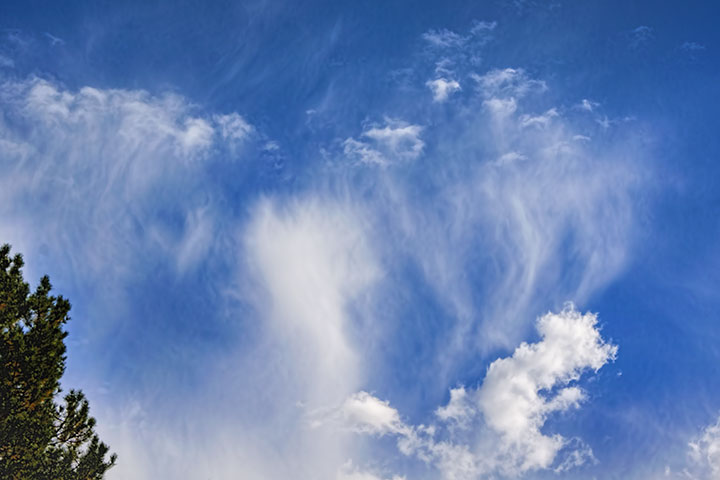
That pretty well explains what is going on in this morning’s picture of fallstreaks.

Water molecules are not as tightly bound together in the liquid as they are in the solid. This means that, at the same temperature, fewer water molecules will escape (evaporate) from an ice crystal than from a water drop.

Wry comment Over two centuries after it was shown to be nonsense, there are still teachers who ignorantly tell their students that clouds form because “cold air cannot hold as much water vapour as warm air.” This sad misrepresentation of reality is rejected by all modern physics. The issue is discussed on this site in an article called condensation. Alas, the air lacks such a holding power and air is actually irrelevant to the issue.

Imagine a small volume in which water drops and ice crystals are together surrounded by water vapour (It is humid). Yes, all three phases—vapour, liquid, solid—frequently coexist at temperatures below 0C.  The vapour molecules will condense on drops and crystals at the same rate. But, it is much easier for the loosely bound molecules in the liquid to evaporate than it is for the tightly bound molecules in the solid. The result is that often there are more molecules arriving than leaving the ice, while there are more molecules leaving than arriving on the liquid: the crystals are growing; the droplets are shrinking.

In the picture, below, the tufts of whiter cloud in the upper portion of the picture are composed of water drops; the greyer streaks that hang below them are of ice crystals. The original water cloud was larger, but when some of the drops froze, they (now being ice) grew rapidly while the remaining water drops shrunk. The increasingly large crystals had a larger terminal velocity and fell below the original water cloud to produce these fallstreaks.

And all this happened for the same reason that it is harder to stick your finger into a block of ice than a bucket of water.

Posted in weather | 3 Comments

Two ungulates


An ungulate is a hoofed mammal (ungulate is from the Latin, ungula, meaning hoof). This region has an unusually diverse population: seven species. Some are in the cattle (bovine) family and have horns: Big-horned Sheep, Mountain Goat. Some are in the deer (cervid) family and have antlers: Moose, Elk, Caribou, Mule Deer, White-tailed Deer.

On Friday, I saw ungulates from each group: White-tailed Deer, Mountain Goat. Now, the first is fairly easy to find; the second is not.

The White-tailed Deer are the conspicuous cervids of the valley bottoms. These two females are browsing beside a river alongside some driftwood.

A mother and her fawn are grazing (unbeknownst) within a hundred metres of some grizzlies.

One of five Mountain Goats is grazing on a steep cliff.

While another glances over the edge.


Posted in mammals | Comments Off on Two ungulates